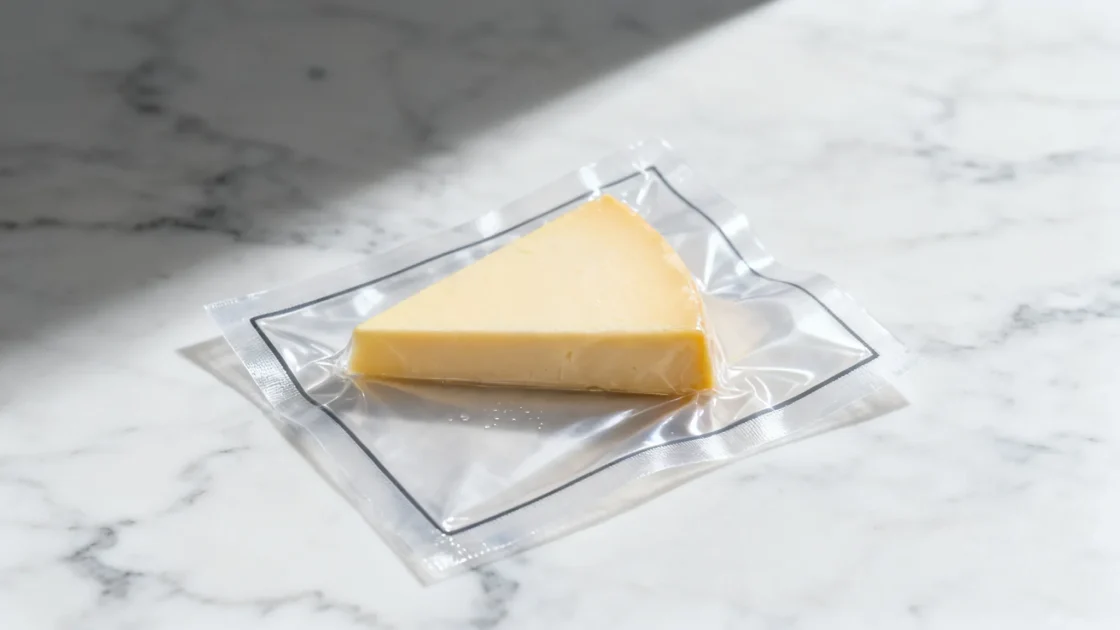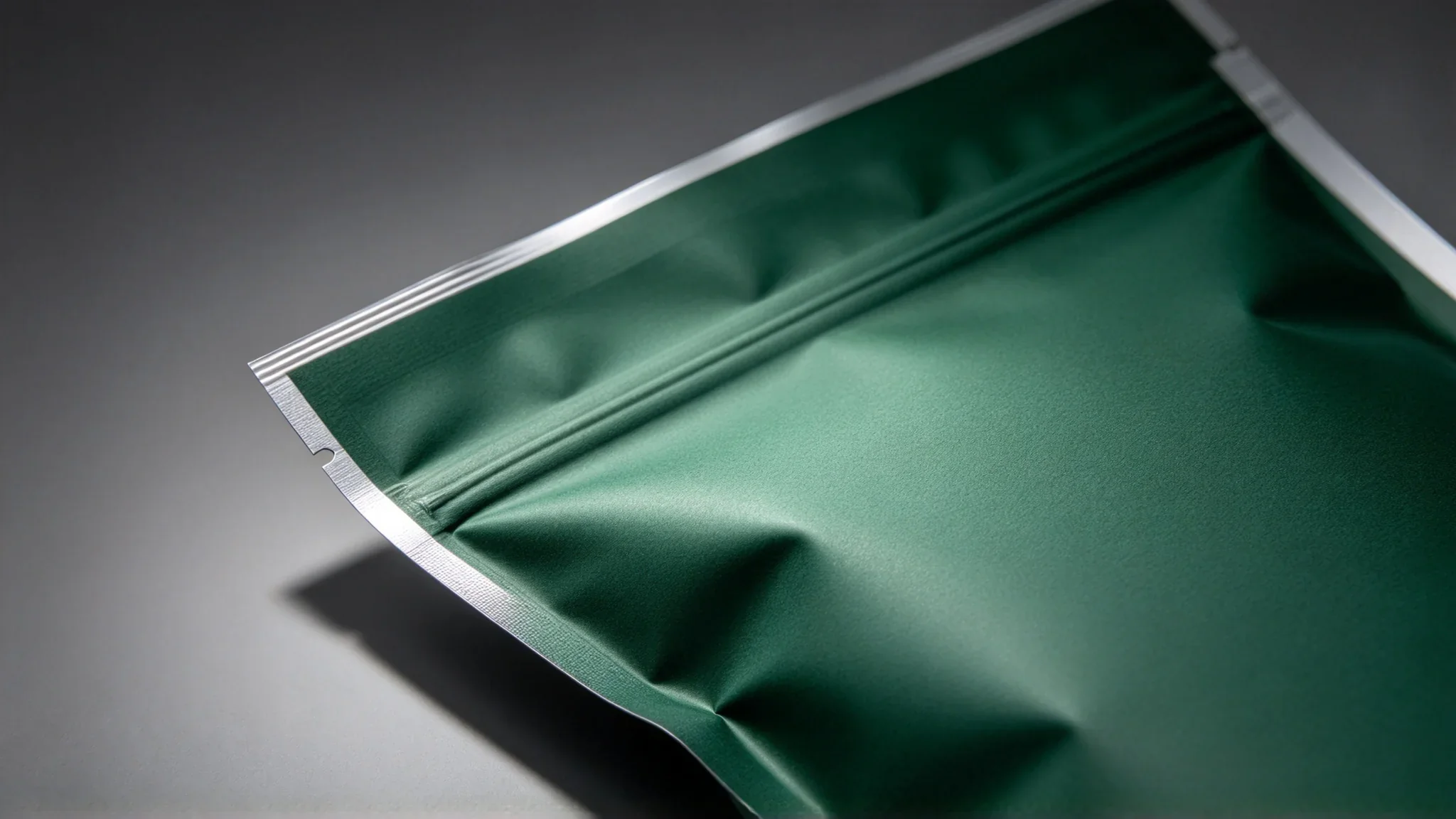
Soft touch film is a matte laminating film that gives a printed pouch a dry, velvety surface instead of the slick feel of gloss. Buyers notice it before they read a word: the pouch stops sliding in the hand, and dark colours look deeper than under a matte varnish. It is a separate lamination pass, not a coating sprayed at the end of the press run, and that pass changes how the pouch behaves on a filling line, how it scuffs in a carton, and how much fine detail the artwork can carry.
What Does Soft Touch Film Actually Feel Like?
The surface reads as dry rather than slick. Gloss film reflects light in one sharp highlight, so the eye treats a printed panel as smooth and reflective. Soft touch scatters that light across a fine grain, which is why the same print looks flat, slightly dusty and deeper in tone. Under raking light you see an even matte texture rather than a mirror.
The tactile part comes from the top layer, not from the printing. Its resin and low gloss level give fingers friction instead of slip, so a pouch feels heavier in the hand than the same structure in gloss. Because the effect is physical, it survives normal print variation but not mechanical rubbing without marking.
Matte Lamination: Lacquer Versus Film
Two routes produce the finish, and they behave differently. A matte lacquer is applied like an ink on press, adds almost no thickness and costs less per pouch. A matte lamination film is a real film bonded to the printed web with adhesive, usually in a separate pass on a laminator. It adds stiffness, protects the print, and holds its texture longer.
For pouches that will travel, the film route is the sturdier choice. The adhesive that bonds it is part of the food-contact package, so it must suit the intended use and be documented by the supplier; in the United States, adhesive and coating components are addressed under 21 CFR Part 175. Confirm the exact build through the custom packaging service page before approving a proof.
Scuff, Burnish and Abrasion in Transit
The most common complaint about soft touch is not wear-through. It is burnishing. When a matte surface is rubbed, by a thumb or a conveyor belt, the texture is polished flat in that spot and begins to reflect light. On a dark solid panel the result is a pale shiny streak that reads as a scratch even though nothing was removed.
Two lab checks make that visible before a production run. A rub test such as ASTM D5264, run with a Sutherland rub tester, shows how surface and print respond to repeated abrasion. A tape adhesion test such as ASTM D3359 shows whether the lamination is bonded firmly enough that a scuff lifts film rather than polishing it. Ask for both on the actual build.
Does Soft Touch Film Change Print Contrast?
Yes, in both directions. Scattered light lowers apparent contrast, so hairlines, reversed small type and fine screens lose crispness. A thin white rule on a dark matte panel is harder to read than on gloss, and a small keyline can vanish at arm’s length.
Solid dark areas gain depth instead, which is why the finish suits black, deep green and burgundy panels. Metallic inks and cold foil are the exception: foil needs gloss to sparkle, and under a matte overlaminate it reads as flat grey unless a spot gloss window sits over it. Colour proofing should include the lamination, because an unlaminated proof overstates contrast.
When Does Soft Touch Pay Off, and When Is It the Wrong Choice?
Use cases for the finish cluster where a pouch is picked up, kept and displayed rather than shipped hard. Cosmetics and personal care lead, because the surface reads as premium at shelf distance; the personal care packaging solutions page shows formats that carry it well, as does the baby cream spout pouch. Premium coffee, tea and confectionery gift packs follow.
The boundary sits on the other side of handling volume. A pouch that crosses a postal network twice, sits in a chilled case with condensation, or is restacked in a retail bin will show burnishing that a gloss pouch would hide. If a pack is bought on cost per thousand and reviewed only in a catalogue render, the extra pass earns nothing.
Slip, Friction and Filling Line Behaviour
A matte surface changes how film slides against itself and against steel, which matters upstream of the shelf. Coefficient of friction is measured under ASTM D1894, and static and kinetic values for a soft touch laminate usually sit higher than for the gloss equivalent.
Higher friction is not automatically a fault. It helps a filled pouch stay put on a conveyor and inside a carton. It hurts when magazine pick-up, roll unwinding or a drop into a case packer depends on the film sliding cleanly. Agree a friction range with the converter before the run, then confirm it on the finished roll, not a flat sheet.
What Should You Check on a Soft Touch Sample?
A sample that looks right on a desk can fail in a warehouse. Work through these checks on the exact build you intend to order.
- View the panel under raking light at a shallow angle, where uneven grain and burnishing appear first.
- Rub one spot repeatedly with a thumb, then look for a polished patch; dark solid areas are the sensitive test.
- Fold and crease the pouch at the seal corners, where film stress concentrates, and inspect for whitening.
- Scan the smallest QR code and the finest type with the reader your customers actually use.
- Run a short trial on the filling line and inspect pouches after the case packer, not before it.
Conclusion
Soft touch is a lamination decision, not a print colour. It buys a dry, deep, premium surface and charges for it in handling tolerance: burnishing on dark panels, weaker contrast for fine type, higher friction, and one more pass in the structure. Those costs are predictable, and each has a test attached.
Three things decide whether the finish suits a pack:
- How the pouch is handled between filling and the customer’s hand.
- Whether the artwork relies on fine detail or on large dark panels.
- Whether the line has been trialled with the actual laminate.
Frequently Asked Questions
Is soft touch film suitable for food contact?
Yes, when the whole structure is built for it. A soft touch film sits on the outside, so the surface touching the product is still the sealant, and the food-contact question belongs to the sealant, the inks and the lamination adhesive. In the United States, adhesive and coating components are covered under 21 CFR Part 175, and the converter should supply a statement of compliance for the exact build. A claim about the film alone is not enough; compliance attaches to the finished laminate.
Why do matte pouches show shiny patches after handling?
Because the texture has been polished, not worn away. Friction from fingers, rubber rollers or pouch-on-pouch contact flattens the fine grain in a local spot, and that spot then reflects light like gloss. The effect is strongest on dark solids and near folds, where pressure concentrates. It cannot be buffed out. Reducing it means a harder matte laminate, lower roller pressure, or accepting that a handled pouch shows its history.
Does the finish reduce seal strength?
No, the seal forms on the inside of the pouch. A soft touch laminate sits on the outer surface and never enters the seal area. What can change is the jaw setting, because added film thickness alters heat transfer and dwell. Seal strength should still be verified on the finished laminate with ASTM F88 rather than assumed from the unlaminated film, and seal edges checked for channelling after a trial run.
Can fine type and QR codes be printed on a soft touch surface?
Yes, if the artwork leaves room for them. Scattered light reduces apparent contrast, so hairlines, reversed small type and dense code modules lose definition at the same size that works on gloss. Keep modules larger, place small type on a solid background, and test scanning with a phone camera in dim light. A spot gloss patch over the code is a common compromise when the brand still wants the velvet feel.