Stick pack packaging succeeds or fails on three decisions: film stiffness, dosing repeatability between 1 and 10 g, and seal land width. A stick pack is a fin-sealed tube rather than a small sachet, so tolerances that pass on a sachet line often fail here. Buyers who treat the format as a scaled-down pillow pack usually end up with channel leaks at the end seals or a line running well below its rated speed. This guide covers the format differences, the variables behind fill accuracy, and the trial data worth collecting before tooling is cut.
What Separates a Stick Pack From a Sachet and a Pillow Pack
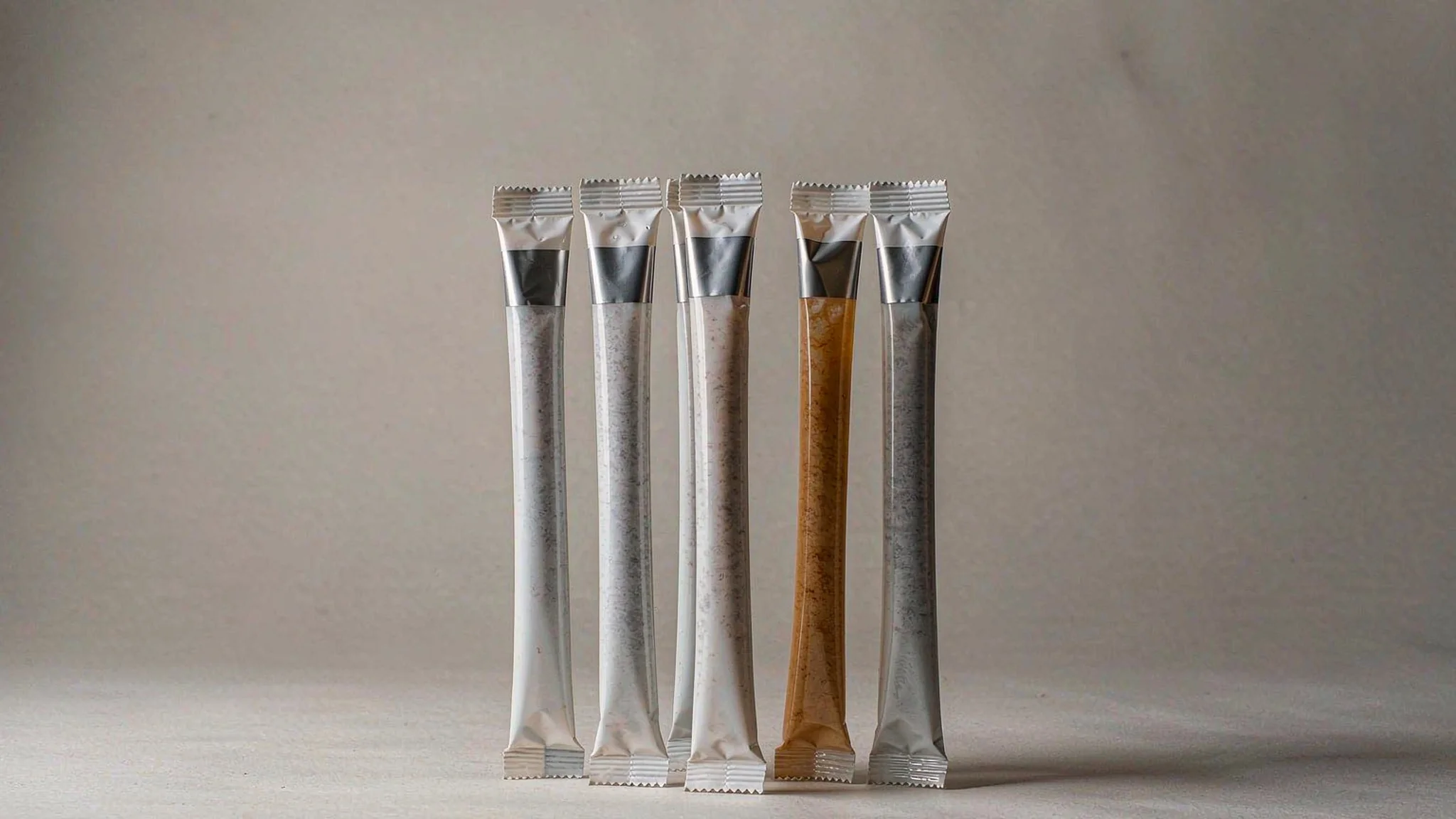
A stick pack is formed from one web folded into a narrow tube, closed by a longitudinal fin seal and two end seals. The finished pack is much taller than it is wide, holds one dose, and opens at a tear notch.
A sachet is a flat three-side or four-side seal pouch: wider, more volume per stroke, more room for the filling head. A pillow pack is a back-seal tube on a wider web, built for volume rather than single dosing. Use cases for a stick pack are narrow by design, and the boundary sits at the seal-to-fill ratio, since the seal area is a large share of a small pack. Single-serve drink formats follow the same logic and are covered in beverage packaging solutions.
Stick Pack Geometry: Web Width, Seal Land and Fill Zone
Web width sets the flat pack width. A 100 mm web folded into a tube gives about 50 mm of flat width, and the fin seal plus a 6 mm land on each side consume much of that before any product fits. Specifying only the outer pack size leaves the fill zone to chance.
Film tracking depends on friction between web and forming collar. Too low and the web slides; too high and it drags, shifting print register and thinning the land on one side. ASTM D1894 measures static and kinetic friction, and the figure is worth having before a forming set is built.
Fill Accuracy Between 1 and 10 g: What Drives the Error
At 2 g, a plus or minus 2 percent tolerance is plus or minus 0.04 g. A checkweigher rarely resolves that against film variation, so accuracy is held at the dosing head. Auger fillers repeat well on free-flowing powder but drift as the hopper empties; cup fillers are fast but follow bulk density; piston fillers suit liquids but need a clean cut-off.
Three variables account for most of the error. Particle size decides how powder settles in the auger flights. Humidity causes bridging in the hopper. Static charge makes fine powder cling to the tube wall, which is also how powder reaches the seal area.
Film Stiffness and Static on a Narrow Web
Stiffness keeps the empty tube open long enough for the end seal to close without wrinkling. A film that is too soft collapses between the jaws and traps a fold that becomes a leak path. Too stiff and it keeps its curl, so the pack sits crooked in the cartoner and the fin seal lifts at the shoulder.
Static is the second half of the problem. Dry, cold air raises surface charge, and fine powder then sticks inside the seal land. Anti-static treatment and controlled filling-room humidity both help. The forming and sealing sequence is described in packaging process instructions.
How Do You Dose Powder and Liquid on the Same Stick Line?
Usually by changing the dosing head, not by reusing one. Powder runs through an auger or a cup; liquid runs through a piston or a peristaltic pump with a positive cut-off. Fill zone height, seal temperature and film structure all differ, so a convertible machine needs change parts and a validated setting sheet per product.
Running both on one line is realistic when doses are small and the products share a film family. It is not realistic with a hygroscopic powder and an oil-based liquid, because the seal windows do not overlap. A seasoning powder format is shown in chicken essence seasoning powder packaging.
How Does Line Speed Change Stick Pack Costs?
Speed is limited by seal dwell, not by the dosing head. A narrow land needs time under pressure at temperature to fuse, and shortening that time to gain cycles pushes the bar temperature up instead. Past a point the film scorches, the seal turns brittle, and reject rate cancels the gain.
Tension control is the second limit: every stop and start changes web tension, and a narrow web amplifies it. Machines that hold steady speed through a splice usually beat a higher nominal rate with frequent stops.
Why Does a Narrow Seal Land Leak Before the Body Fails?
Because the failure is a channel, not a burst. A powder particle caught in the seal keeps two surfaces apart along a line, and pressure finds that line long before the laminate is stressed. Uneven jaw pressure on a short land does the same.
Two tests separate the causes. ASTM F2029 makes laboratory heat seals at controlled temperature, pressure and dwell, mapping the seal window before production. ASTM F88 measures seal strength: a low but consistent result points to a parameter, a scattered result to contamination.
What Should a Buyer Send Before a Stick Pack Filling Trial?
A trial answers only the questions it was set up for. Send this data with the sample.
- Dose weight, target tolerance and the checkweigher resolution on the line.
- Bulk density, particle size range, and whether the powder is hygroscopic or cohesive.
- Target pack length and width, plus stick count per carton.
- Candidate film structure and which side is the seal side.
- Line speed target, filling room temperature and humidity range.
Ask for sealed samples at three dwell times and two temperatures, then leak test them rather than judging by eye. A liquid dose format for reference is the travel size shampoo sachet.
Conclusion
Stick pack decisions are cheap on paper and expensive in tooling. Work in this order:
- Fix the dose, the tolerance and the checkweigher resolution, since these set the dosing principle.
- Choose film stiffness against web width and forming collar, then confirm friction with a measured value.
- Map the seal window with laboratory seals and prove strength before committing to a forming set.
None of these steps needs a production order.
Frequently Asked Questions
Can one stick pack line fill both powder and liquid?
Only with change parts and a separate setting sheet per product. The dosing principle differs, since powder runs through an auger or cup and liquid needs a piston or pump with a positive cut-off, and the fill zone height and seal temperature usually differ as well. Confirm the film family first, because a hygroscopic powder and an oil-based liquid rarely share a usable window.
How tight should fill weight tolerance be in stick pack packaging?
Set it from the label claim and the local weight-and-measure rules, not from what the filler can currently hold. At 2 g, a plus or minus 2 percent band is plus or minus 0.04 g, finer than most checkweighers resolve against film weight variation. In practice the tolerance is held by weighing the dose at the head during setup, then monitored statistically during the run. Write it into the purchase specification, since a filler that meets it on one powder may drift on another.
Why do finished stick packs curl and jam in the cartoner?
Curling is usually film memory rather than a sealing fault. A laminate with high stiffness relative to the web width keeps the curl it picked up on the forming collar, so the pack does not lie flat in the magazine. Cooling time after the end seal matters too, since a warm pack deforms at the collator. Check the stiffness balance in both directions, then add cooling conveyor length before changing seal settings.
Does a hygroscopic powder need a special film for a stick pack?
Yes. Stick pack packaging for a hygroscopic powder needs a moisture barrier rather than a standard clear laminate. A high water vapour barrier layer keeps the dose free-flowing, and the seal land has to stay clean because one powder bridge defeats the barrier at the edge. Ask for the water vapour transmission rate on the exact structure, and treat it as one input, not a shelf-life promise. Confirm real shelf life by storing filled packs in the intended climate.