





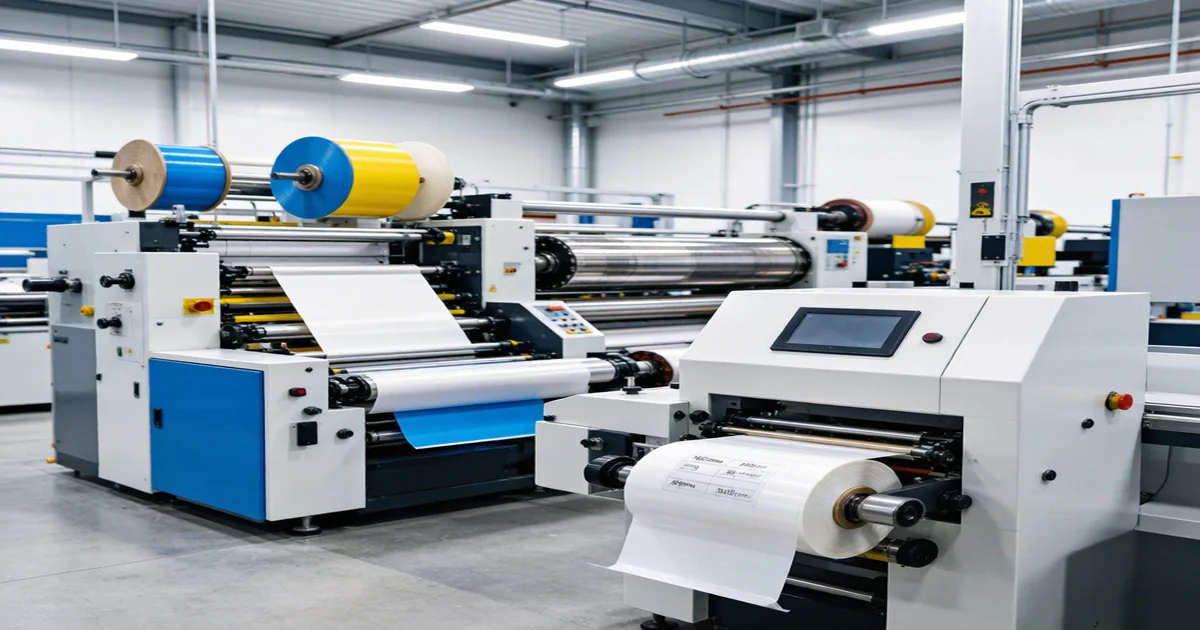
Packaging printing process is the core step that determines the visual quality of packaging. Many brands, when customizing packaging for the first time, have no idea what the difference is between “gravure printing,” “flexographic printing,” and “digital printing,” and end up choosing the wrong process—either overspending or failing to achieve the expected print quality.
As a packaging printing enterprise with gravure, flexographic, and digital production lines, we break down the selection logic of packaging printing process into five dimensions—quality, cost, minimum order quantity, delivery time, and eco-friendliness—to help you make a rational decision.
Gravure Printing: The “Traditional King” of Quality Ceiling
Working Principle and Advantages of Gravure Printing
Gravure printing transfers ink by engraving the image onto a metal cylinder; after the ink pan supplies ink, a doctor blade scrapes off the excess on the surface, and the recessed cells retain ink and transfer it to the substrate. This structure determines its core advantages:
| Metric | Gravure performance | Comparison baseline |
|——|————-|———-|
| Ink layer thickness | Up to 40–60 µm | Highest ink layer |
| Color saturation | Best | Industry benchmark |
| Gradient reproduction | Over 200 lpi | Beyond flexo’s reach |
| Print-run stability | No color difference within 500k impressions | Highest bulk consistency |
> Applicability judgment: For brands pursuing ultimate print quality, with single-SKU annual volume >10,000 units and sufficient budget, gravure printing is the natural choice.
Cost Structure of Gravure Printing
The biggest “threshold” of gravure printing is the plate-making cost. Taking common 8-color printing as an example:
| Item | Cost range | Note |
|——|———-|——|
| Plate-making cost | CNY 800–2,500/color | 8 colors total CNY 6,400–20,000 |
| Printing fee | CNY 0.08–0.25/impression | Decreases with volume |
| Minimum order quantity | 5,000–10,000 units | Below this is uneconomical |
Key strategy: If expected annual volume can absorb it, the plate-making cost amortized over volume makes the per-pouch cost extremely low. But for trial production or limited editions, gravure severely drags down ROI.
Flexographic Printing: The “Rising Star” Under the Eco Trend
Working Principle and Advantages of Flexographic Printing
Flexographic printing uses flexible rubber or resin plates, with eco-friendly water-based or UV inks. In recent years, as plate precision has improved, the share of flexography in packaging printing process is rising rapidly.
| Advantage | Description |
|——|——|
| Eco-friendliness | Water-based ink, no organic solvent emissions |
| Wide substrate compatibility | Corrugated, plastic film, aluminum foil all work |
| Low plate-making cost | About 30%–50% of gravure |
| Suited to medium runs | Sweet spot of 3,000–50,000 units |
Quality Ceiling of Flexographic Printing
The core limitation of flexography is the hard-to-control dot gain, which makes gradient and fine-line reproduction inferior to gravure. But today’s high-precision laser plate-making has narrowed this gap to a degree imperceptible to the naked eye—unless you are a specialty coffee brand needing ultimate gradient effects, flexographic print quality is more than sufficient.
Digital Printing: The “Game Changer” of the Small-Batch Customization Era
Disruptive Advantages of Digital Printing
Digital printing requires no plate-making; it drives the printing equipment directly from a digital file. From the cost perspective of small batches (<2,000 units), digital printing in packaging printing process is the absolute winner.
| Metric | Digital printing | Gravure / flexo |
|——|———-|————-|
| Minimum order quantity | From 1 unit | 3,000–10,000 units |
| Delivery time | 3–7 days | 15–25 days |
| Plate-change cost | CNY 0 | CNY 800–2,500/color |
| Personalization | Supported | Not supported |
| Color consistency | Slightly lower (between batches) | Excellent |
> Field experience: Premium brands, new-product tests, limited editions, trade-show giveaways—all these scenarios suit digital printing. We have even seen brands run digital-print “different artwork on every pouch” marketing campaigns, which traditional printing simply cannot do.
Current Limitations of Digital Printing
– High unit price: advantageous for small batches, but once over 5,000 units the unit price is overtaken by gravure
– Slightly narrower color gamut: certain spot colors (such as metallic, fluorescent… [truncated]





