





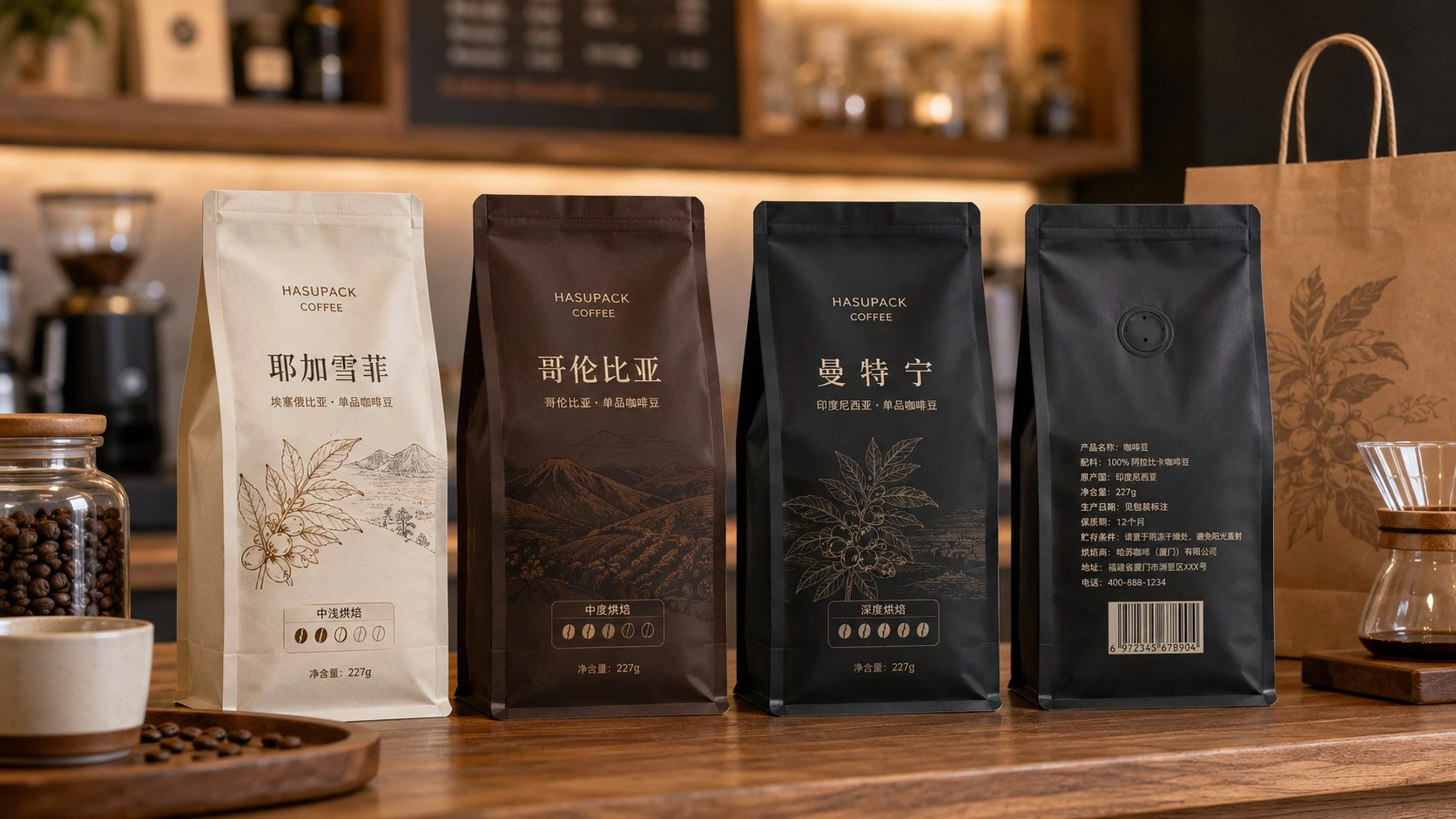
In the food processing industry, the choice of packaging material directly affects product shelf life, compliance review outcomes, and the share of packaging cost. From three dimensions-food contact material regulations, barrier performance parameters, and cost control strategies-this article provides procurement decision-makers with a systematic reference for material selection.
I. Food Contact Material Compliance Requirements (China + Export)
1.1 Domestic Compliance Baseline
Food-grade plastic packaging materials must comply with the GB 4806 series standards:
| Standard No. | Scope | Core Requirements |
|——|———|———|
| GB 4806.1-2016 | General safety requirements | Total migration, heavy metal limits |
| GB 4806.7-2016 | Plastic materials and products | Specific migration limits (SML) |
| GB 4806.8-2016 | Paper and paperboard materials and products | Microorganisms, fluorescent substances |
| GB 31603-2015 | Migration testing | n-Hexane, ethanol simulant testing |
Procurement review points:
Suppliers must provide a GB 4806 Declaration of Conformity (DoC) and a third-party test report (SGS / CTI / PONY).
1.2 Additional Requirements for Export Markets
| Target Market | Regulatory Framework | Key Differences |
|———|——–|———|
| EU | EU 10/2011 | Overall migration ≤ 10 mg/dm²; requires DoC + conformity assessment |
| US FDA | 21 CFR 174-186 | Specific additive clearance; requires FDA-registered facility |
| Japan | Ministry of Health, Labour and Welfare Notification No. 370 | Positive list system; stricter limits on specific substances |
Recommendation: Export-oriented companies should require suppliers to provide a multi-market compliance declaration to avoid the increased management cost of purchasing different formulations in separate batches.
–
II. Interpreting Key Barrier Performance Parameters
The three main causes of food spoilage: oxygen transmission (oxidation), water vapor transmission (moisture), and odor ingress. The following parameters should be considered during selection:
2.1 Oxygen Transmission Rate (OTR)
| Food Category | OTR Requirement | Recommended Barrier Layer Material |
|———|———|—————-|
| High-fat foods (nuts, chips) | ≤ 1 cm³/(m²·d·atm) | EVOH (best barrier) |
| Medium-fat foods (biscuits, cereals) | ≤ 50 cm³/(m²·d·atm) | PA (nylon) |
| Low-sensitivity foods (dry noodles, confectionery) | ≤ 200 cm³/(m²·d·atm) | PET / BOPP |
Test method: GB/T 19789 (equal-pressure method), ASTM D3985 (for export reports)
2.2 Water Vapor Transmission Rate (WVTR)
| Food Category | WVTR Requirement | Recommended Inner-Layer Material |
|———|——–|—————-|
| Highly moisture-sensitive (biscuits, milk powder) | ≤ 2 g/(m²·d) | LLDPE (excellent moisture barrier) |
| Medium-sensitivity (bread, pastry) | ≤ 10 g/(m²·d) | mLLDPE |
| Frozen foods (dumplings, meat) | ≤ 5 g/(m²·d) + low-temperature resistance | EVA-modified PE |
Note: Frozen packaging requires additional testing of WVTR at -18°C; data tested at room temperature does not apply.
2.3 Recommended Typical Three-Layer Co-Extrusion Structures
Based on barrier requirements, the following layer structures are recommended:
“`
Outer layer (printing layer): PET 12 µm or PA 15 µm
↓ provides printability and puncture resistance
Middle layer (barrier layer): EVOH 3-5 µm or PA 20 µm
↓ blocks oxygen and retains aroma
Inner layer (heat-seal layer): LDPE 60-80 µm or CPP 50 µm
↓ provides heat-seal strength and resistance to product corrosion
“`
Thickness ratio recommendation: outer 20% / middle 15% / inner 65% (based on a total thickness of 100 µm)
–
III. Cost Control Strategy: Cheaper Is Not Always Better
3.1 Total Cost of Ownership (TCO) Calculation
Packaging cost != unit purchase price; it must be calculated comprehensively:
“`
TCO = unit purchase price + loss cost + return risk cost + compliance replacement cost
“`
Example comparison:
| Option | Unit Price | Damage Rate | Compliance Risk | TCO Assessment |
|——|———|———|———|———|
| Low-cost structure without EVOH | CNY 2.1/m | 3.2% | High (no DoC) | Higher actual cost |
| Standard PET/PA/PE | CNY 2.8/m | 0.8% | Low (with DoC) | Best overall |
| High-spec PET/EVOH/PE | CNY 3.6/m | 0.5% | Very low | Over-specified |
3.2 Compliance-Based Ways to Reduce Cost
–
IV. Supplier Audit Checklist (Save for Procurement)
Before placing a formal order, it is recommended to audit suppliers against the following checklist:
–
V. 2025-2026 Compliance Trend Alert
–
Conclusion
Procuring food-grade rollstock film is a technical decision, not merely a commercial negotiation. Establishing a supplier management system based on parameter comparison, compliance review, and TCO evaluation is the only way to optimize cost while ensuring food safety.
Recommended next step: Compile the OTR/WVTR requirements of your company’s main SKUs and build a standardized procurement specification to serve as a unified basis for supplier comparison.
–
To learn more about packaging technology, refer to HASUPACK knowledge or OMOPACK knowledge.





