





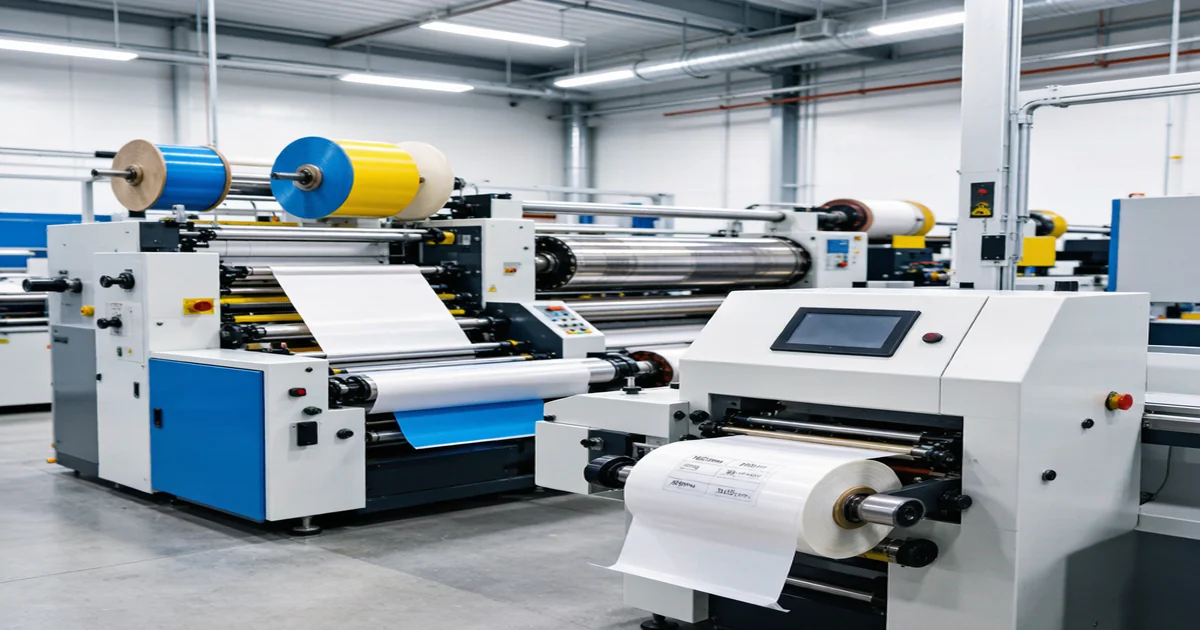
Packaging printing processes are the core factor determining a package’s visual quality. Many brands, when customizing packaging for the first time, have no idea of the difference between “gravure printing,” “flexographic printing,” and “digital printing,” and end up choosing the wrong process — either overspending or falling short of the expected print result.
As a packaging printer with three production lines — gravure, flexographic, and digital — we break down the packaging printing process selection logic into five dimensions: quality, cost, minimum order quantity, lead time, and environmental impact, to help you make a rational decision.
Gravure Printing: The “Traditional King” of Quality Ceilings
How Gravure Printing Works and Its Advantages
In gravure printing, the image is engraved onto a metal cylinder; after an ink fountain supplies ink, a doctor blade wipes away the excess on the surface, leaving ink only in the recessed cells to transfer onto the substrate. This structure defines its core advantages:
| Metric | Gravure performance | Benchmark |
|——|————-|———-|
| Ink layer thickness | Up to 40–60 μm | Highest ink layer |
| Color saturation | Best | Industry benchmark |
| Gradient reproduction | Above 200 lpi | Beyond flexography’s reach |
| Print-run stability | No color deviation within 500,000 impressions | Highest consistency for full production runs |
> Suitability assessment: For brands pursuing ultimate print quality, with annual volume per SKU >10,000 units and sufficient budget, gravure printing is the unequivocal choice.
Gravure Printing Cost Structure
The biggest “barrier” in gravure printing is the plate-making cost. Taking common 8-color printing as an example:
| Item | Cost range | Note |
|——|———-|——|
| Plate-making cost | CNY 800–2,500/color | 8 colors total CNY 6,400–20,000 |
| Printing cost | CNY 0.08–0.25/impression | Decreases with volume |
| Minimum order quantity | 5,000–10,000 units | Below this is uneconomical |
Key strategy: If the expected annual volume can be absorbed, the per-pouch cost becomes extremely low once plate-making cost is amortized. But for trial production or limited editions, gravure seriously drags down ROI.
Flexographic Printing: The “Rising Star” Under the Environmental Trend
How Flexographic Printing Works and Its Advantages
Flexographic printing (Flexography) uses flexible rubber or photopolymer plates with eco-friendly water-based or UV inks. In recent years, as plate precision has improved, the share of flexography within packaging printing processes is rising rapidly.
| Advantage | Description |
|——|——|
| Eco-friendliness | Water-based inks, no organic solvent emissions |
| Wide substrate compatibility | Corrugated board, plastic film, aluminum foil all work |
| Low plate-making cost | About 30%–50% of gravure |
| Suited to mid-volume | Sweet spot of 3,000–50,000 units |
The Quality Ceiling of Flexographic Printing
The core limitation of flexography is that the dot gain is hard to control, so gradient and fine-line reproduction are not as good as gravure. But today’s high-precision laser plate-making has narrowed this gap to the point of being indistinguishable to the naked eye — unless you are a specialty coffee brand that needs ultimate gradient effects, flexographic print quality is more than sufficient.
Digital Printing: The “Game Changer” of the Small-Batch Customization Era
The Disruptive Advantages of Digital Printing
Digital printing requires no plate-making and drives the printing equipment directly from digital files. From the cost perspective of packaging printing processes for small batches (<2,000 units), digital printing is the absolute winner.
| Metric | Digital printing | Gravure/Flexography |
|——|———-|————-|
| Minimum order quantity | From 1 unit | 3,000–10,000 units |
| Lead time | 3–7 days | 15–25 days |
| Plate-change cost | CNY 0 | CNY 800–2,500/color |
| Personalization | Supported | Not supported |
| Color consistency | Slightly lower (between batches) | Excellent |
> Field experience: Premium brands, new-product testing, limited editions, and trade-show giveaways — all of these scenarios suit digital printing. We have even seen brands run “different artwork on every pouch” marketing campaigns with digital printing, something traditional printing simply cannot do.
Current Limitations of Digital Printing
– Higher unit price: The advantage is clear for small batches, but beyond 5,000 units the unit price is overtaken by gravure
– Slightly narrower color gamut: Some spot colors (e.g., metallic, fluorescent) reproduce less well than gravure
– Slower print speed: Production speed is about 1/5 to 1/10 of gravure
A Panoramic Comparison of the Three Packaging Printing Processes
Decision Matrix for Packaging Printing Processes
| Requirement scenario | Recommended process | Core reason |
|———-|———-|———-|
| Annual volume >20,000 units | Gravure printing | Plate cost amortized; lowest per-pouch cost |
| Mid-volume 3,000–20,000 units | Flexographic printing | Best cost-performance balance |
| Small batch <3,000 units | Digital printing | No plate cost; fast delivery |
| High gradient/spot-color requirement | Gravure printing | Thick ink layer; saturated colors |
| High environmental requirement (water-based ink) | Flexographic printing | Water-based ink + degradable substrate |
| Need personalization/variable data | Digital printing | Only one supporting Variable Data |
| Export to EU (PPWR compliance) | Flexography/Digital | Low VOC emissions |
The “Hybrid Strategy”: Gravure for Volume + Digital for Proofing
The most practical strategy is to use digital for proofing and gravure for mass production. This lets you test market response at the lowest cost while securing gravure’s print quality at scale.
If your packaging also involves flexible packaging printing needs (such as stand-up pouches and tea bags with color printing), you may also explore our sister brand’s food flexible packaging printing platform for integrated printing advice spanning rigid and flexible packaging.
Environmental Trends and Future Directions in Packaging Printing Processes
Control of Printing VOC Emissions
From 2025, VOC (volatile organic compound) emissions from Chinese packaging printers will be subject to stricter control:
– Gravure printing must use low-VOC inks (already 70% of the market)
– New printing lines must be equipped with RTO (regenerative thermal oxidizer) exhaust treatment equipment
– The target share of flexographic water-based ink use is 80% by 2028
Digital Printing’s Environmental Advantage Is Being Re-evaluated
Because digital printing has no plate-making step and an ink utilization rate >95% (gravure about 60%–70%), its full life-cycle environmental performance is being re-evaluated. Brands in the EU are already specifically choosing digital printing to achieve “carbon-neutral packaging” goals.
Conclusion: A Selection Framework for Packaging Printing Processes
Reviewing the full comparison of packaging printing processes, the selection decision can be summarized in the following paths:
1. Calculate the volume — Under 5,000 units/year choose digital; 5,000–20,000 choose flexography; over 20,000 choose gravure
2. Confirm quality needs — For ultimate gradients and spot colors choose gravure; ordinary brand printing is fine with flexography
3. Assess environmental compliance — For EU export choose flexographic water-based ink or digital; domestically prefer low-VOC gravure ink
4. Testing strategy — Always choose digital at the proofing stage, then switch to mass production
> Packaging printing processes are not a “the more premium the better” choice, but a “the better the match, the better” decision.
To learn about proofing services for different printing processes, please refer to our [Packaging Proofing Guide](#).
📞 Need professional packaging printing consultation? Contact the HASUPACK expert team for process recommendations tailored to your print volume and quality needs.
—
*References: The China Printing Technology Association’s “2025 Packaging Printing Process Development Report,” the printing VOC limit clauses of the EU PPWR regulation, and GB 38507-2020 “Limits of Volatile Organic Compounds in Inks.”*





