





Many customers ask the same question the first time they receive a packaging proposal: how many layers does a laminate pouch actually have, and why can’t a single plastic film solve it? The answer lies in the product’s requirements for barrier, strength, temperature resistance, and printability. A single film rarely meets all of them, so the factory bonds two to five performance-complementary materials with adhesive or resin into a “each-does-its-job” laminate, which then becomes a finished pouch through slitting, printing, and pouch making.
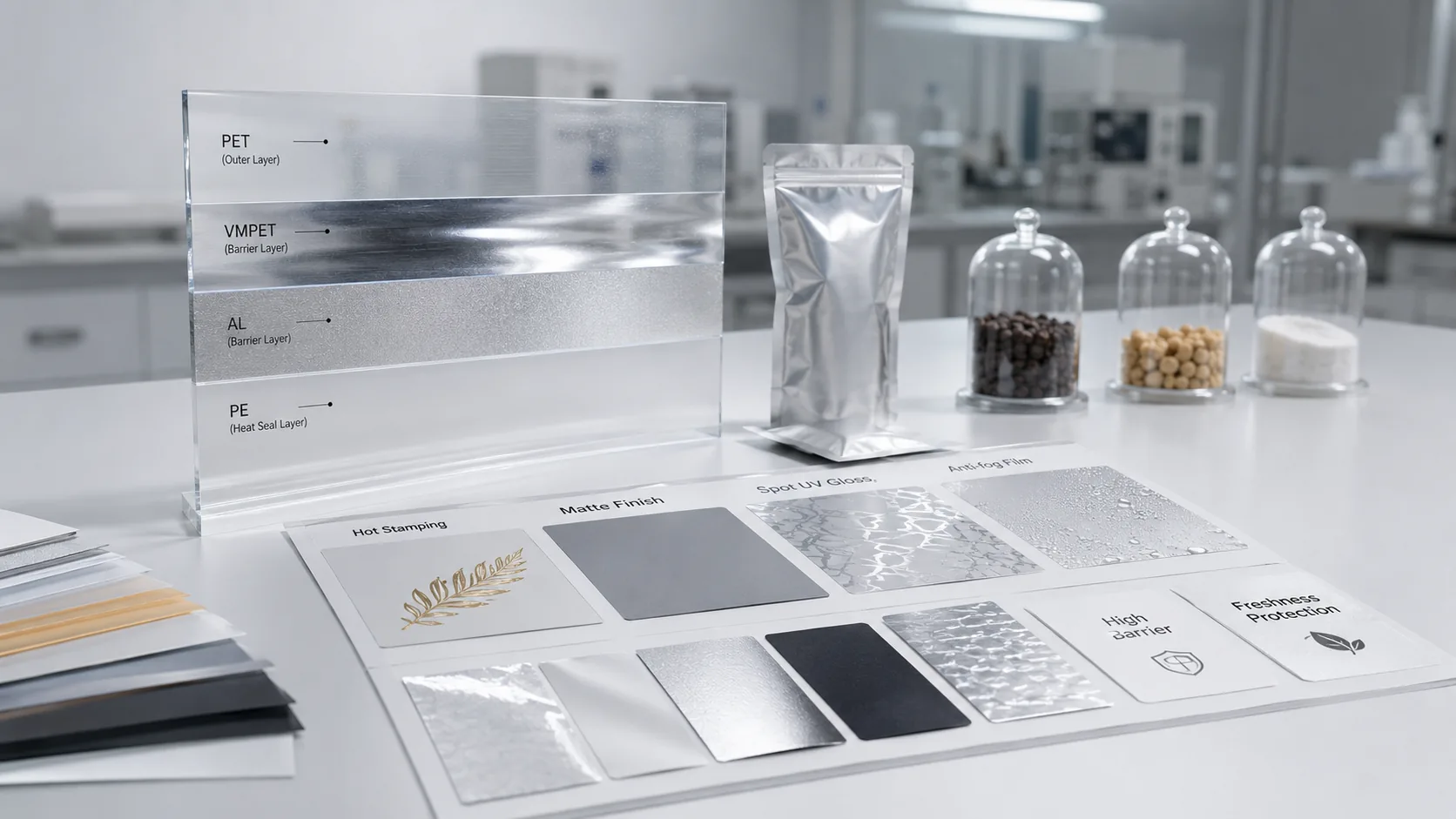
From a factory perspective, the following explains the layer logic of a laminate pouch, the function of each layer, and common misconceptions in structural design, so purchasing and product teams can read proposals with confidence.
Why a laminate pouch must be layered
The core contradiction of flexible packaging is: consumers want packaging that is thin and cheap, yet the product needs oxygen barrier, moisture barrier, light barrier, high-temperature resistance, puncture resistance, and good printability. No single material can do all of this. PE has good sealing and flexibility but low temperature resistance and poor oxygen barrier; PET has high stiffness and printability but poor heat-seal performance; aluminum foil is nearly absolute in barrier yet cannot form a pouch alone. Bonding them together trades the least total material for the most functions.
Layering also brings cost flexibility: the load-bearing and barrier layers can be made thinner, leaving thickness only where it is truly needed. For pouches of the same load capacity, different structural designs can differ in gram weight by over 20%.
The three-layer structure is the most common starting point
Most food laminate pouches on the market are three-layer structures, typically “print layer + barrier layer + heat-seal layer.” The print layer usually uses PET or BOPP, carrying the artwork and ensuring appearance stiffness; the middle layer is chosen by product need — aluminum foil, metallized film, EVOH, or PA — providing barrier and strength; the inner PE or CPP contacts food directly and provides heat sealing and seal integrity.
The three-layer structure balances cost, processing difficulty, and performance, suiting ambient-distribution scenarios such as nuts, biscuits, seasoning powders, and household products. If the product only needs basic moisture protection, the middle layer can be switched to metallized film, keeping the metallic look while lowering gram weight. The differences among lamination methods are detailed in the Composite Packaging Process Explained guide.
Four- and five-layer structures: when to add layers
When a product needs high-temperature sterilization, long shelf life, or strong puncture resistance, three layers are not enough. Four- and five-layer structures usually add a PA (nylon) layer to improve puncture resistance and temperature performance, or add an aluminum-foil layer to maximize barrier. A typical retort structure such as PET/PA/AL/CPP maintains seal integrity and no delamination under 121℃ sterilization.
More layers is not automatically better. Each added layer raises lamination passes, adhesive usage, loss rate, and process time, and therefore cost. The only standard for whether to add a layer is whether the existing structure showed a specific failure mode in testing — for example, oxygen transmission rate exceeding limits, drop damage, or delamination after retorting. Adding a layer only with a clear failure cause is a sound engineering decision.
What each layer does: material code quick reference
- PET: commonly used outer layer; high stiffness, good temperature resistance, good printability; provides mechanical strength.
- BOPP: alternative outer layer; low cost, high gloss, but lower temperature resistance than PET.
- AL (aluminum foil): strongest barrier; used for light barrier and high oxygen-barrier scenarios.
- VMPET (metallized film): lower-cost barrier option with a metallic appearance.
- PA (nylon): puncture-resistant and stretch-resistant; common choice for frozen and retort structures.
- EVOH: transparent high-barrier material, suited to products that need to show the contents.
- PE / CPP: inner heat-seal materials that determine seal strength and seal integrity.
Three misconceptions easy to fall into in structural design
The first misconception is looking only at barrier data and ignoring seal reliability. Even the best barrier structure fails shelf life if the inner heat-seal window is too narrow, making line sealing unstable. The second is ignoring the product’s oil and acidity. Oily foods accelerate swelling of certain adhesive layers, and acidic contents demand more of the aluminum-foil layer; such products need dedicated product-compatibility testing.
The third is copying someone else’s structure. For the same nut product, different moisture content, pack size, transport distance, and target shelf life mean different optimal structures. Directly adopting a competitor’s formula can easily lead to either “over-specification and high cost” or “failure under a certain path.” The safer approach is to provide product parameters and distribution conditions, and let the factory propose two or three candidate structures and verify them by sampling.
From structure diagram to physical verification
After the structure is set, verification usually has four steps: first make a small-sample lamination to confirm interlayer adhesion; then make a pouch sample to confirm heat-seal parameters and pouch dimensions; then run a real-product fill test; and finally arrange accelerated or actual shelf-life observation. Peel strength, seal strength, and oxygen/moisture barrier data are best requested at the sampling stage as a baseline for later full-production acceptance. Retort products also need extra confirmation of post-temperature appearance and delamination; see the High-Temperature Retort Pouch Material Combination guide.
Frequently Asked Questions
Q: Does more layers mean safer packaging? A: Safety depends on whether the structure matches the contents, not on the layer count itself. Adding layers mainly improves barrier and mechanical strength and has no direct relation to food-contact safety, which is determined by material compliance and seal integrity.
Q: Can metallized film replace aluminum foil to cut cost? A: If the product has medium sensitivity to oxygen and light and a modest shelf-life requirement, metallized film is a viable option; if long shelf life or strong light barrier is required, aluminum foil remains irreplaceable.
Conclusion
Understanding the layer logic of a laminate pouch is essentially translating “what performance the packaging needs” into “what each layer should do.” The earlier the structure is confirmed, the fewer sampling rounds and lower rework cost later. If you are advancing a new-product packaging project, contact HASUPACK for structure evaluation and sampling advice; for small-batch cross-border retail packaging solutions, you can also learn about OMOPACK at https://www.omopack.com.





