





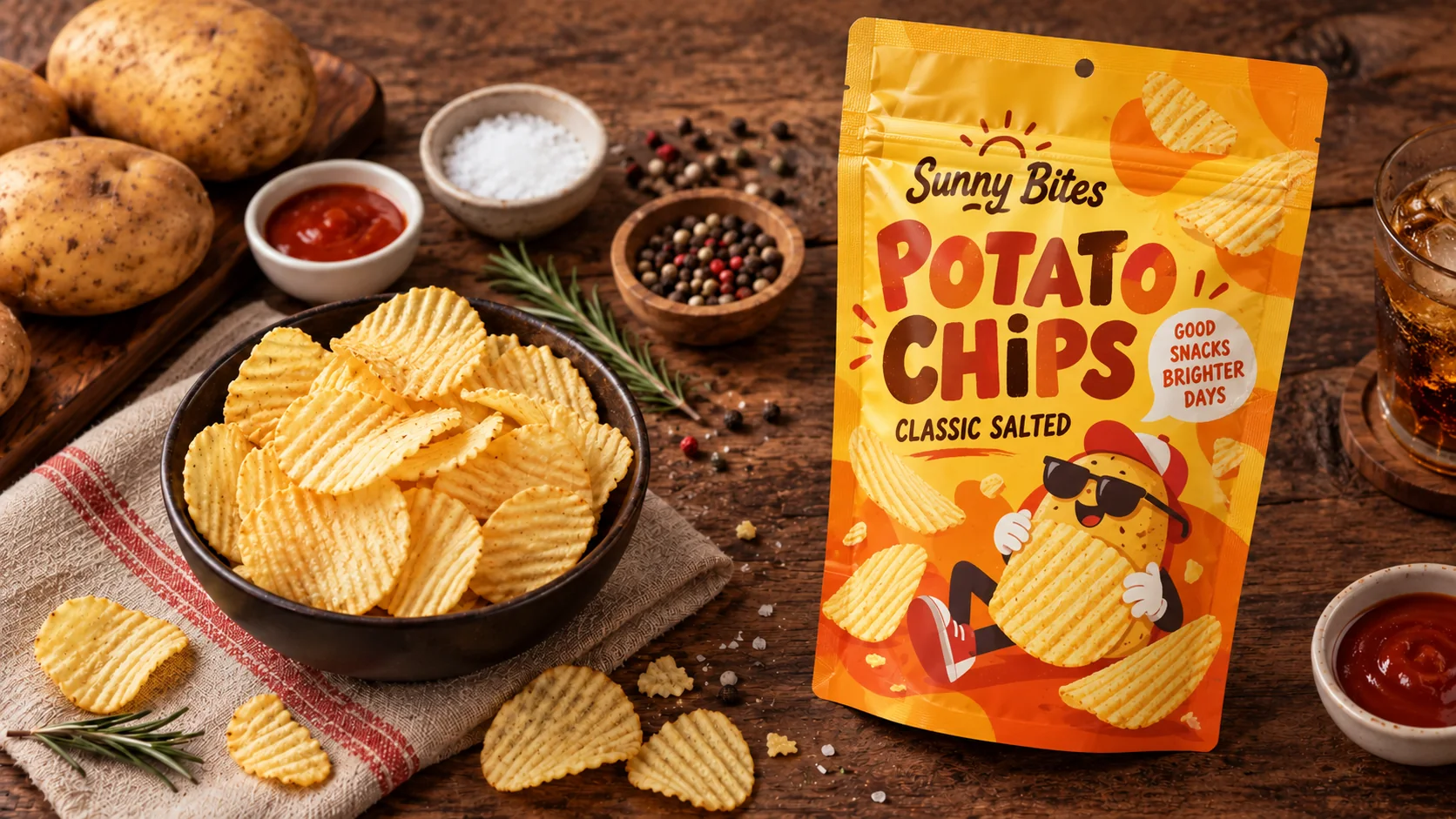
So a “gas-flushed bag” is not a complete solution on its own. The product’s crispness, oil stability, piece strength, headspace, heat-seal window, and outer carton must be considered together. HASUPACK’s Confectionery & Snack Packaging Solutions can serve as a reference for pouch format and material direction; the actual specification still has to return to the product and equipment.
Potato-chip packaging looks mature, yet detail problems often surface once it hits the production line: some bags are stiff right off the line but slowly go slack after a week of transport; some have decent barrier data yet trap salt particles and crumbs in the horizontal seal; others are inflated hard to reduce fragments, only to lower the carton fill count and raise the pressure on the seal edge.
The four most common failure points in potato-chip bags
| Risk | Typical symptom | Packaging factors to verify |
|---|---|---|
| Moisture uptake | Declining crispness, softer mouthfeel | Moisture barrier, seal integrity, shelf life under hot-humid conditions |
| Oxidation | Reduced aroma, rancid oil off-flavor | Oxygen transmission, headspace residual oxygen, light exposure, leakage |
| Crush damage | Lower whole-chip rate, more in-pack crumbs | Gas-flush cushioning, bag dimensions, carton strength, stacking and transport route |
| Seal instability | Slow leakage, wrinkled or open seal edge | Hot tack, seal window, oil/salt/crumb entrapment, production speed |
Moisture barrier is the first line for keeping crispness
Potato chips and most puffed snacks are very sensitive in texture to moisture. But “moisture-barrier film” is not a precise enough technical requirement. The project should first set the acceptable crispness or moisture change, then, combined with shelf life, bag surface area, and the sales region’s temperature and humidity, determine the moisture-transmission performance the full structure needs.
Note especially that a film’s lab value does not guarantee the finished bag performs the same. Creases, printing and lamination quality, the seal edge, and micro-leaks all change the real result. The more reliable approach is to make samples with the actual contents, planned gas-flush conditions, and production seal parameters — not just test a flat film.
Gas flushing reduces crushing, but “more gas is not better”
For fragile products, in-bag gas creates a cushioning space in the flexible package. But if the bag over-inflates, the seal edge and outer carton may bear higher pressure, and a single carton may not hold the planned count. Conversely, too little headspace cannot provide enough cushioning.
Therefore compare different gas-flush levels with quantified methods: record bag thickness, per-carton arrangement, stacking height, and fragment rate after simulated transport. Do not treat “inflated” as the sole criterion for flush effectiveness.
Manage oil oxidation and residual oxygen separately
In the formulation, oil type, oil content, antioxidant system, post-frying handling, and pre-packaging dwell time all affect oxidation speed. Packaging is only one link. If low-oxygen gas replacement is used, simultaneously check flush time, gas purity, headspace residual oxygen, and post-seal retention.
For light-sensitive products, an opaque or light-barrier structure may be more appropriate; if a clear window is unavoidable, stability testing should use the actual window area and material. This is a trade-off between function and display and should not be decided by layout alone.
Whether rollstock fits must be judged at normal production speed
Potato chips and puffed snacks usually use automatic form-fill-seal equipment. Film thickness is only one dimension; stiffness, coefficient of friction, curl, print registration mark, hot tack, and seal-layer contamination resistance all affect production.
Trials must not only check whether bags can be made at slow speed. Run at a speed close to production and record tracking deviation, stretching, cutting, seal skips, and stoppage count. HASUPACK’s Packaging Rollstock Film page can help organize rollstock and pouch-format direction, but final dimensions and surface performance must match the actual equipment.
The seal is the most underestimated position in the whole system
Potato-chip crumbs, salt particles, and oil can all enter the horizontal seal zone. Raising temperature does not necessarily fix entrapped material and may instead deform the film or stick to the knife. During development, simultaneously optimize the drop rhythm, anti-entrapment control, headspace, seal pressure, temperature, and time.
ASTM’s packaging standards catalog includes methods such as F88/F88M (seal strength), F1921 (hot tack), D3985 (oxygen transmission rate), and F1249 (water vapor transmission rate). They answer different questions, and test conditions cannot be skipped. Companies should agree on method, sampling, and acceptance criteria with the packaging supplier and testing party before using them for production verification.
From sample to production, don’t reverse the order
- Define product acceptance criteria. Replace “good taste” with comparable crispness, moisture, sensory, and fragment-rate metrics.
- Record distribution conditions. Specify sales-region temperature and humidity, transit time, parcel or full-case channel, stacking, and display method.
- Screen candidate structures. Compare moisture and oxygen barrier, crease resistance, seal layer, and equipment compatibility.
- Run trials at normal production speed. Record film running, gas flushing, residual oxygen, seal-temperature window, and scrap causes.
- Verify with finished packs. Arrange shelf-life, leak, seal, drop, vibration, and full-carton stacking tests together.
Information to make clear at the first discussion
- Product formulation traits, oil content, moisture, and known sensitivity to oxygen/light
- Individual piece size, shape, net content, and desired headspace
- Target shelf life and main sales regions
- Machine model, film web direction, expected speed, sealing type, and gas-flush system
- Units per carton, carton specs, and stacking/transport conditions
- Food-contact, labeling, and testing requirements
Frequently asked questions about potato-chip packaging
Is the gas in potato-chip bags always nitrogen?
It should not be judged by appearance alone. Companies must set a gas-management plan based on product, process, regulations, and target residual oxygen, and monitor it in production; “the bag is very inflated” cannot be taken as proof of gas composition.
Which suits potato chips better, a stand-up pouch or a back-seal pillow pouch?
It depends on fill volume, equipment, display, cost, and whether the user needs resealing. High-speed automatic lines often use pillow pouches formed from rollstock; products eaten over multiple sittings can evaluate a zip-lock stand-up pouch. The final choice should be decided by machine and transport testing.
Is metallized film always better than clear film?
They cannot be compared broadly. The full structure’s barrier, crease resistance, sealing, printing, and equipment compatibility all need to be seen. Evaluating measured data together with the product’s shelf-life result is what makes sense.
Does a thicker bag make potato chips less likely to break?
Not necessarily. Fragments are also affected by headspace, gas flush, bag dimensions, outer carton, stacking, and handling. The film’s mechanical properties matter, but are not the only variable.
A potato-chip bag does not work alone. Leave out any one link among product, gas, film, seal, outer carton, and transport, and the pretty lab data may lose meaning. Testing these links connected before mass production is more effective than simply increasing thickness.





