





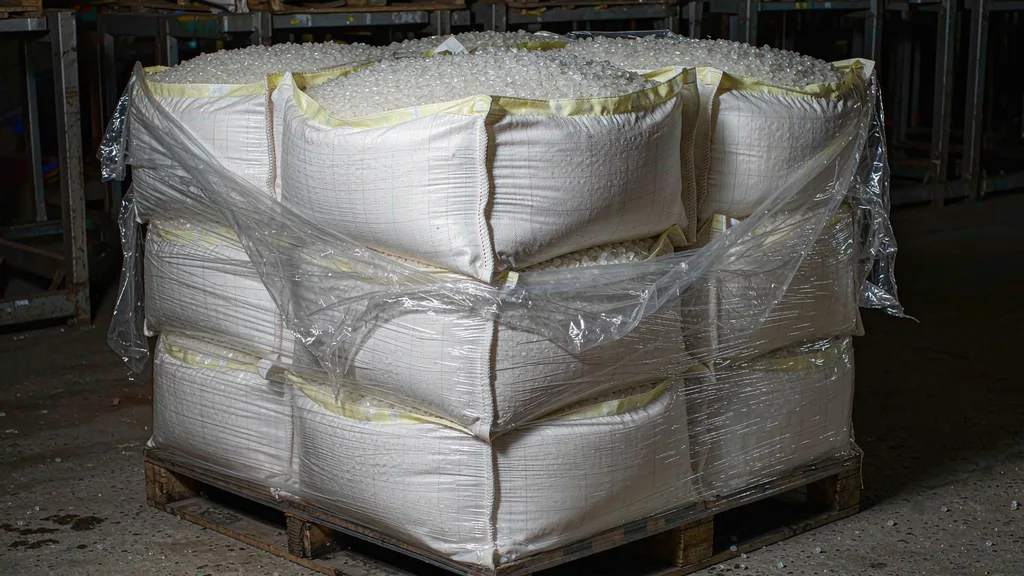
How to choose a 25kg heavy-duty bag–the first deciding factor is not price but the filling method: an automatic filling line calls for FFS heavy film roll, free-flowing powder calls for a valve bag, and manual or semi-automatic filling calls for an open-mouth bag. The three routes correspond to completely different film thicknesses, heat-seal systems, and acceptance metrics; the cost of choosing the wrong route is usually not changing the bag but halting and reworking the entire filling line.
What Are the Three Mainstream Technical Routes for 25kg Heavy-Duty Bags?
Heavy-duty bags refer to heavy plastic packaging bags loading 10 to 50kg; 25kg is the most common specification for chemical raw materials, grain-oil by-products, and building-material additives. The market mainly supplies three routes:
- FFS heavy film roll: heavy PE rollstock is formed, filled, and sealed on-site on a fully automatic Form-Fill-Seal machine, with filling speeds up to 20 to 40 bags per minute, the mainstream solution for large chemical and resin plants.
- Valve bag: a filling valve is built into the bag corner; material is fed through the valve by air pressure or screw and the valve self-closes after filling, suited to free-flowing powders such as cement, putty powder, and starch–low dust, fast filling.
- Open-mouth bag: the open mouth is hand- or semi-automatically sleeved and filled, then heat-sealed or sewn shut; highest flexibility and lowest equipment investment, suited to small-to-medium output and multi-spec scenarios.
The three routes cannot be simply interchanged: FFS requires strict matching between the filling line and film-roll parameters, valve bags require the material to be free-flowing, and the open-mouth bag’s labor cost is amplified at high volume. When HASUPACK customizes a heavy-duty solution for a client, step one is always to confirm the filling line type, then work backward to the film structure and pouch format.
How to Choose Thickness and Formulation for FFS Heavy Film
The conventional thickness of FFS heavy film is between 150 and 220 um; the heavier the material and the sharper its edges, the thicker the film. But thickness is not the only metric–formulation is often more critical:
- Resin system: the mainstream is LDPE/LLDPE blending or mLLDPE toughening formulations, pursuing high dart impact and creep resistance; loading sharp particles (e.g., regrind plastic pellets) requires higher toughness and puncture-resistance grade.
- Coefficient of friction: FFS high-speed bag pulling requires a stable film-surface COF; too high on the outer layer causes film slip, too low causes stack slip, so the outer layer is typically controlled at 0.15 to 0.25 and kept consistent between batches. Unstable COF is the number-one cause of frequent FFS line stoppages; HASUPACK previously wrote a dedicated explainer on COF and slip agents.
- Heat-seal layer formulation: the heat-seal layer determines low-temperature seal initiation and heat-seal strength; dust in the filling environment directly contaminates the seal surface, so the formulation must also provide contamination-resistant sealing.
When purchasing, require the supplier to provide measured dart-impact, tensile-strength, and coefficient-of-friction data for each film batch, rather than only checking that thickness passes.
Which Strength Metrics to Watch, and How to Run the Standard Tests
The core of heavy-duty bag acceptance is four mechanical metrics, each with a corresponding national-standard test method:
- Drop test: per GB/T 4857.5, a fully loaded bag is dropped from a specified height to assess bag-body and seal impact resistance. The 25kg norm requires three drops from 0.8 to 1.2 m without rupture; the exact height is agreed by transport mode and customer standard.
- Stacking test: per GB/T 4857.3, fully loaded bags are stacked for over 24 hours without collapse or rupture, simulating warehouse and container stacking.
- Tensile strength and elongation at break: intrinsic film metrics; heavy-duty film longitudinal tensile strength is typically required at 25 MPa or above.
- Heat-seal strength: the heat-sealed area of a heavy-duty bag is typically required at >=30 N/15mm; poor sealing shows in transit as seal-edge cracking and leakage, the most common customer complaint.
These four must be written into the purchase contract as acceptance conditions, with batch sampling on arrival. For the logic of setting heat-seal parameters, compare with HASUPACK’s heat-sealing temperature guide; heat-seal windows differ greatly between resin systems. For how the bag’s structural layers share these mechanical tasks, the layer-structure diagram of composite packaging bags gives a more intuitive breakdown.
In What Scenarios Are Valve Bags and Open-Mouth Bags More Cost-Effective?
The applicable premise of a valve bag is that the material can self-flow: resin powder, starch, flour, and dry-mix mortar powders fill fastest, and after the valve self-closes no secondary sealing is needed–the operator only sleeves the bag. But it demands high bag stiffness, usually using multi-layer heavy film or a paper-plastic structure, with a unit price higher than an equivalent FFS heavy film.
The open-mouth bag wins on cheap equipment and flexible spec switching; 25kg liquid by-products, granules, and bulk material can all be filled, with sealing by heat seal or sewing machine. The downside is high manual bag-sleeving volume and seal quality depending on the operator, so heat-seal parameters and sampling frequency must be fixed into the work instruction. For lines below 2,000 bags per day, the open-mouth bag solution often has the lowest total cost; above that volume, the automation advantage of FFS or valve bags quickly opens a gap.
How to Set the Procurement Acceptance Checklist
Heavy-duty bags are a typical “one bag breaks, the whole pallet is wasted” category, so we recommend fixing five acceptance items:
- Write the four mechanical metrics into the contract (drop, stacking, tensile, heat-seal strength) along with the test-method standards.
- Request measured reports per batch: dart impact and coefficient of friction provided batch by batch; “same as last batch” is not accepted.
- Run an on-site trial on the first order: FFS film must be test-run on your own filling machine, recording bag-pull speed, seal temperature, and reject-bag rate; only scale up after the trial passes.
- Retain and seal samples: keep 5 to 10 empty bags and filled samples per batch so there is a comparable reference when a bag bursts.
- Agree on burst-bag responsibility and compensation: clearly define the responsibility boundary for in-transit burst rate and warehouse collapse to avoid later disputes.
If the product also has moisture-proof and antioxidant requirements, the heavy film can additionally laminate an EVOH or metallized layer, but note that a high-barrier structure raises heat-sealing and pouch-making difficulty and needs one more matching pass with the filling line. For differences at the pouch-making process level, HASUPACK’s pouch-making process guide: how three-side, four-side, and eight-side seals are formed helps you understand how different forming methods affect heavy-duty bag strength.
FAQ
How thick should a 25kg heavy-duty bag be?
For conventional 25kg granular material, choose 150 to 180 um; for sharp or high-hardness material, choose 180 to 220 um. Thickness must be read together with the resin formulation: a 160 um film with an mLLDPE toughening formulation often outperforms a 200 um film with a conventional formulation in impact resistance, so rely on measured dart-impact data.
Can FFS heavy film and valve bags substitute for each other?
In most scenarios they cannot directly substitute. FFS depends on an automatic form-fill-seal machine, while valve bags depend on material free-flow and a valve filling machine. Unless the filling line itself supports both, switching routes means changing the filling equipment, so the evaluation must count equipment investment, not just bag unit price.
What heat-seal strength qualifies for a heavy-duty bag?
The industry norm requires heat-seal strength no lower than 30 N/15mm; for sharp materials and long ocean shipping, it is advised to raise it above 40 N/15mm. For acceptance, run the supporting tests of the GB/T 4857 series and combine with simulated drops based on actual transport road conditions.
What burst rate should be controlled to?
When an FFS line runs stably, the filling-stage burst rate should be below 0.3%, and the combined post-transport damage rate is typically required below 0.5%. Above this level, first troubleshoot heat-seal parameters and coefficient of friction rather than simply thickening the film.
Is a high-barrier heavy-duty bag necessary?
It is only necessary when the contents are sensitive to moisture or oxygen, such as certain additives and pre-mixes. A high-barrier structure raises cost noticeably and affects FFS bag-pull performance, so shelf-life validation should precede selection to avoid paying extra material and tuning cost for unneeded performance.
Is there a low-MOQ option for small-batch heavy-duty bags?
Yes. The open-mouth bag route is most MOQ-friendly, often customizable from just a few thousand pieces; FFS heavy film needs machine commissioning, so the first order is advised to be no less than one full roll. At the small-batch stage you can start with a semi-automatic open-mouth bag solution and switch to an automated route once output stabilizes.





