





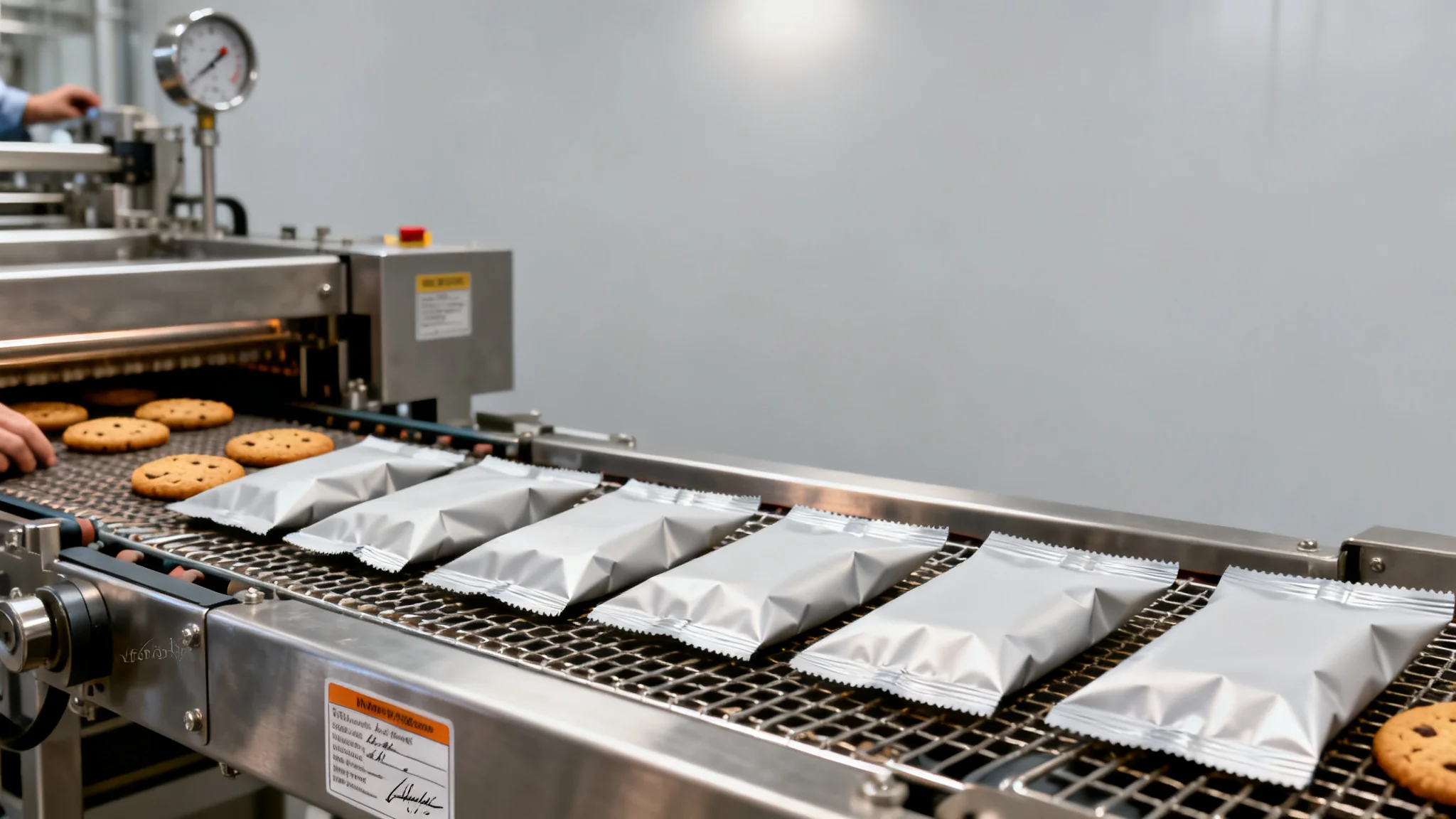
For baked-food packaging, when products are bagged right after cooling, the most error-prone factor is not the material but residual heat. Biscuits, cookies, and cakes leave the oven with a still-high core temperature; if cooling time is insufficient before bagging and sealing, water vapor inside the pouch condenses on the film’s inner surface, the product surface softens, and the seal zone goes weak from heat and oil. Following the on-site sequence of domestic food factories, this article breaks the cooling-to-sealing stretch into checkable steps.
What Happens Inside a Pouch That Was Not Cooled Enough?
The following judgments apply on the premise that the product is stored at ambient temperature and contains no cream or fresh-fruit filling that requires refrigeration.
Key Takeaways
- Before bagging, read the core temperature, not the surface temperature; fix the measurement point for comparability.
- Inner-wall fogging mostly comes from residual-heat condensation, not from the material’s barrier grade.
- If the seal looks intact yet cracks after transport, first check the seal’s cooling and setting, before considering thicker material.
- Thick products high in oil and sugar are most sensitive to residual heat; check the cooling section and seal parameters together.
During baking, moisture is driven to the product surface, then during cooling it rebalances inward. If you seal while the core is still hot, the vapor pressure inside the pouch exceeds the outside, and vapor migrates to the cooler film surface and condenses. Seeing inner-wall fogging and a soft product surface on opening is basically this process.
The same residual heat also affects the seal. The inner film enters the sealing jaws at an elevated temperature and gets re-heated briefly, so its cooling and setting are insufficient, and the seal’s actual strength falls below the sampling value. Once squeezed in transport, the seal cracks from its weakest segment. Such problems often escape random inspection because the seal looks intact.
How to First Tell Whether It Is a Crispness or a Seal Problem?
The two types look similar but troubleshoot differently. A crispness problem is usually noticed shortly after opening—soft product surface, tough mouthfeel—while the bag’s appearance and weight are normal. A seal problem shows as air leakage, a softened bag, and local collapse after stacking, while the product inside may still be fine when opened.
On the line you can make a simple distinction: take pouches from the same just-sealed batch; open one group immediately and check the inner wall for foggy condensation, and leave the other group until the next day to check seal appearance and internal pressure. If the first group shows condensation while the second’s seal still looks normal, the problem concentrates in the cooling stage; if the second group’s seal shows whitening or edge wrinkling, turn to the seal parameters.
Which Products Are Most Sensitive to Residual Heat?
Products high in oil, high in sugar, and large in thickness are most sensitive to residual heat. Oil flows more readily at higher temperature and easily seeps into the seal zone, hurting heat sealing; sugar stays somewhat sticky under residual heat and easily leaves marks at the mouth; thick products cool slowly at the core—the surface may feel cool while the inside is still hot.
Thin crispy biscuits are relatively better, but they often run on high-speed pillow packaging, leaving less time for the cooling section, so the real risk is not low. When judging, do not look only at surface temperature; measure core temperature and fix the measurement point so later data is comparable.
Seal-Parameter Check List: Troubleshoot in Order
Confirm each item in the following order; you can usually locate the specific stage on the line.
- Discharge temperature: record temperatures at the cooling-tunnel exit and the bagger infeed, and confirm whether the dwell time between them changes with line speed.
- Cooling-section airflow: is the airflow volume and direction uniform; is there a clear temperature difference between edge and center products.
- Feeding rhythm: does the bagger stop intermittently; the first few packs after a restart are more likely to carry residual heat.
- Seal parameters: are heat-seal temperature, pressure, and time still at the sampling settings, or were they manually adjusted.
- Seal-zone cleanliness: do the upper and lower jaws and the anti-stick cloth have sugar powder, crumbs, or oil residue.
- Cooling and setting: does the post-seal conveyor have enough travel for the seal to cool naturally, avoiding immediate stacking.
Heat-seal parameter settings are directly tied to the material structure; different inner films correspond to quite different temperature ranges, so specific values should be confirmed by sampling. See the note on heat-seal temperature setting. The post-cooling conveyor and rollstock web travel also affect the seal; related details are in the compilation on packaging rollstock process.
What to Confirm When Sampling?
At the sampling stage, the time is best spent reproducing actual production conditions, not just making a few appearance samples. We suggest running continuously at the actual line speed and deliberately stopping once midway to see whether the first few packs after restart show seal anomalies.
Seal-strength comparison is best done by a unified method. The peel-strength test method, specimen width, and tensile speed all affect the reading; ASTM F88/F88M gives the test protocol for seal peel of flexible barrier materials—record the conditions before comparing, or it means little. For baked snacks, pouch-format selection and structure direction can also draw on the classification thinking in the candy and snack packaging solutions.
Conclusion
For baked snacks, most crispness and seal problems are already decided at the cooling stage. First record the relationship among discharge temperature, cooling dwell time, and line speed; then confirm the seal parameters were not changed and the seal zone has no sugar powder or oil residue. At sampling, run continuously at the actual line speed and schedule a stop, and record the seal-peel test by a unified method. Only after both cooling and sealing are stable should you discuss adjusting the material structure.
Frequently Asked Questions
How long must freshly baked biscuits cool before bagging?
It mainly depends on product thickness, sugar and oil content, cooling-tunnel airflow, and output; there is no fixed duration. The workable approach is to use core temperature as the criterion: first set the allowed maximum core temperature before bagging, then back-calculate the required dwell time, and re-confirm as line speed changes. Surface temperature is not enough as a basis, because a thick biscuit’s core is often much hotter; we suggest fixing the measurement point and recording it over the long term.
Does inner-wall fogging necessarily mean the material’s barrier is insufficient?
No. The more common cause of inner-wall fogging is the product being too warm at sealing, so vapor condenses on the film—little to do with the baked-food packaging’s barrier grade. Insufficient barrier shows as outside vapor slowly penetrating and the product gradually softening, a process counted in days, whereas residual-heat condensation appears shortly after sealing. First separate the two by opening observation and weighing, then decide whether to adjust the material structure. When recording, we suggest noting the opening time, in-pouch odor, and ambient humidity together, since the same batch may behave differently across storage locations.
If the seal looks intact but cracks after transport, what should you check first?
First check the seal’s cooling and setting, not thicker material. A seal’s strength is not yet stable right after forming; if it is stacked immediately or enters a high-temperature environment, the same batch’s seal strength becomes clearly inconsistent. You can compare a cracked post-transport pouch with same-period stock from the warehouse, focusing on whether the seal’s inner layer shows stretch whitening or re-heating marks, then trace back the conveyor travel and stacking time after the bagger.
What extra requirements does high-oil baked snack place on the seal?
Mainly preventing oil from entering the seal zone and choosing a suitable inner film. Oil at seal temperature reduces the inner surface’s heat-seal effect, forming local weak seals; meanwhile some oil migrates into the film, affecting appearance and print adhesion. In practice, control the dosing drop, keep the jaws clean, confirm the inner film’s compatibility with oil, and verify the seal-strength change after long storage through sampling.





