





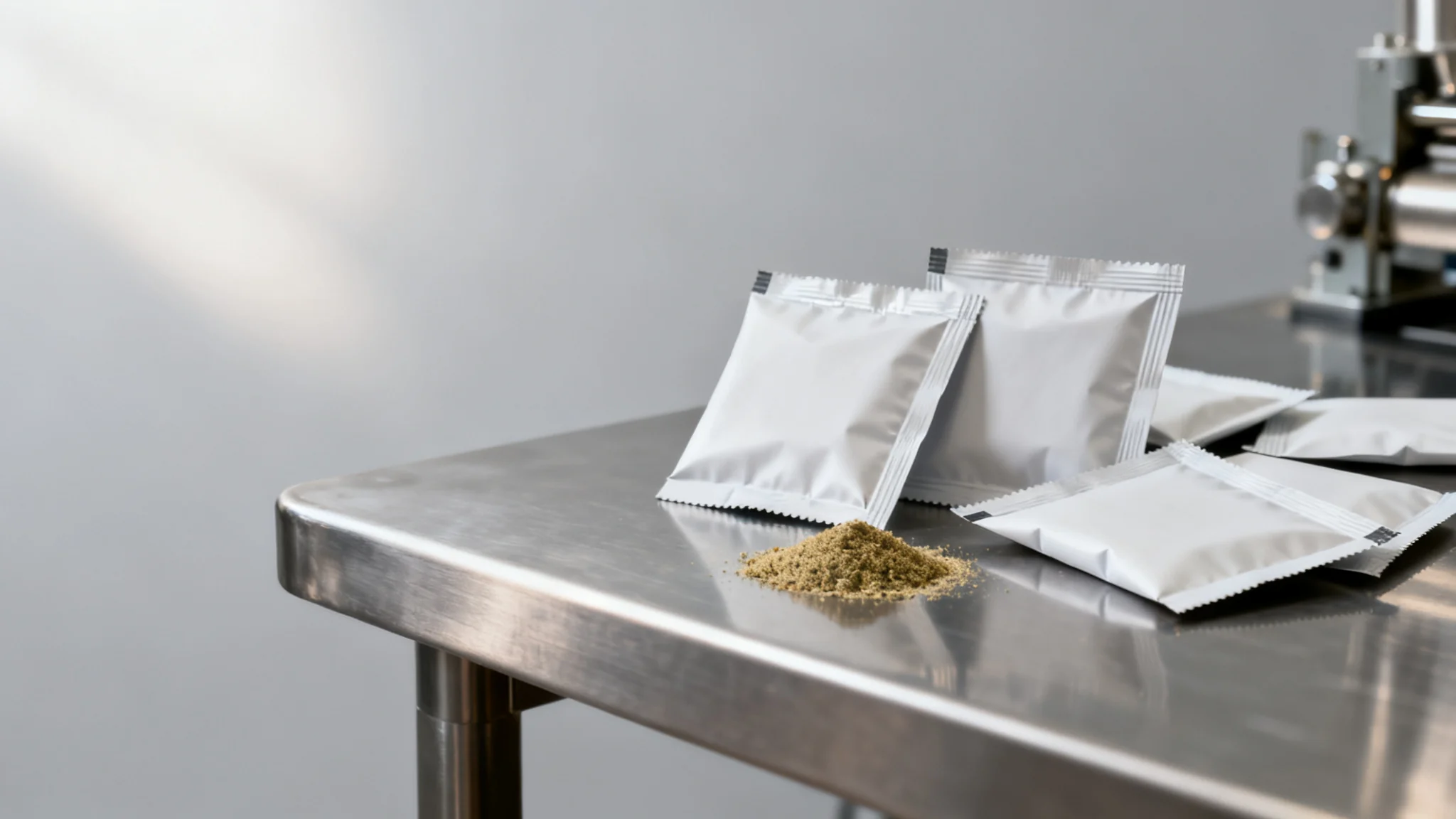
A single-serve seasoning sachet looks simple, but the real difficulty is that fill weight, the tear notch, and filling stability constrain each other. Widen the pouch a bit and fill weight stabilizes, but the tear-notch position then drifts from the seal edge; widen the seal to reduce leaks and the volume left for powder shrinks. Domestic factories making small seasoning sachets usually get stuck iterating samples among these three variables. This article breaks the spec-setting process into steps in order, and lists what to record during sampling.
Why Fill-Weight Accuracy Ties to the Seal and the Tear Notch
Key Takeaways
- Changing pouch width is the costliest, so set it first, then back-calculate fill weight and seal width.
- Fill-weight accuracy is judged by the weight distribution in continuous production, not by a few samples on the sampling bench.
- The tear-notch position must be confirmed together with the seal edge and the film’s tear direction.
- Among the four variables of filling stability, dosing drop height and film-web travel are the priorities.
Fill weight is not an independent metric. For the same pouch format, once the powder’s as-poured bulk density shifts, the weight filled in the same volume changes; products with large weight deviation often need more internal pouch space to absorb the swing, but more space means the powder distributes more unevenly inside and is more likely to rest at the mouth before sealing.
The tear notch follows the same logic. The notch works by guiding the tear along the seal edge from a starter cut; if unstable fill weight makes each sachet’s actual seal position float within tolerance, the notch’s position relative to the seal is no longer fixed, and when consumers tear they either cannot tear or tear straight into the pouch body. These three variables pull on each other on the same chart and must be set together.
Why Set Pouch Width Before Fill Weight?
The recommended sequence is to fix pouch width first, then back-calculate fill weight and seal width. Pouch width decides the packaging machine’s former size and the beat of each forming cycle, so changing it costs the most; fill weight can be adjusted via dosing volume and powder density at relatively low cost; seal width and tear-notch position fall in the tooling and printing scope at medium cost.
Pouch width can be chosen against two constraints. One is the volume of a single serving plus the margin for the powder’s angle of repose; the other is the packaging machine’s former specification, where fine-tuning from an existing spec is usually cheaper than cutting a new former. After fixing width, use the measured as-poured bulk density to calculate the dosing volume, then build a volume-to-weight table for direct use in production.
Which Side Should the Tear Notch Go On?
Putting the notch on the short side is usually handier: the tear travel is short and the force direction is clear, and it is safer for fine-powder contents—less likely to squeeze powder out while tearing. A notch on the long side makes the pack look wider on the shelf, but the tear path is long and, when the film’s tear direction is unfavorable, diagonal tearing is likely.
Notch depth and count also need adjusting to pouch width. On narrow sachets, double small notches are often more reliable than a single deep notch; on wide sachets, confirm the notch’s relative position to the transverse seal so the tear travels straight along the seal edge. Such details relate to pouch format and seal shape; first refer to the note on the three-side seal pouch format, then confirm against your own tooling.
Which Variables Does Filling Stability Depend On?
On-line stability mainly comes down to four variables. The first is the dosing method: screw dosing meters by volume, so powder-density swings pass straight through to fill weight; gravimetric dosing is more accurate but slower in cycle. The second is the dosing drop height: the greater the drop, the more the powder flies inside the pouch and the worse the mouth contamination.
The third is the film’s tension and coefficient of friction. If the film does not run smoothly on the former, it intermittently wanders and the seal position shifts with it. The rollstock’s inner-film choice and slip-agent level both affect this; the relevant judgment can refer to the compilation on food-grade rollstock material selection. The fourth is sealing-jaw cleanliness and cooling: after one shift of continuous running, powder buildup on the jaws and temperature drift both degrade seal quality.
Sampling Confirmation Checklist
- Run a continuous stretch with the actual powder and record the weight distribution of 100 consecutive sachets, not just a few samples.
- Record seal temperature, pressure, and time at the actual line speed, and schedule a stop midway to observe the first few sachets after restart.
- Measure the tear-notch’s relative offset from the seal at line start and again after one hour of running.
- Check seal appearance continuity and whether the mouth shows powder traces, retaining samples at fixed intervals.
- Check standing and stacking behavior after filling with the real product, and re-inspect after standing a while.
- Run a seal-peel test by a unified method; the sample count for comparison must cover the whole run.
The test protocol for seal peel affects the reading, so specimen width and tensile speed must both be recorded, or data across batches cannot be compared. ASTM F1929 gives a dye-penetration method for detecting seal channels, suitable for confirming whether connected gaps exist inside the seal; the specific sample count should follow your own acceptance standard.
Conclusion
For single-serve seasoning sachets, we suggest proceeding in the order pouch width, fill weight, tear-notch position, fixing the costliest-to-change item first. Fill-weight accuracy should be judged by the weight distribution in continuous production, not a few samples on the bench; the tear effect must be confirmed together with the film’s tear direction and notch position; and filling stability must first address dosing drop height and film-web travel. When a product line spans multiple formulations, you can first group them into two or three density ranges, fix one spec per range, then verify fill tolerance item by item. This range-based spec method only works if the density differences between formulations can be controlled in bands. For related pouch formats and material directions, see the overall thinking in the seasoning and sauce packaging.
Frequently Asked Questions
How many formulations can one spec of a single-serve seasoning sachet cover?
Usually it can cover several formulations with close as-poured bulk density. The constraint is fill tolerance: at the same volume, the larger the density difference, the larger the weight deviation; beyond the tolerance you can accept, a separate spec is needed. In practice, first group formulations into two or three density ranges, fix one spec per range, then verify fill tolerance for each formulation individually. Fewer specs help changeovers and matter more for low-volume, multi-flavor lines. Such small seasoning sachet specs usually land on the existing pouch formats of seasoning packaging bags.
If the tear notch won’t tear or tears crooked, what should you change first?
First check the notch’s relative position to the seal edge, then consider changing the notch shape. If the notch is too far from the seal, the tear gets no guidance from the seal edge and easily goes diagonal into the pouch body; if the notch does not match the film’s tear direction, it shows as won’t-tear or stops midway. After confirming both, you can look at notch depth and whether to add a symmetric notch on the other side. Changing the film or structure is generally the last resort, as it costs the most.
If the pouch mouth always has powder during filling, where do you mainly check?
First check the dosing drop height and powder fly, then static. The closer the dosing outlet is to the seal zone and the greater the drop, the higher the chance powder lands on the mouth; fine powder picks up static while the web travels and adsorbs onto the film’s inner surface, carrying it all the way to the seal zone. You can first split the dosing sequence into two stages to reduce the single-dose amount, then confirm whether ionized air is needed. Also set the sealing-jaw cleaning interval by shift rather than waiting for defects.
How wide should the seal be on a small seasoning sachet?
It depends on pouch width, powder flowability, and packaging-machine accuracy; there is no single number. A wider seal absorbs slight seal-position offset and reduces leaks, but it eats into the effective internal volume; on narrow sachets this is especially marked—the wider the seal, the less space for powder and the harder the fill-weight control. We suggest first setting an initial ratio by pouch width, then adjusting via the actual leak rate and weight distribution from line runs, rather than copying another product’s numbers outright.





