





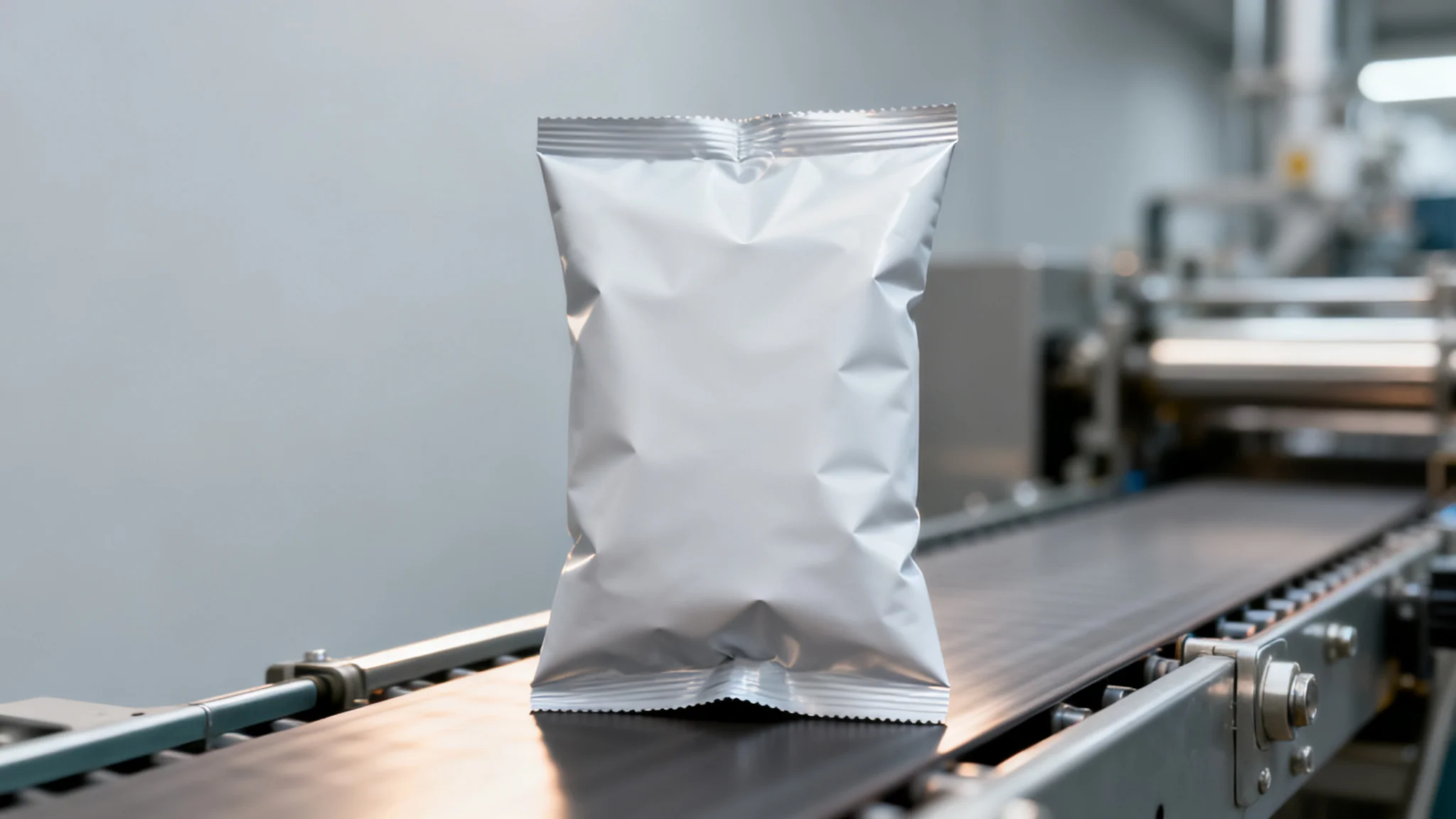
Nitrogen flushing packaging replaces the air inside a filled pouch with nitrogen immediately before the final seal, which is the most direct way to bring headspace oxygen down without reformulating the product. The flush is only one part of the system. What remains after sealing, and what enters later through the film, decides whether the pack holds its quality to the end of shelf life. This guide covers residual oxygen targets, barrier pairing, how gas behaves in different pouch formats, seal contamination after injection, and the checks that confirm the flush worked.
What Nitrogen Flushing Packaging Does to Residual Oxygen
Air is about 21 percent oxygen, and that headspace gas is the first thing to attack a sensitive filling. A flush does not create a vacuum: nitrogen is injected into the open pouch or the forming tube, the mixture is pushed out of the mouth, and the seal closes on a headspace that is mostly nitrogen. The slight positive pressure helps the pouch keep its shape under stacking. Use cases for nitrogen flushing packaging cluster around fried snacks, nuts, ground coffee and powders, where oxidation shows as rancidity, colour loss or aroma fade. The flush acts on headspace gas only. It does not remove oxygen dissolved in the product or held inside porous particles, and displacement is never complete at line speed, so a residual oxygen target belongs in the written specification and is confirmed with a headspace analyser.
Film Barrier and Pouch Format Together
A flush removes the oxygen already inside; the film then controls what comes back through the wall. A strong flush cannot cover an under-specified barrier, so match the barrier layer to product sensitivity and read the measured transmission rate on the actual laminate rather than a data sheet. Readings are only comparable when test conditions are stated; see ASTM D3985 for oxygen gas transmission rate. Candidate directions include metallized PET, aluminium foil and EVOH-containing laminates. Metallized film loses barrier where the metal layer flex-cracks, foil is stiff enough to stress a seal on a tight radius, and EVOH needs moisture protection. None is a guaranteed shelf life, and the surrounding structures are listed in the candy and snack packaging solutions range.
The same flush also behaves differently by format. On a vertical form fill seal machine a pillow bag forms around the product, and injected gas expands it into a cushion that presses on the back seal throughout. A stand-up pouch traps gas in the bottom gusset corners, which resist compression and hold pressure against the bottom seal. A flat-bottom pack behaves closer to a carton and spreads pressure across the panels. The consequence appears on the pallet: an over-inflated pack loses stacking stability, and flexible film lets the gas volume shift in transit and work the seals open.
Seal Contamination After Gas Injection
The most common reason a flushed pack fails is the seal, not the gas. Nitrogen leaving the nozzle at line speed lifts powder, sugar or salt dust from the product into the seal zone, where it sits between the sealant layers and stops the polymer chains bonding across the full width. A channel of a few millimetres lets nitrogen out and air in. Controls sit upstream and at the jaw: keep fill height below the seal line, angle the nozzle away from the product, add dust extraction near the mouth, and allow enough dwell time for the sealant to flow. An olefin sealant resin for food contact is regulated under 21 CFR 177.1520, though the finished laminate still has to be confirmed for the destination market. Seal settings themselves are set out in the packaging process instructions.
Which Products Need a Valve Instead of a Flush
Freshly roasted coffee releases carbon dioxide for days. A flushed and sealed pack with no outlet swells as that gas accumulates, and the pressure pushes on every seal. A one-way valve lets gas leave while limiting air entry, which is why roasted coffee usually needs a valve before it needs a flush. Ground coffee releases faster than whole bean, so the decision is tied to grind, roast level and the gap between roasting and packing. Both are visible on the coffee and snack pouch and the roasted coffee quad seal pack. Valve and zipper also compete for the same panel, so plan both positions on the die line before approving artwork.
How to Verify Flushing on the Production Line
Verification is a routine measurement, not a one-off trial. Take packs at the start, middle and end of a run and read headspace oxygen with an analyser that pierces the pack and seals the puncture. Sample after the pack has settled, because gas keeps mixing inside the pouch after sealing, then record the values against the target. Pair the reading with a seal check: the bubble immersion method in ASTM D3078 shows where gas escapes and is quick enough for line-side use. A pack high on oxygen but holding pressure points to the film or to incomplete displacement; a pack that bubbles points to the seal.
When Nitrogen Flushing Is the Wrong Choice
Flushing adds a gas supply, a nozzle and a control step, and it pays back only where oxygen is the dominant failure mode. Fresh produce that respires needs a balanced gas mixture rather than pure nitrogen, otherwise the tissue turns anaerobic. Products stable through low water activity or high sugar gain little. The boundary sits on the other side of a shelf-life trial: if an unflushed control pack holds quality for the required period, the flush is cost without benefit.
Conclusion
A flushed pack is a system of gas, film and seal, and the weakest of the three sets the result. Work through it in this order:
- Define the residual oxygen target from a shelf-life trial on the real product, not from a default figure.
- Choose the barrier layer against that target and confirm the measured transmission rate on the actual laminate.
- Fix the seal, meaning fill height, nozzle angle, dust extraction and dwell time, then verify it with a bubble test.
Only then is it worth tuning gas flow. Buyers who ask for the residual oxygen target, the barrier data and the seal verification record get a pack that can be judged; buyers who ask only for a flush get a claim.
Frequently Asked Questions
Does nitrogen flushing packaging remove all the oxygen from a pouch?
No. A nitrogen flushing packaging setup lowers headspace oxygen to a small residual, and it does not touch oxygen dissolved in the product or held inside powder particles. Oxygen also returns through the film over time at a rate set by the barrier layer. The practical question is whether residual level plus ingress rate stays inside target for the whole shelf life, which is checked with a headspace analyser and a barrier measurement on the finished laminate.
Which film structure suits a flushed snack pouch?
Start from the product’s sensitivity, then choose the barrier. Metallized PET is the common middle option, aluminium foil suits highly sensitive fills, and EVOH works where a thinner barrier is needed and moisture is controlled separately. The sealant layer matters as much, because dust in the seal leaks regardless of film quality. Ask for measured oxygen transmission and seal strength on the finished laminate, then run a shelf-life trial.
Can a flushed pouch run on an existing vertical form fill seal line?
Usually yes, if the line has gas injection hardware. The nozzle has to reach the filling zone without blocking product flow, and film stiffness, jaw width and dwell time all interact with the gas volume, so a film that ran well without flushing may need a different seal setting. Ask the machine supplier whether the existing jaws and unwind tolerate the added clearance, then confirm with a short trial that includes headspace readings.
Why does a flushed pouch still collapse or go soft on the shelf?
Check the seal before blaming the film. A channel leak lets the internal gas escape and the pack flattens within days, while a barrier problem shows as a gradual oxygen rise with the pack shape still intact. Bubble immersion testing separates those two cases quickly. Pressure changes during transport and at higher delivery altitude also flatten a pack sealed with a small gas volume, so appearance alone never proves a leak.





