





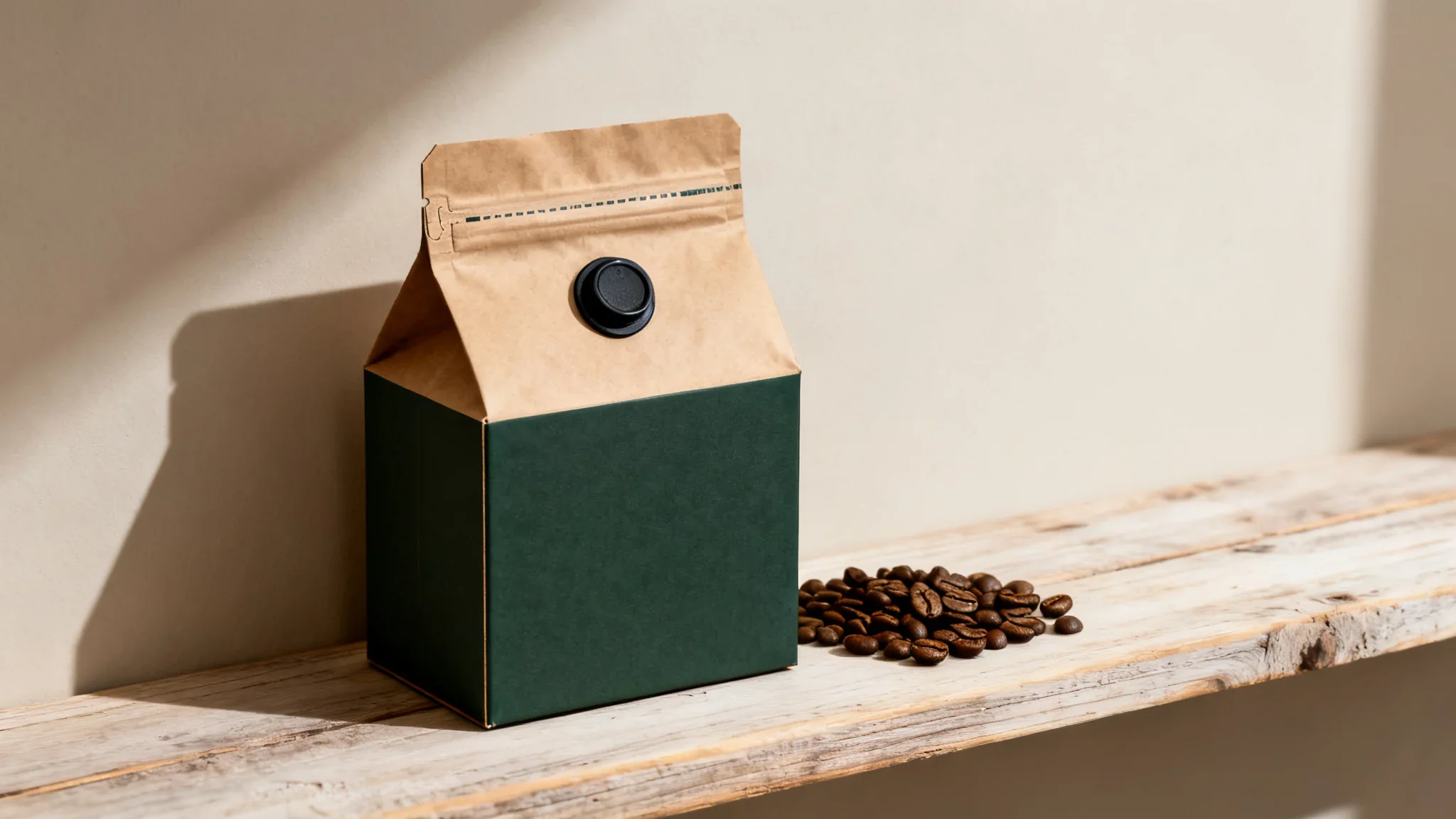
A flat bottom coffee bag is chosen for one reason: it stands. The box-pouch format, built from a folded bottom gusset and two side gussets, gives a roaster a rectangular footprint on the shelf, five usable print panels and a wide top opening for filling. It also creates three conflicts that decide whether the pack works. The valve and the zipper both want the same flat film area, the laminate has to stay stiff enough to hold the corners square, and the coffee has to release its gas before the bag is closed. This guide works through those three, plus the equipment the format demands.
Why Does a Flat Bottom Coffee Bag Hold Its Shape?
Because the filled product presses the folded bottom panel flat, and the side gussets unfold into vertical walls. A stand-up pouch with a curved doy bottom carries its load on one seam; a box pouch spreads it across four corner seals and a rectangular base. Shape retention still depends on two variables the buyer controls: fill weight relative to bag volume, and laminate stiffness. An underfilled bag of 250 g in a 500 g shell has nothing to press the bottom flat, so the base buckles inward and the bag tips forward on the shelf.
Box-Pouch Geometry: Bottom Fold, Side Gusset and Corner Seals
The bottom is a folded sheet sealed into a rectangle, which means four corner points carry most of the stress and three seal directions meet at each one. A corner that is sealed too narrow, or sealed over print, becomes the first leak path once the bag is dropped or compressed on a pallet. Print layout has to leave a clear land along every seal edge, including the diagonal folds at the base. Because the format exposes five panels, artwork has to be designed panel by panel, or front panel copy wraps around a gusset on press.
Valve and Zipper Placement: Where the Two Conflict
A one-way valve is a gasket pressed against a clean, flat patch of film, and it only seals if the film under it stays undistorted. A press-to-close zipper is welded inside the top of the bag, which leaves a raised track running across the panel a short distance below the top seal. Put the valve in that band and the gasket sits on the ridge: the valve weeps, and the leak reads as a seam failure in a bubble test. Keep the valve below the zipper land, above the fill line, on a plain panel clear of the corner folds.
How Long Should Roasted Coffee Degas Before Packing?
Long enough that the bag does not balloon, short enough that the beans do not stale. Roasted coffee releases carbon dioxide for days after the roast, with the heaviest flow in the first hours. Pack immediately and the valve has to handle that burst, so the top seal and the valve patch take pressure while the coffee is still settling. Rest the batch too long in an open container and oxygen does the damage the valve was meant to prevent. The resting window follows roast level and process, so test it: hold filled packs and watch for pillow-shaped bags and slow valve recovery.
Film Stiffness for a Stable Shelf Block
A box pouch needs a stiff outer layer to keep the corners square and the panels flat. Polyester outer film carries print and stiffness, a metallised or aluminium foil middle layer handles oxygen and light, and a polyethylene sealant contacts the beans. Downgauging the outer layer to save material shows up as rounded corners, a bag that slumps after a week on shelf, and a shelf block that will not stack straight. Stiffness also affects sealing: a floppy laminate wrinkles in the zipper jaws, and a wrinkled zipper track leaks. Flat-film oxygen transmission is measured to ASTM D3985, but pack performance still has to be confirmed on filled bags.
What Filling Equipment Does the Format Need?
A pre-made pouch filler, either rotary or linear, with a pouch opener wide enough to stretch the top opening and a station that squares the bottom before filling. The sequence is open, square the base, dose, optional nitrogen flush, close the zipper, then top seal. Rollstock vertical form-fill-seal machines rarely produce a true box pouch, so a roaster moving from pillow bags to this format is usually buying new equipment as well as a new bag. Valve insertion is normally done by the converter, because the patch has to be placed before the bag is finished.
When Is a Flat Bottom Coffee Bag the Wrong Choice?
Use cases for the format are retail whole bean and ground coffee in the 250 g to 1 kg range, gift packs and subscription boxes, where shelf presence and a straight front panel justify the higher film consumption. The boundary sits on the other side for sample sizes of 50 g or less, where the base geometry wastes more film than the pack earns, and for low-volume roasters who have no pre-made pouch machine on site. E-commerce only also weakens the case: a lighter stand-up pouch ships with less void fill. The custom packaging service covers size and artwork changes when the range spans both.
Conclusion
Most problems with this format trace back to a corner seal, a valve that sits on the zipper ridge, or a laminate soft enough to let the base buckle. Three checks cover the risk before a production run:
- Fill three bags at the intended weight and stand them for a week, then check the base and corners against the drawing.
- Run a bubble test on bags taken from the start, middle and end of the run, and record where leaks appear.
- Hold a filled bag for 48 hours and watch valve recovery and panel bulge before approving the valve position.
Seal strength on the top seal and zipper weld is measured to ASTM F88, and the sealant in contact with the coffee should be a grade covered by 21 CFR 177.1520. Send fill weight, bean density, roast schedule and target shelf life with any enquiry; each one moves the laminate specification. The packaging process instructions page lists the proof steps that follow, and the roasted coffee quad seal pouch and kraft coffee bean pouch pages show the closest formats already in production.
Frequently Asked Questions
Does a flat bottom coffee bag always need a degassing valve?
No, not always. A flat bottom coffee bag needs a one-way valve when it is filled within a few days of roasting, because the beans are still releasing carbon dioxide and the pack would otherwise swell and stress the top seal. Where the batch has rested long enough that gas flow has slowed, a valve adds cost without doing much work. Settle it with a holding trial: pack on consecutive days after roast and compare panel bulge and valve recovery.
Can the valve sit above the zipper track?
It should not. The zipper weld leaves a raised profile, and a valve gasket pressed over that profile cannot seal against flat film, so the pack weeps gas at the valve instead of through the seal. Keep the valve on a plain panel below the zipper land and clear of the corner folds, and mark the position on the artwork so the converter and the filling line agree on it.
Which film structure keeps beans fresh in this format?
A three-layer laminate is the usual starting point. Polyester outside for stiffness and print, a metallised or aluminium foil middle for oxygen and light, and a polyethylene sealant inside against the beans. The middle layer does the barrier work, so its grade matters more than total thickness. Ask for measured oxygen transmission on the actual laminate and confirm the sealant grade against the food-contact rules before approving artwork.
Why do the bottom corners leak after filling?
Corner seal damage during opening is the usual cause. Pouch opener jaws stretch the top opening and can crease the base folds, and a crease that runs through a corner seal leaves a channel that only shows up under pressure. Product trapped in the seal during dosing is the second cause. Inspect the corners after filling, then confirm with a bubble test before changing the laminate.





