





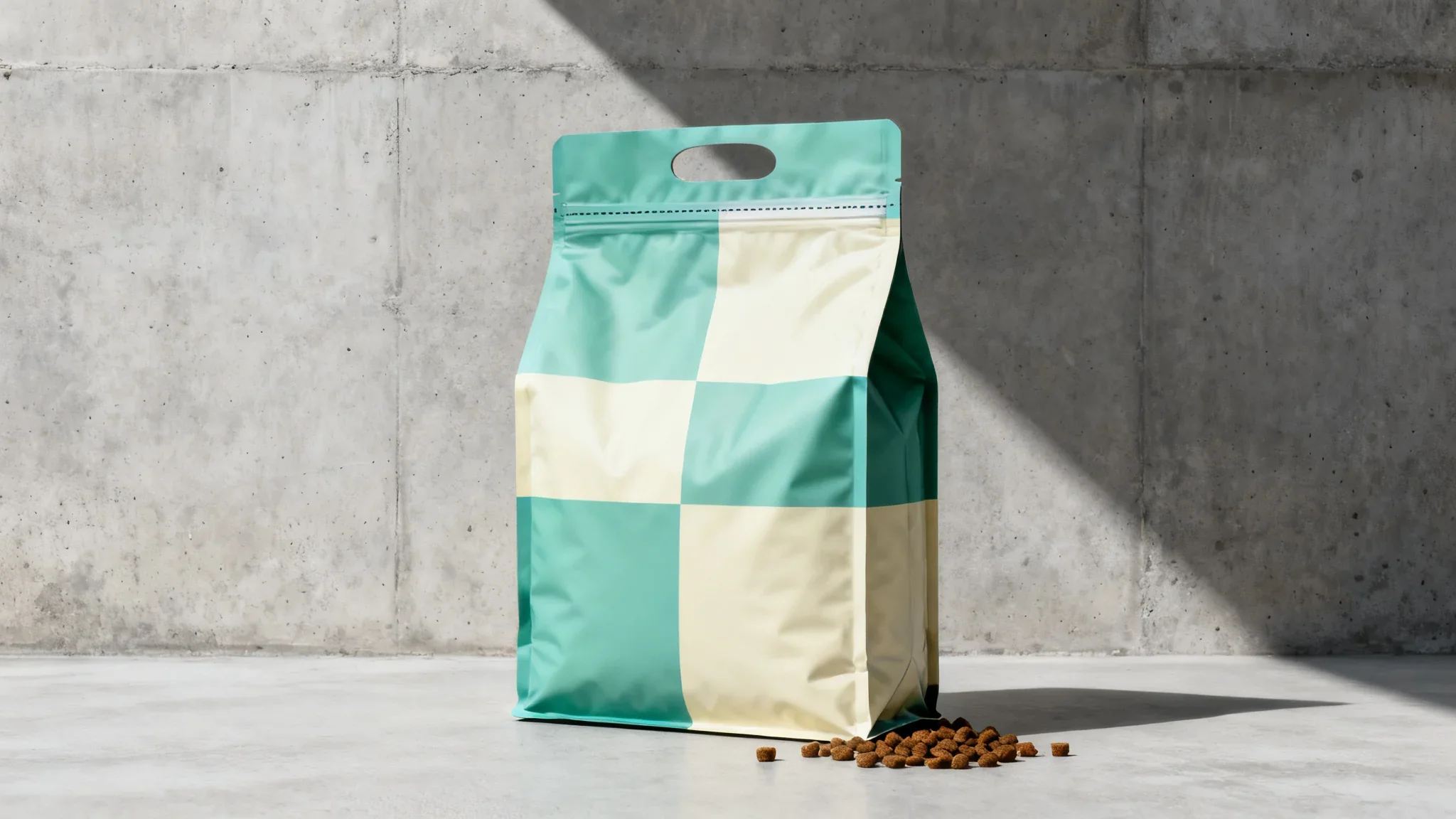
A flat bottom pet food bag carries two loads at once: the kibble inside and the shape the pack has to hold on a shelf or pallet. Between 1 kg and 10 kg the second job changes faster than most buyers expect. The same box-pouch construction that stands neatly at 2 kg can sag at the gusset, tear at the handle or split a corner weld at 10 kg. The differences come from film stiffness, gusset geometry, seal width and how the bag is filled, not from one headline figure on a data sheet.
How Much Does Kibble Weight Change the Bag Specification?
Weight alone does not set the bag size, because kibble bulk density moves a lot between recipes. A light, porous extruded kibble takes far more volume per kilo than a dense pellet, so two 10 kg fills can need different bag bodies. The practical start is a measured bulk density from the actual product, taken after cooling and before packing. From that figure the fill volume follows, and the body is sized with headspace for the product column and the seal zone. A specification written from weight alone usually ends up too tight at the seal or too loose to stand.
Side Gusset and Bottom Seal: Where the Load Travels
In a box pouch the weight runs down the front and back panels, folds into the side gussets and lands on the bottom panel. The bottom is not a single flat seal: it is folded, welded and folded again, so four corner welds take a stress concentration the panels never see. At 1 kg to 3 kg the film absorbs that. At 8 kg to 10 kg the corner welds are the first place to look, together with the width of the bottom seal. A wider seal and a stiffer outer layer spread the load, and seal strength is checked on the finished bag, not flat coupons. Measurement follows ASTM F88 and should be read alongside drop behaviour, not on its own.
What Handle Type Survives a 10 kg Fill?
Two handle families dominate this format. A die-cut handle is punched through the top gusset, so the film around the punch carries the whole pack; a welded handle strip spreads load along the top seam. Die-cut handles fail at the punch radius, where a sharp inner edge starts a tear that runs down the gusset. Applied handles fail at the bond line when the patch is narrower than the load path. The fix is the same in principle: carry load across the full top width, keep generous material around any cut, and match patch stiffness to the bag body. A static hang test on filled bags shows more than a tensile figure.
How Should the Zipper Be Positioned on a 10 kg Pack?
A press-to-close zipper needs a flat land, a clean track and enough film on both sides. At 10 kg people pour rather than reach in, so placement matters more than type. Setting the zipper below a plain header keeps the top seal intact and leaves a printable band. Setting it at the top edge saves film but leaves a narrow seal above the tracks, which is where leaks start on heavy packs. Slider closures close the full span in one movement; the trade-off is a thicker profile on the filling line. Wide zipper layouts are shown on the dog food zipper quad seal pouch page.
Puncture Risk from Sharp Kibble
Kibble corners and edges are the main mechanical threat to the film, and damage rarely appears where it started. A piece pressed against the film during filling creates a stress point that opens later in the pallet or in a shopping bag. Risk rises with fill drop height, with overfilling that leaves no slack, and at the bottom corners where the film is folded twice. Thicker sealant, a tougher inner layer and a larger corner radius all help, as does slowing the fill so product settles rather than compacts. Slow-rate penetration resistance ranks candidate films and is described in ASTM F1306; passing it does not prove a filled bag survives a pallet, so it narrows the choice before a fill trial.
When to Use This Format and Where It Stops
Use cases for a flat bottom pet food bag sit between roughly 1 kg and 10 kg, where the pack has to stand on a shelf, carry printing on four panels and reopen repeatedly. Below 1 kg a stand-up pouch or three-side-seal sachet is cheaper and fills faster. Above 10 kg the format stops paying: film weight for the load rises quickly, carrying becomes a two-hand job, and gusseted heavy-duty bags take over. The boundary also runs through the filling line. Pre-made box pouches need a filler that opens the gusset and seats the bag; a vertical form-fill-seal line cannot make this shape at all. Where the line is fixed, packaging process instructions for each format are worth reading first.
Pallet, Compression and Drop Testing
Most failures on this format happen after the bag leaves the filler, so transport tests matter most. Compression resistance under a stacked pallet is measured with ASTM D642, and shows whether bottom bags keep their shape long enough for the stack above to stay stable. Drop testing on filled bags exposes corner welds and handles. A practical sequence: fill at production weight, stack to planned pallet height, hold for the expected storage period, then drop from carrying and shelf height. Failures at that stage point to a specific part of the construction, not to the film as a whole.
Conclusion
A flat bottom pet food bag for 1 kg to 10 kg is a load-bearing structure, so the specification has to be built in order. Start from measured bulk density and fill weight, size the body from that volume, then work outward through gusset, bottom seal and handle before choosing a closure. Where recyclability is a requirement, mono-material structures exist, and the recyclable cat food quad seal bag shows the same format built from one material family. Pet food formats and their limits are collected under pet food packaging solutions.
- Measure bulk density and set the fill volume, not the weight alone.
- Check gusset, bottom seal and handle against the load at the top of the range.
- Verify the filled bag in compression and drop before approving artwork.
Frequently Asked Questions
Is there a fill weight where a flat bottom pet food bag stops working?
No single number applies, but the practical ceiling sits near 10 kg. Above that, the film gauge needed to carry the load rises sharply, the handle becomes a two-hand lift, and heavy-duty gusseted bags take over. A flat bottom pet food bag is also limited by the filling line, since the pouch filler has to open the gusset on every cycle. A trial at your intended weight settles it faster than a specification table.
Should a 10 kg bag have a zipper at all?
Only if the pack is opened and closed many times at home. A 10 kg bag is often decanted into a container, and in that case a plain top seal with a tear notch is cheaper and leaves a wider seal area, which reduces leak risk on a heavy pack. If a zipper is required, a slider closure handles the wide span better than a press-to-close track, and the header above it should stay wide enough for the seal jaws to close on flat film.
Why do handles tear before the bag body fails?
Because a handle concentrates the whole load into a small area of film. A die-cut handle pulls on material around the punch, and a tight inner radius starts a tear that travels down the gusset. An applied handle pulls on its bond line instead. Widening the material around the cut, spreading the attachment across the top seam and lifting filled bags by the handle will show the difference.
How do you check whether sharp kibble will puncture the film?
Compare candidate films with a slow-rate penetration test, then confirm on filled bags. ASTM F1306 ranks structures by the energy needed to penetrate a clamped film, which is useful for narrowing the choice quickly. It does not reproduce a pallet full of kibble, so the second step is a fill trial at production weight, stacked and dropped, with bottom corners inspected for pinholes and small splits after the hold period.





