A retort pouch ready meal has to survive a pressure cooker, not just a supermarket shelf. Choosing the format first and then matching the film to a sterilization temperature usually leads to a bag that inflates, leaks at the seal or cannot be loaded into the retort at all. The sequence that works is the reverse: fix the sterilization regime with the food technologist, then pick a film that holds gas barrier after that heat load, then choose a format that fits the filling line and the basket.
Start With the Sterilization Regime, Not the Pouch
The retort cycle sets almost every other variable in the project. Its temperature, hold time and the pressure used to offset internal pressure decide which films survive, how much headspace is needed and whether the pouch can expand without breaking a seal.
Temperatures above 100 °C are reached by applying external pressure, which is why the pouch is handled in a pressurized vessel rather than a water bath. If counter pressure falls below the vapour pressure inside a hot pouch, the seal and the film carry the difference. That is the mechanism behind swollen, split bags in a first trial, and why the cycle and the pouch belong in one specification.
How Does Sterilization Temperature Change the Film Structure?
A film that passes a 121 °C cycle is not automatically suitable for a hotter one. Each retort grade is qualified against a temperature band, and the polypropylene sealing layer, the adhesive and the outer polyester each have a limit.
The properties that matter after the heat load differ from the ones on the room-temperature data sheet. Seal strength, oxygen barrier, flex crack resistance and bond strength all have to be re-checked on a retorted pouch, because a laminate can pass every incoming test and still delaminate in the vessel.
Test methods matter here. ASTM F88 covers seal strength and ASTM F1927 covers oxygen transmission at controlled humidity, which counts because dry-measured barrier values overstate performance for a moist meal.
Headspace and Internal Pressure in a Retort Pouch
Headspace is the working volume that absorbs expansion during heating, and it is usually set by habit rather than by the cycle. A pouch filled too full has nowhere to release pressure and loads the seal directly; too much headspace becomes a moving gas bubble that stresses the same seal in handling.
The headspace figure comes from a trial, not a formula. Fill a short run, retort it with the intended cycle and pressure, then check for paneling, ballooning, seal creep and corner distortion. Steam or nitrogen flush changes the starting atmosphere but does not replace that trial.
Flat Pouch, Stand-Up Pouch or Spouted Pouch?
Format decides how the meal is filled, retorted and opened. Each of three formats has an application window rather than a ranking.
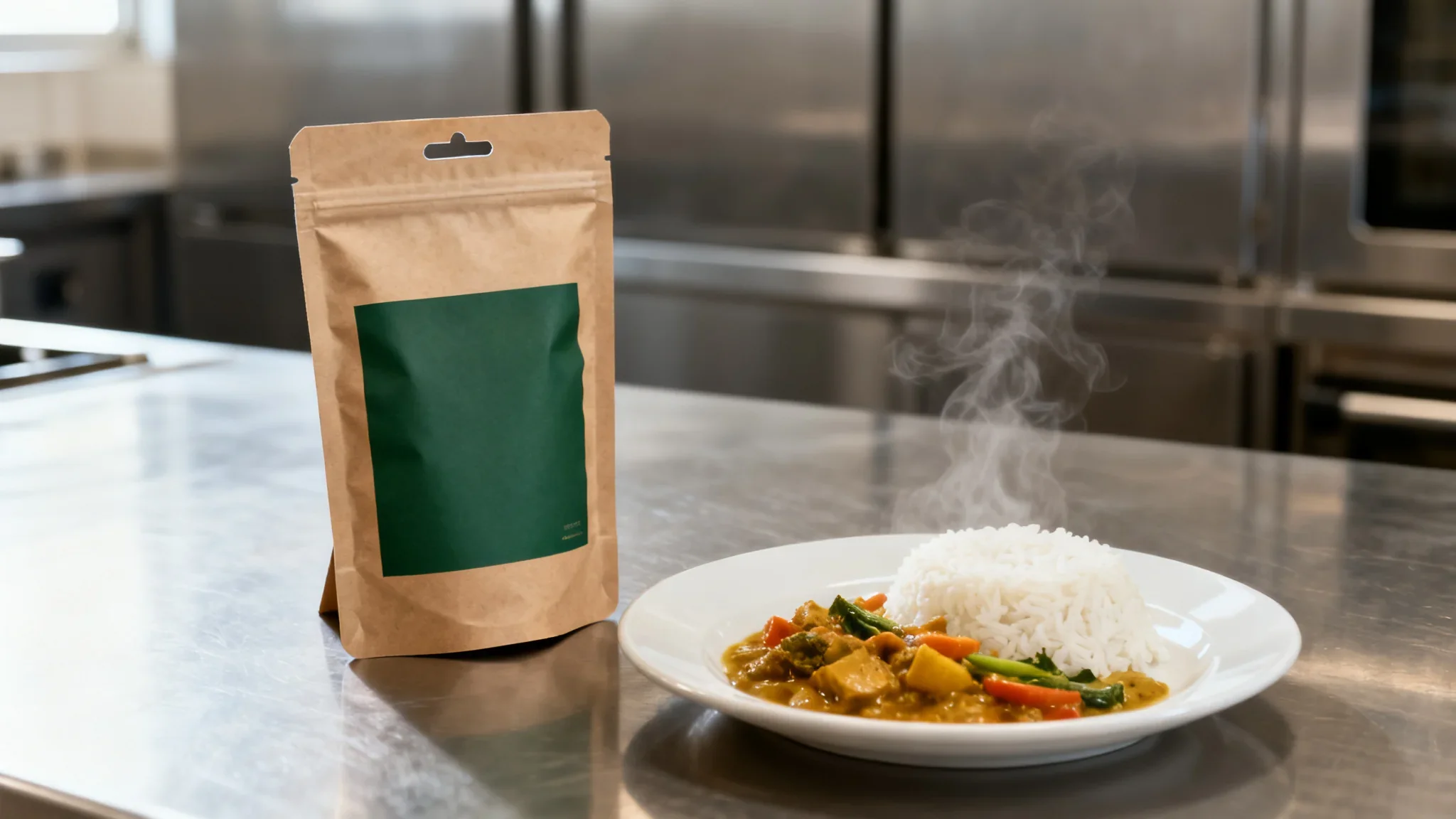
- Flat retort pouch — sealed on three or four sides, no bottom gusset. It lies flat in the basket and suits rice, curry, stew and single-serve portions. Use cases are high-volume lines with tray-based retort crates.
- Stand-up retort pouch — a bottom gusset forms a base after retorting, giving upright shelf presence for meals and soups, but the gusset folds are extra seal geometry to inspect every cycle.
- Spouted retort pouch — a spout and cap for pourable soups, sauces and infant meals. The spout joint is a second sealing interface that needs its own verification.
The boundary sits at the filling line. A format that suits the product may still be rejected because the filler cannot handle it or the crates take flat bags only. See the ready meal pouch options before the trial stage.
What Does the Filling Line Require From a Retort Pouch?
The closing step decides whether the pouch is retort-safe at all. Seals are made under a defined jaw pressure, temperature and dwell, and a seal over a contaminated area fails in the vessel even when it looks clean on the line.
Three conditions recur: product in the seal zone, wrinkles in the seal path and uneven jaw pressure across a wide pouch. Each is a sealing problem rather than a film problem, so the fix sits on the machine. Packaging process instructions cover those closing parameters and the inspection routine.
Which Tests Should Be Run Before Scaling Up?
Sequence the tests so the expensive ones come last. Running them out of order produces results that cannot be interpreted.
- Short retort trial. Confirm the pouch survives the cycle and pressure without paneling, ballooning or seal creep.
- Seal strength after retorting. Measure retorted pouches, not plain samples, using ASTM F88 as the reference method.
- Leak and integrity check. A bubble test such as ASTM D3078 finds pinholes and channel leaks that a visual inspection misses.
- Distribution trial. Drop and vibration on a filled case, not a bare pouch.
Where Retort Pouches Are the Wrong Answer
A retort pouch is the wrong container when the product needs a rigid profile, a resealable wide mouth or a format the retort cannot physically accept. Very large portions and solid pieces that must stay intact through a pressure cycle push the decision toward cans, trays or glass.
Food-contact compliance is a starting condition rather than a differentiator. The laminate has to meet the destination market’s requirements for the intended use, which the converter and buyer settle together; 21 CFR 177.1520 is one reference for olefin polymers in the US market, not a replacement for a project declaration.
Recyclability is a separate trade-off. Monomaterial retort structures exist and they change the sealing window and often the temperature ceiling, so they belong in the same trial plan. Recyclable retort pouch structures show what has been built in that direction.
Conclusion
Fix the sterilization regime first, then the film, then the format, and test in that order. Most failures trace back to a project that picked a bag shape before anyone agreed on the cycle.
- Agree temperature, hold time and counter pressure with the food technologist.
- Select a retort grade qualified for that band and confirm barrier after retorting.
- Choose flat, stand-up or spouted by filling line and retort crate, then trial.
The flexible packaging solutions overview sets out format and material scope by category.
Frequently Asked Questions
Can any flexible pouch be used as a retort pouch ready meal pack?
No. A retort pouch ready meal pack needs a film qualified for the cycle’s pressure and temperature, plus a seal that holds under counter pressure. Standard snack or frozen laminates survive the fill but fail in the vessel, because their sealing layer softens above the boiling point. Ask the converter for a retort grade and for test data measured on retorted pouches. A room-temperature data sheet proves nothing about a bag that has been through the vessel.
Does a retort pouch have to be flat to work in a retort?
No, but flat pouches are easier to load. A stand-up retort pouch works when the basket and tray are designed for its gusset, and the folded base has to be inspected each cycle because it is additional seal geometry. The retort crate decides, not the product style. Before committing to a format, check the crate depth, the way pouches are stacked and whether the gusset can sit without being pressed by the layer above it.
Why do retort pouches swell or burst during the cycle?
Counter pressure was too low for the internal vapour pressure of that product. When external pressure drops below the pressure inside the hot pouch, the difference is carried by the seal and the film, and the weakest point gives way. The fix usually sits in the retort recipe rather than in the laminate. Review the pressure ramp, the dwell at peak temperature and the cooling sequence, then repeat the trial with the same pouch batch so the comparison stays valid.
What should be checked on a retort pouch sample before approving it?
Start with the seal after retorting, not before. Inspect the seal path for channels and product inclusion, measure seal strength on retorted samples, then run a bubble leak test. Barrier and bond strength come next, because heat and moisture change what the film data sheet reports. Finish with a filled-case drop test, since a pouch that passes on the bench can still fail once its case is handled.