





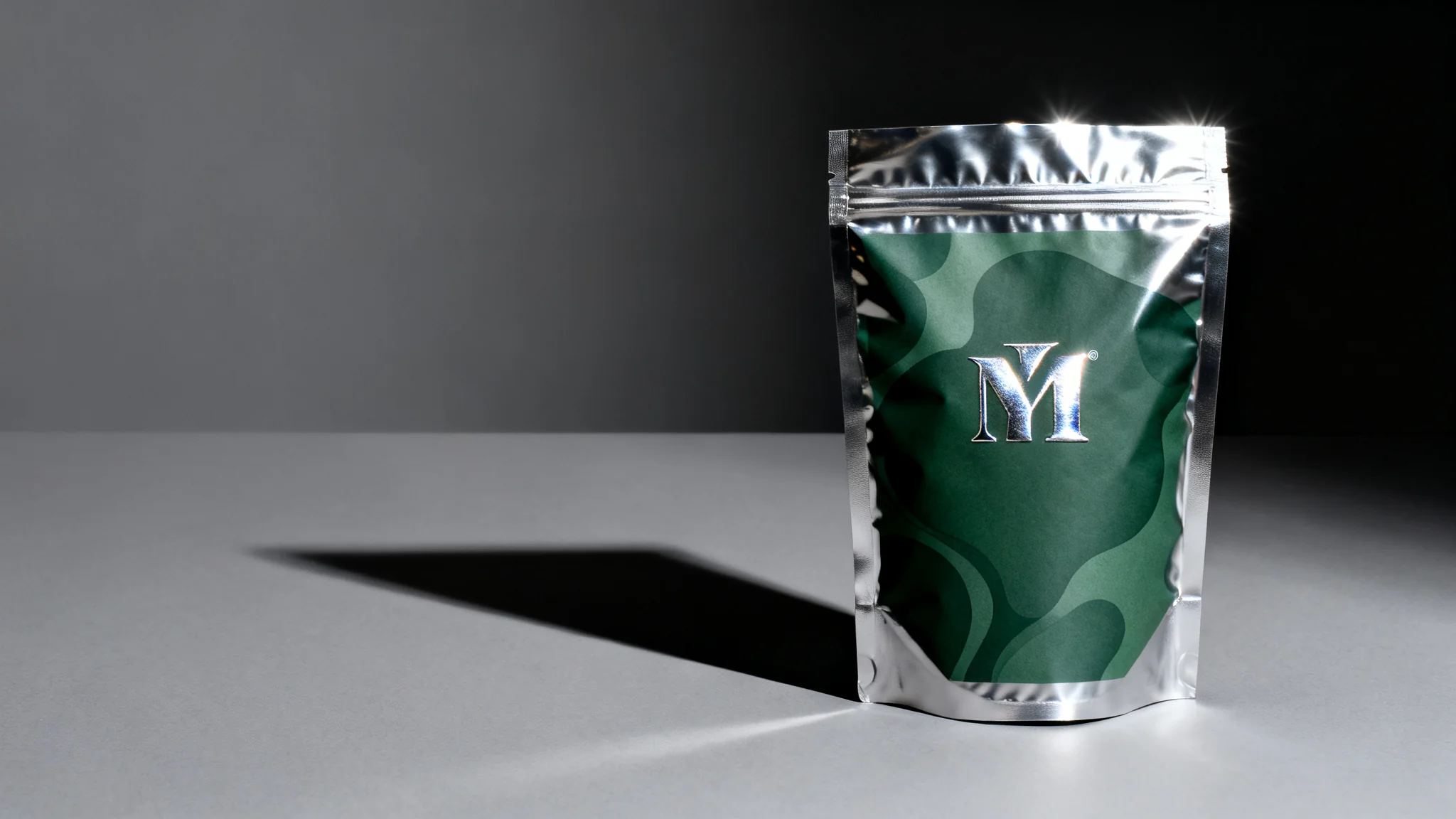
Cold foil packaging applies a metallic layer to a printed surface in one press pass, and the decision that follows is usually about where that metal belongs. Cold foil runs in-line on a flexographic press: a UV-curable adhesive is printed where the metal should sit, foil is pressed against it under a nip, the adhesive cures, and the carrier film peels away. The exposed foil is then overprinted with process colour. The result reads as metal on the shelf without a separate stamping step, and that single fact drives most of the cost and process consequences.
How Cold Foil Transfer Works on a Printed Pouch
The sequence is fixed: adhesive plate, foil nip, UV cure, strip, then print. Because the adhesive is printed, its plate carries the artwork shape instead of a solid patch, so the metallic area is defined by a print station rather than a heated die.
That order explains a practical rule. Foil sits below the ink, so any colour printed over it must be transparent enough to let the metal read through. Heavy opaque white kills the effect; a translucent tint keeps it. On custom printed pouches the usual layout puts the metallic accent under a brand mark or a seal device, with surrounding panels printed on plain film.
Cold Foil Versus Hot Stamping
Hot stamping presses a heated die against foil and film together and transfers metal by heat and pressure; cold foil transfers by adhesive and cure. The difference shows in edge sharpness, substrate tolerance and tooling.
Hot stamping holds fine detail. A heated die carries hairlines, small reversed type and tight serifs that an adhesive plate and anilox cannot reproduce as consistently, so artwork built on type reversed out of the metal at small sizes belongs there.
Cold foil wins on substrate breadth and tooling. It runs on the same press, holding registration in one pass with no separate die to buy or store. On short runs the stamping die cost is heavy per unit; on long runs the gap narrows.
Spot UV: Gloss Without Metal
Spot UV lays a clear varnish through a printed plate and cures it to a raised gloss. It adds depth against a matte varnish but produces no metallic reflection, so it is a different tool, not a cheaper substitute. A common pairing is cold foil for the metallic area with spot UV registered over it.
It fails predictably: coverage too thin reads patchy under raking light, and varnish over a fold or seal zone cracks. Keep it off the seal area and off tight radii.
What Resolution and Substrate Limits Apply to Cold Foil?
Resolution is set by the adhesive plate and the anilox that meters it. A coarse anilox lays down more adhesive and gives a more solid metal with coarser edges; a fine anilox sharpens edges and thins the layer. Every extra demand on edge quality costs a plate revision and a set-up, which is why artwork is simplified before a foil job is quoted.
Substrate matters more than buyers expect. Cold foil needs a smooth, well sealed print surface; on a porous or textured stock the adhesive sinks in and the transfer turns ragged. Coated films and paper-faced structures transfer cleanly, while uncoated kraft returns a duller, broken metal.
Overlamination and Scuff Resistance
Bare cold foil scuffs. Metal on the outside of a pouch meets conveyor rails, carton edges and handling before it meets a shopper, and a scratched accent reads as a defect. An overlaminate or a full surface varnish is the usual answer, and the choice changes both sheen and abrasion result.
Test rather than assume. Abrasion resistance of printed material is measured by rubbing a loaded specimen and reading the damage, described in ASTM D5264, and foil adhesion to the ink or film beneath is rated with a tape pull per ASTM D3359. Order both on the finished structure, not on a lab sample of the same film.
Which Cost Drivers Matter Most?
Foil consumption tracks metallic area, not pouch count. A large solid panel uses far more carrier length per impression than a small logo, and the carrier cannot be reclaimed. Artwork that opens the metal with a line pattern or a small mark cuts that line directly.
Plate count is the second driver. Each foil colour needs its own adhesive plate and station, so two metals mean two plates, two foils and two registration targets. Press time is the third: added stations slow the run, and start-up waste rises because foil needs more impressions to reach stable register.
Quote the same artwork three ways: cold foil, hot stamping, and spot UV alone, on identical film and quantity. Review the die line against a packaging knowledge base before the quote goes out.
When to Use Cold Foil and When to Skip It
Use cases for cold foil are narrow but clear: a metallic brand mark on a printed pouch, a premium line sitting beside a competitor’s foil pack, and jobs where one press pass beats a second operation. It suits medium and long runs on coated film or paper-faced structures, where registration matters more than hairline detail and foil station layout is reviewed on custom printed food grade film.
The boundary sits on the other side. Skip it when the artwork depends on fine reversed type inside the metal, when the pouch is handled hard with no overlaminate, or when the metallic area is too small to justify a foil station. If the metal only has to add shine, spot UV carries the intent at lower complexity.
Conclusion
Cold foil is a press decision before it is a design decision. It transfers metal by adhesive and cure, holds registration in one pass, and gives up edge sharpness to hot stamping in exchange for tooling economy.
Three checks settle most briefs:
- Compare the artwork’s edge detail against what an adhesive plate can hold.
- Confirm the structure and its overlaminate before approving a sheen.
- Quote cold foil, hot stamping and spot UV on identical terms, on the same film.
Structures that carry a metallic accent, such as a quad seal coffee pouch, show how foil, matte varnish and film stiffness interact.
Frequently Asked Questions
Is cold foil packaging food safe?
Yes, when the foil system and its adhesive are cleared for the intended contact. Cold foil packaging keeps the metal on the external print surface, but the adhesive and any overprint varnish still fall under food-contact rules wherever migration is possible. In the United States, adhesives and components of coatings used on food packaging are covered by 21 CFR Part 175; in the EU the converter works from the framework regulation and national lists. Ask for adhesive and varnish declarations for the exact structure rather than a generic foil data sheet.
Can cold foil and hot stamping run on the same pouch?
It can, and the usual reason is detail. Hot stamping holds small reversed-out type and hairline rules that an adhesive plate struggles to reproduce, while cold foil carries broad metallic panels in the main press pass. Running both means two tooling sets, two registration targets and a slower press, so each element should justify itself separately. If the stamping is there for one small mark, check whether that mark can be simplified into the cold foil plate.
Why does the foil look dull after lamination?
The overlaminate is usually the cause. A matte laminate over cold foil scatters reflection and reads grey rather than metal, and a heavy laminating adhesive can bury the surface texture of the foil. Gloss laminate keeps the metal bright but shows scuffs sooner. Ask for a laminate sample over the actual foil on the actual film, and judge it at the angle the pack is seen on shelf instead of flat under a desk lamp.
How much foil area should a pouch design use?
Keep the metallic area to the part that carries meaning. Foil consumption follows the printed adhesive area, so a large solid panel costs more per impression than a small mark and rarely reads better on shelf. A line pattern, an outline or a single brand device delivers the metallic cue at a fraction of the carrier length. Where the design does need a wide bright field, confirm the cost before the artwork is finalised.





