





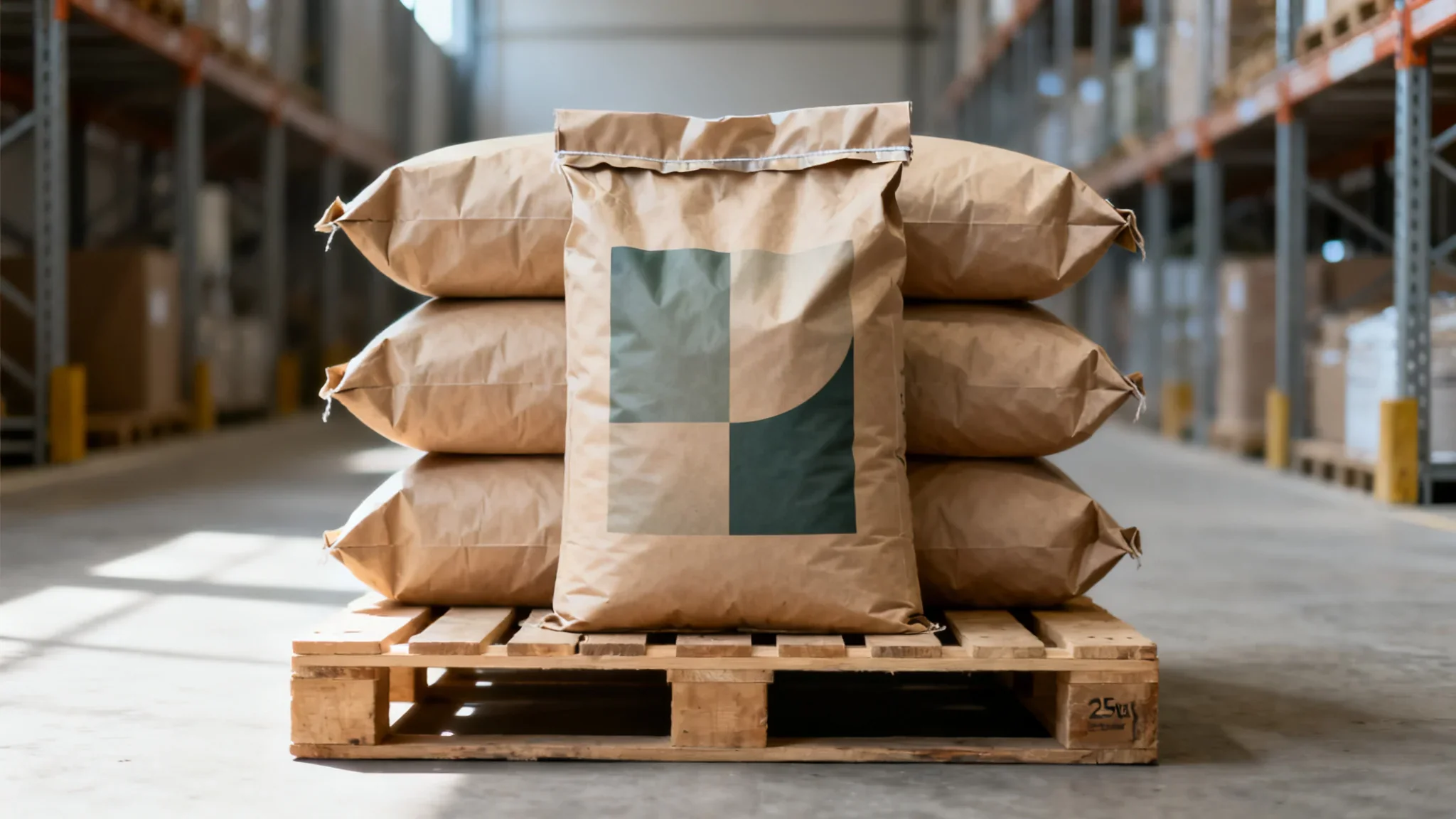
A fertilizer packaging bag has to do two jobs that pull against each other: keep moisture away from a hygroscopic salt, and survive 10 kg to 25 kg of dead weight through palletising, stacking and transport. The structure that solves both is decided by fill weight, product chemistry, storage climate and handling — inputs the buyer usually already has. This guide settles the film, seal, handle and label decisions in that order.
Why Moisture Control Comes Before Print or Cost
Urea, ammonium nitrate and most NPK blends pull moisture from the air. Absorbed water dissolves surface granules, and on drying the salt recrystallises into bridges between particles. The result is a bag of hard lumps that will not flow through a spreader.
Three paths admit moisture: transmission through the film, channels along a contaminated seal, and flex cracks at gusset folds after handling. Transmission is the one buyers measure, and ASTM F1249 is the water vapour transmission rate test that makes candidate structures comparable. Seal channels and flex cracks are cheaper to prevent and more common in complaints. Settle barrier first: no print specification compensates for a bag that cakes in the warehouse.
Film Structures for 10 kg to 25 kg Bags
Use cases for a heavy fertilizer bag are narrow enough that three structures cover most enquiries. Coextruded PE is the baseline — good moisture barrier for its thickness, low cost, enough elongation for a drop. BOPP/PE adds a printable surface and stiffness for retail packs. PET/PE, or PET/metallised PET/PE in humid climates, raises barrier and cost together.
Thickness follows two variables: fill weight and product sharpness. Granular fertilizer is not aggressive; prilled product with hard edges is. The boundary sits on the other side for paper-look laminates. They print well and suit retail shelves, but the paper layer carries no barrier, so the PE liner does all the work. Agricultural product packaging built on these laminates shows how much of the structure is decided by the product rather than the print.
What Changes When the Product Is Hygroscopic?
Hygroscopic product changes the filling line, not the film alone. Fertilizer often leaves the cooler warm, and warm product sealed into a bag releases moisture into the headspace as it cools. That vapour condenses on the inner film and runs down to the base of the bag, which is why caking complaints start at the bottom.
The controls are product temperature at the filler, headspace volume, and how long a bag sits before palletising. Measure product moisture at filling, then repeat after two weeks in storage; the difference shows whether the film is working or the fill temperature is.
Seal Zone: Dust, Fines and Jaw Contamination
A bag usually fails at the seal before anywhere else, and the cause is product sitting in the seal area. Fines cling to the film as the bag leaves the filler, a jaw closes over them, and a channel a few millimetres wide stays open. The bag holds at first and leaks once the pallet is compressed.
The fix is mechanical: an air knife at the bag top, a short settling distance between fill and seal, and jaw pressure set for the film in front of you, not the previous job. Seal strength is verified with ASTM F88 peel testing on production samples.
Handle and Pallet Handling for Heavy Bags
A die-cut handle removes film exactly where the top seal needs it most. On a 20 kg bag the carry load concentrates at the two ends of the cut, and that is where splits begin. Three options manage it: a handle punched above a full-width seal with a reinforced patch, a separate handle film welded across the top, or a shaped top spreading load over a wider radius.
Stacking adds a different load. Bags slide when surface friction is low, and a leaning pallet starts as a slip at the second layer. ASTM D1894 measures film friction and ASTM D642 covers compressive resistance of the loaded container; ask for both when the pallet will be double-stacked. This handle quad seal bag shows how handle geometry and seal land are traded off.
Can a Heavy-Duty Bag Be Vented Without Losing Barrier?
Yes, when the vent is one-way and sized to actual gas flow. Venting is justified when the product releases gas after filling, or when bags cross pressure changes and arrive ballooned.
Micro-perforation is the cheapest vent and the worst choice for a hygroscopic salt, because it admits moisture in both directions. A one-way valve lets gas out and limits vapour ingress, at extra cost per bag and one more element on the artwork. Confirm the cause first: ballooning is often trapped fill temperature rather than gas, and cooling the product removes it at no material cost. Seal performance for the finished pack is checked in the same production process as the lamination.
Which Label Details Must the Buyer Confirm Locally?
The converter prints what the buyer approves; the buyer owns the content. Nutrient declaration, net mass, batch code, manufacturer and importer details, and hazard pictograms where the market requires them fall under local fertilizer or chemical control rules that differ by country.
A converter can check registration, contrast and code readability but cannot certify that a declaration satisfies a national register. Send approved artwork with the destination market named, and keep variable data — batch, date, QR — on a separate layer so a coding change does not trigger a plate remake. Custom pouch programmes run artwork approval as its own gate for this reason.
Conclusion
Three decisions carry most of the risk in a fertilizer packaging bag project, and they are cheaper to settle in sequence than to correct afterwards.
- Fix the barrier from product chemistry and storage climate, then confirm it with a water vapour transmission rate test on the proposed laminate.
- Size the structure and handle from fill weight and handling, including pallet compression and surface friction.
- Settle seal, vent and label content before artwork approval, so the print run carries no open question.
Each step narrows the next, and trials that fail usually started from a film sample rather than from the product.
Frequently Asked Questions
How much moisture protection does a fertilizer bag actually need?
Two variables set it: the salt and the storage climate, not the bag format. A fertilizer packaging bag for urea or an ammonium nitrate blend needs a higher moisture barrier than one for an inert filler, because those salts absorb water and then cake. Ask for the water vapour transmission rate of the proposed laminate, tested to ASTM F1249, and compare candidates on that basis. An unconditioned store in a humid climate changes the requirement more than a thicker film does.
Is a PP woven bag still right for 25 kg of fertilizer?
Often yes on cost, but the woven fabric is not what protects the product. Woven PP gives tensile strength and stackability, while a loose LDPE liner inside provides the moisture barrier, and the liner thickness plus the way its ends are closed decides real performance. If the liner is thin, open at the top, or punctured by the woven texture, moisture reaches the product regardless of the outer bag. For retail packs up to 10 kg, a laminated film bag removes the liner step entirely.
Why do bags split at the handle rather than at the seal?
Because the handle cut interrupts the seal land and concentrates load at two points. On a filled 20 kg bag, every lift transfers the full weight through the film left beside the cut. A patch, a separate handle film, or a wider radius at the cut ends spreads that load. Seal splits usually point elsewhere: product in the seal zone, or jaw temperature left from the previous job. Look at where the failure starts before changing the film.
What should be checked on the first pallet of a new bag?
Seal integrity, filled dimensions and stack stability, checked on that first pallet before the container ships. Measure filled thickness against the specification, because a bag that fills thicker than planned will not reach the pallet height. Pull samples for seal strength and check a few bags for product inside the seal area. Double-stack the pallet for a shift and watch for lean or slip at the second layer. Catching these on pallet one costs far less than a claim.





