





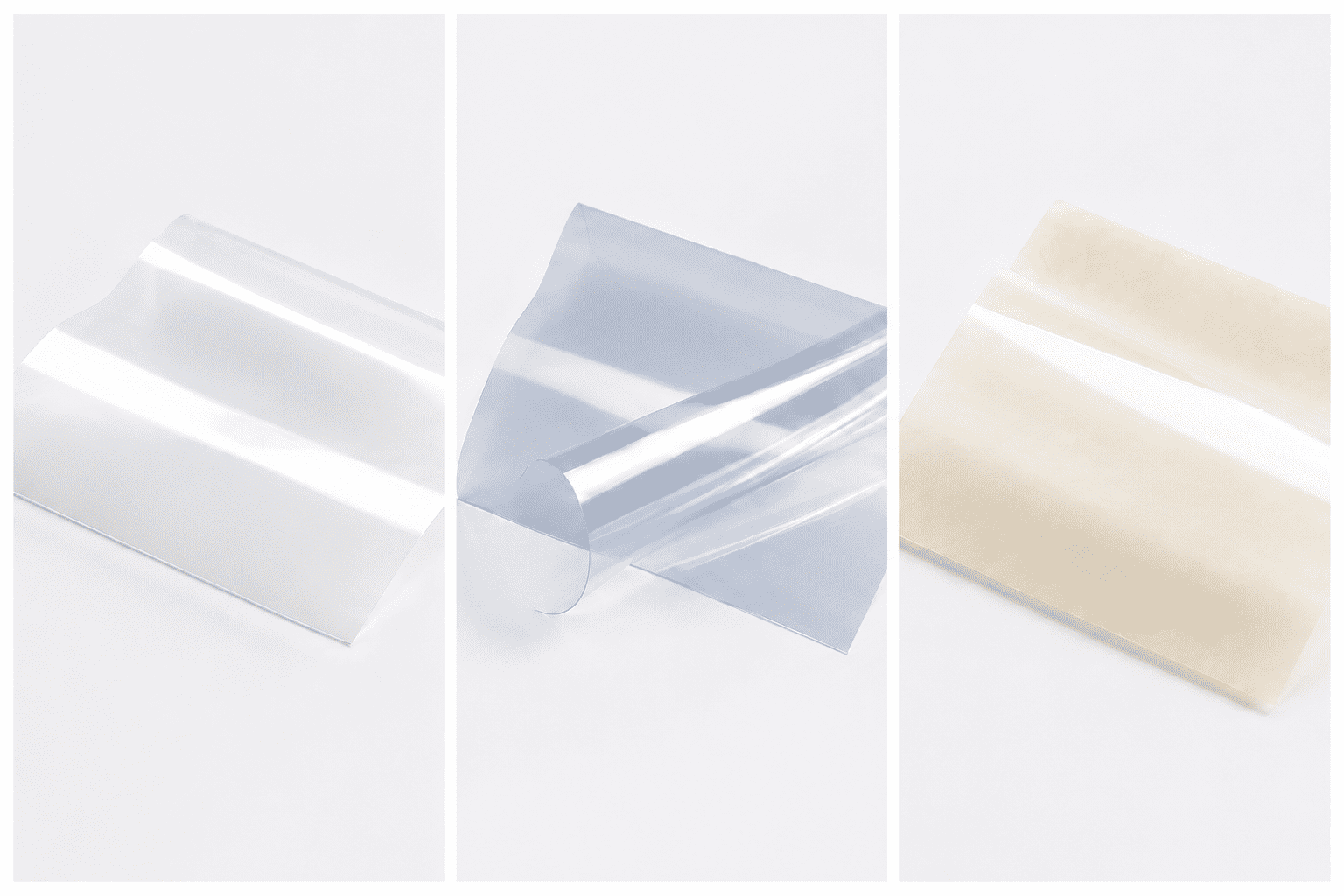
A food packaging pouch may look like just a bag, but what truly affects product freshness, sealing, presentation, and transport safety is often the choice of packaging material. Different foods have different packaging requirements—for example, nuts care more about moisture barrier, coffee about barrier and degassing, frozen food about low-temperature resistance, and snack packaging about print quality and shelf display.
For brands, choosing the right food packaging material is not just about “holding the product,” but about keeping the product in better condition throughout storage, transport, sales, and consumer use.
1. PE Material: Flexible, Commonly Used for Inner-Layer Heat Sealing
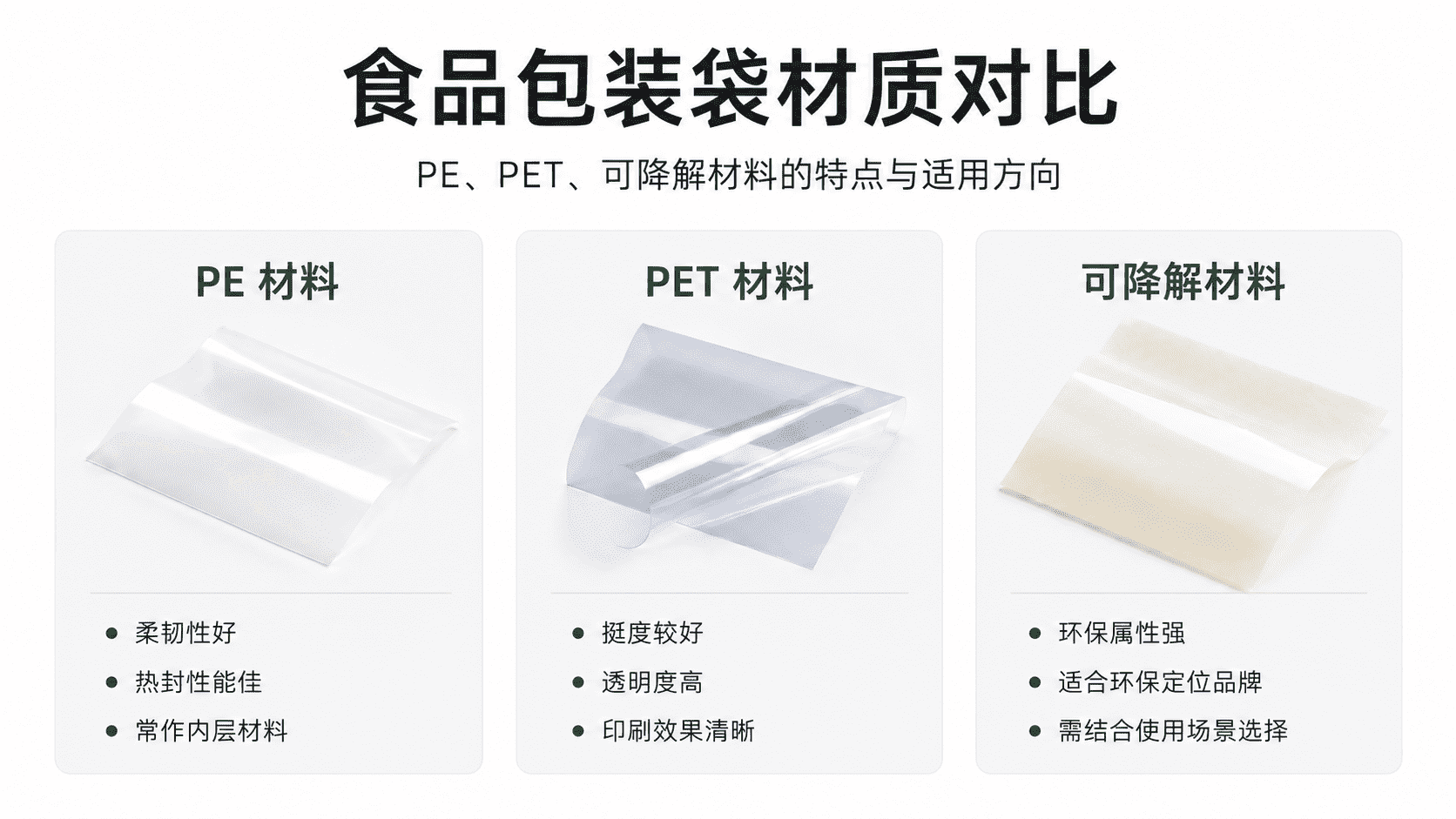
PE is a very common material in food packaging, offering good flexibility and heat-seal performance. Many laminated food packaging pouches use PE as the inner-layer material because it helps the pouch achieve a good seal.
PE is suitable for snacks, nuts, seasonings, pet food, frozen food, and similar packaging applications. Its advantages are a soft feel, stable sealing, and wide applicability, but its barrier performance is relatively limited when used alone, so in many food packages it is laminated with PET, PA, VMPET, AL, and other materials.
Common applications include:
- Inner layer of food stand-up pouches
- Inner layer of three-side seal food pouches
- Inner layer of flat-bottom nut pouches
- Frozen food packaging pouches
- Pet snack packaging pouches
If the product has high requirements for moisture barrier, oxidation resistance, or light protection, using single-layer PE alone is generally not recommended; instead, choose a laminate structure based on the product’s properties.
2. PET Material: Good Stiffness, Clear Print Results
PET is one of the common outer-layer materials in food packaging pouches. It features good stiffness, high transparency, and stable print performance, making it suitable for food packaging that requires strong visual presentation.
Many food pouches use PET for the outer layer because it keeps the print layout flatter and makes patterns and text appear clearer. For DTC brands, e-commerce foods, premium snacks, coffee, and tea, PET can enhance the overall quality of the packaging.
Common PET advantages include:
- Clearer printed graphics
- Better pouch stiffness
- More stable surface texture
- Suitable for laminating with various functional materials
- Suitable for gloss and matte surface finishes
For example, a nut flat-bottom pouch can use a PET / VMPET / PE structure, with the outer layer handling print presentation, the middle layer improving barrier performance, and the inner layer responsible for heat-seal sealing. This ensures both appearance and food preservation needs.
3. Biodegradable Materials: Suitable for Eco-Positioned Brands, but Consider the Actual Use Case
As demand for eco-friendly packaging grows, biodegradable food packaging is drawing increasing attention from brands. Biodegradable materials are typically suitable for lightweight food packaging, single-use packaging, short-cycle use cases, and brand products that emphasize environmental concepts.
However, biodegradable materials are not a universal substitute for all food packaging. Different biodegradable materials vary in heat resistance, barrier properties, strength, heat-seal stability, and cost. If the product itself requires a long shelf life, high barrier, moisture resistance, oil resistance, or frozen storage, the material structure must be evaluated against actual needs.
Products worth considering for biodegradable packaging include:
- Light meals
- Bakery products
- Dry-goods small packs
- Eco-brand trial sizes
- Single-use food packaging
- Some short-shelf-life food packages
If a brand focuses on an eco concept, biodegradable packaging can help enhance brand image. But before formal mass production, we recommend prototyping and testing first to confirm that the packaging’s strength, sealing, print, and storage performance meet product requirements.
4. How Different Foods Should Choose Packaging Materials
Different foods have different functional requirements for packaging pouches; material selection should consider neither price alone nor appearance alone.
1. Nuts and Dried Fruits
Nuts and dried fruits easily absorb moisture and are also affected by oxygen. The pouch should focus on moisture barrier, barrier properties, and sealing performance.
Recommended directions:
PET / VMPET / PE, PET / AL / PE, PET / PE, and other laminate structures.
Suitable pouch formats:
flat-bottom pouch, stand-up zipper pouch, three-side seal pouch.
2. Coffee Packaging
Coffee requires high barrier performance, especially to reduce the impact of oxygen, moisture, and light on coffee flavor. For coffee bean packaging, a one-way degassing valve design can also be added.
Recommended directions:
PET / AL / PE, PET / VMPET / PE, kraft paper / VMPET / PE.
Suitable pouch formats:
flat-bottom coffee pouch, stand-up pouch, gusset pouch.
3. Chips and Puffed Snacks
Chips and puffed snacks need a certain level of barrier performance in the packaging, along with good display effect. Rollstock film packaging and center-seal pouches are common choices.
Recommended directions:
PET / VMPET / PE, BOPP / VMPET / PE.
Suitable pouch formats:
center-seal pouch, rollstock film packaging, pillow pack pouch.
4. Frozen Food
Frozen food packaging needs to address low-temperature resistance, puncture resistance, and seal stability. If the packaging becomes brittle in low-temperature environments, it may affect transport and storage safety.
Recommended directions:
PET / PE, PA / PE, and other laminate structures.
Suitable pouch formats:
three-side seal pouch, four-side seal pouch, stand-up pouch.
5. Pet Food and Pet Snacks
Pet food packaging typically has high requirements for load-bearing, sealing, moisture barrier, and puncture resistance. For large-capacity packaging, pouch thickness and bottom structure must also be considered.
Recommended directions:
PET / PE, PET / VMPET / PE, PET / AL / PE.
Suitable pouch formats:
stand-up zipper pouch, flat-bottom pouch, large-capacity flat-bottom pouch.
5. Core Logic of Food Packaging Material Selection
When selecting food packaging materials, you can start by answering the following questions:
First, is the product sensitive to moisture?
If the product easily absorbs moisture, choose a composite material with better moisture barrier performance.
Second, is the product sensitive to oxidation?
If the product easily oxidizes and spoils—such as nuts, coffee, and tea—a higher-barrier structure should be considered.
Third, does the packaging need light protection?
If the contents are light-sensitive, consider adding metallized or aluminum foil materials.
Fourth, does the packaging need to convey quality?
If the product targets the premium segment, visual effects can be enhanced with a PET outer layer, matte film, soft-touch film, spot UV, hot foil stamping, and similar processes.
Fifth, is an eco positioning needed?
If the brand emphasizes environmental concepts, paper-plastic laminate, biodegradable materials, or recyclability can be considered, but this must be evaluated comprehensively against the product’s shelf life and usage environment.
6. Food Packaging Requires the Right Pouch Format, Not Just the Right Material
Material determines the functional foundation of the packaging; pouch format determines its presentation and user experience. Common food packaging formats include three-side seal pouch, stand-up pouch, flat-bottom pouch, center-seal pouch, rollstock film packaging, and gusset pouch.
If the product needs shelf display, choose a stand-up pouch or flat-bottom pouch.
If the product is an e-commerce small pack, choose a three-side seal pouch or center-seal pouch.
If the product requires automatic packaging-machine production, choose rollstock film packaging.
If the product has a larger capacity, choose a flat-bottom pouch or large-capacity stand-up pouch.
Therefore, custom food packaging is not simply choosing one material, but comprehensively determining the packaging solution based on product type, capacity specifications, storage method, sales channel, and brand positioning.
7. Conclusion: The Right Material Makes Food Packaging More Valuable
The material choice for food packaging pouches directly affects product freshness, transport stability, shelf presentation, and consumer experience. PE, PET, and biodegradable materials each have their own characteristics; no single material is definitively better—it depends on whether it suits the specific product.
For food brands, good packaging should simultaneously meet three goals: protect the product, enhance presentation, and help drive sales.
If you are looking for a custom food packaging pouch solution, you can select a more suitable composite material, pouch format, and surface process based on product type, capacity, shelf life, usage scenario, and design needs. A professional packaging factory can also provide one-stop customization—from material recommendations and pouch selection to sampling and mass production—based on samples, artwork, or reference images.
Common Packaging Material Comparison
| Material | Characteristics | Eco-friendliness |
|---|---|---|
| PE | Flexible, low cost | Recyclable |
| PET | Transparent, high strength | Recyclable |
| Biodegradable materials | Eco-friendly, compostable | Biodegradable |
See OMOPACK material knowledge for details.





