





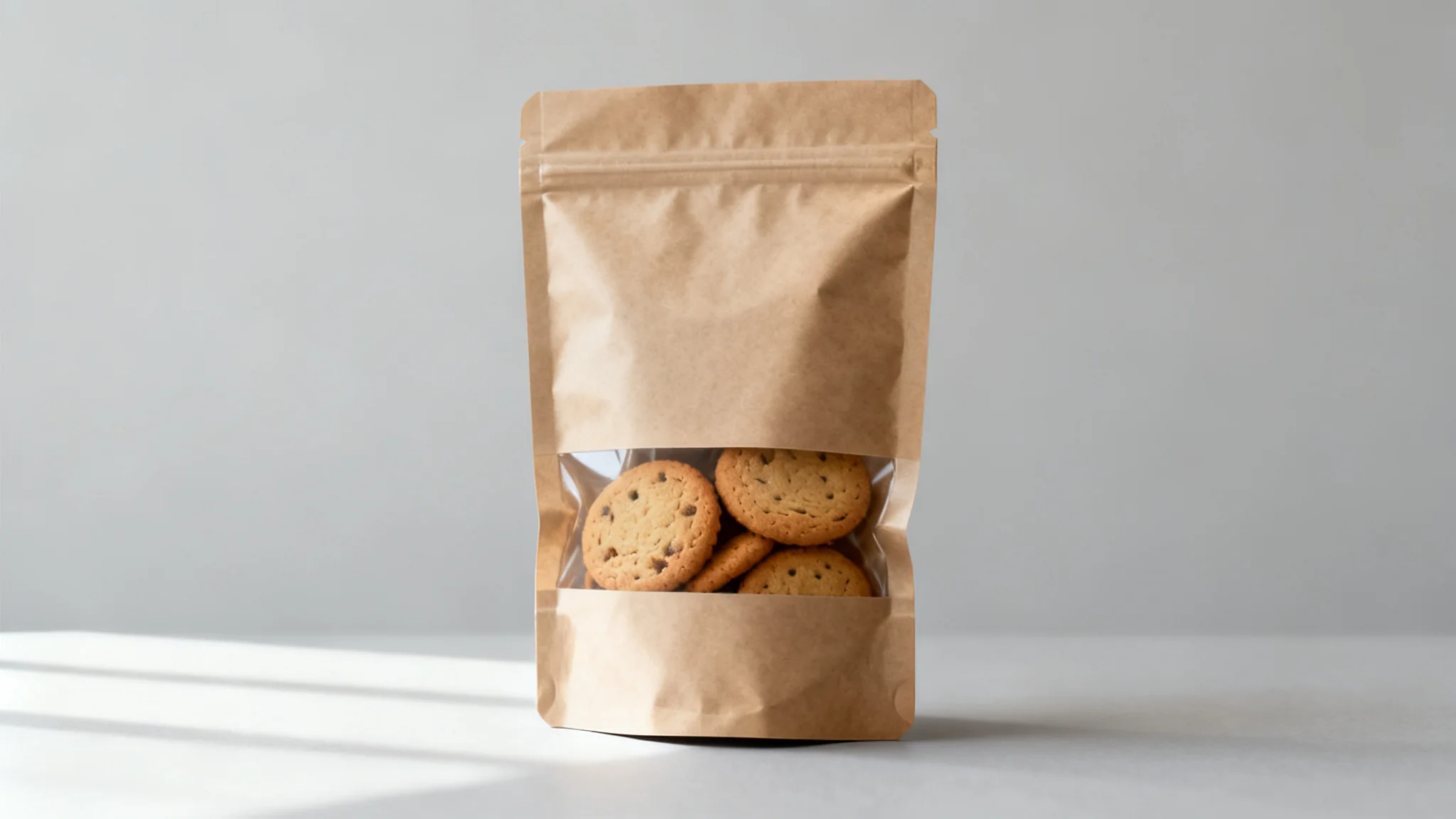
A kraft paper pouch with a clear window sells the product and the material story at the same time, so it appears on more specification sheets than any other paper-based format. The format is simple to describe and harder to specify: a printed paper ply carries the brand, a clear window shows the contents, and an inner sealant layer decides what the pack protects against. Most sourcing problems come from treating those three jobs as one decision. This guide separates them and sets out where the paper and window combination works.
Why Buyers Choose a Kraft Paper Pouch
Unbleached kraft reads as natural, matte and low-ink, which is why it suits organic food, specialty coffee, tea, pet treats and solid personal care items. It prints cleanly in one colour and has enough tear strength that many gauges open without a notch. The texture is the selling point: buyers recognise the surface as paper before they read a word. What they miss is that the visible paper is a minority of the structure by weight once the sealant film is counted, and that the film sets the shelf life. Treat kraft as the outer presentation layer, as in this kraft paper coffee bean pouch for whole bean retail packs.
Which Layer Does the Work in a Kraft Paper Pouch?
Three structures cover most kraft pouch enquiries. Paper/PE is the workhorse for dry goods with a short shelf life: the paper gives stiffness and print surface, the polyethylene gives the seal and a basic moisture barrier. Paper/AL/PE adds foil and is the structure to ask about when contents are sensitive to oxygen, light or aroma, such as ground coffee or nuts. Paper/VMPET/PE sits between the two, with a metallised layer that improves barrier at lower weight than foil. Paper components for food contact are covered in 21 CFR Part 176 and polyolefin sealants in 21 CFR 177.1520, so a US-bound project should be checked against both. Confirm which ply does the barrier work before comparing quotations.
How Is the Window Sealed Into the Paper?
Two executions are common and they behave differently. In the die-cut version the inner sealant film spans the whole front panel and the paper is cut away to expose it; there is no separate window material, so it cannot fall out or peel. In the patch version a clear film is bonded into the opening, which allows a window film with different properties, such as a stiffer or higher-clarity grade. Die-cutting is cheaper and more robust; patching gives more optical freedom. Both create a stress concentration at the window edge, where cracks and leaks begin on a stand-up format. Keep the cut line away from fold lines and the seal zone, and confirm seal settings at the paper-to-film transition.
Where Grease Resistance Breaks Down
Kraft paper is not a grease barrier. Oil migrates through uncoated paper and leaves a translucent stain that reads to a buyer as a defect, even when the pack still protects the product. Resistance comes from the film ply, a dispersion coating, or a grease-resistant paper grade, and each carries a different cost and recycling consequence. The weak point is the cut edge of the window, where grease wicks along exposed fibres and appears as a ring around the opening. For fried snacks, high-fat chocolate or pet treats with rendered fat, test the finished pouch rather than the flat laminate. ASTM F119 covers grease penetration rate and is the method worth agreeing with a converter.
Moisture and Oxygen Limits You Should Plan For
Paper takes up moisture from the air, and a damp ply loses stiffness, cockles and weakens at the seams. That is why the paper in a kraft pouch is always backed by film, and why the paper side faces outward. Moisture vapour transmission is measured on film with ASTM F1249, but the figure that matters is the finished structure, window and seals included. Oxygen follows the same logic: a foil ply changes the answer by orders of magnitude, while polyethylene barely restricts oxygen at all. Ask for barrier data on the finished structure, at the thickness and window size you intend to buy.
Is a Kraft Paper Pouch Recyclable?
Usually not in a standard paper stream, and any claim should name the stream. A paper/PE laminate has to be separated before the fibre can be repulped, and most mills treat film-laminated paper as a contaminant, so a pouch in a paper bin can downgrade the batch. Some mills accept fibre-based packaging with a defined polymer content, and acceptance varies by country. A window sharpens the question, because that area is pure film with no fibre to recover. Where recycling matters, the defensible options are a mono-material paper structure, a fully certified compostable structure, or a clear statement of the intended stream; these recyclable and compostable pouch formats show what currently exists.
When Should You Use a Windowed Kraft Pouch Instead of a Fully Printed One?
Use cases for the window are products that have to be seen: cookies with inclusions, freeze-dried candy, loose tea, granola, dried fruit, or a snack where colour is the promise. The boundary sits on the other side. Choose a fully printed pouch when contents are uniform, light-sensitive, or when the front panel must carry regulatory text and a strong brand block. A window costs printable area and adds a film edge, so it earns its place only if seeing the product closes a sale. On a first production run it also exposes fill-level problems that a printed pouch hides. Typical fits are three-side-seal window pouches for freeze-dried candy and the wider candy and snack packaging range built on the same structure.
Conclusion
A kraft paper pouch with window is a presentation decision wrapped around a barrier decision, and the barrier decision determines whether the pack works. The sequence that avoids most rework is short:
- Fix the product’s sensitivity to moisture, oxygen, grease and light.
- Select paper/PE, paper/VMPET/PE or paper/AL/PE against that list.
- Decide whether the window is die-cut into the sealant film or patched in.
Then confirm the seal at the window edge on a filled sample, and name the recycling stream before artwork is signed off.
Frequently Asked Questions
Does a kraft paper pouch with window keep cookies crisp?
No, not on its own. A kraft paper pouch with window keeps cookies crisp only when the inner film provides a real moisture barrier and every seal is intact, because paper itself transmits moisture readily. Paper/PE slows moisture pickup enough for a short shelf life, while paper/AL/PE is the structure for longer distribution. Test a filled pouch rather than trusting a film data sheet, since the window edge and seals decide the outcome more than the flat panel does.
Can the window be added without changing the barrier?
Mostly yes. When the window is die-cut and the existing sealant film runs behind it, the barrier of that panel is unchanged because no material was removed. A patched window does change the structure, since the patch film may differ from the sealant, so barrier has to be assessed again. In both cases the seal around the opening becomes the weakest line and should be checked on a filled sample.
Why does grease show through the paper around the window?
Wicking at the cut edge. Grease travels through exposed paper fibres at the window opening and spreads outward, leaving a translucent ring that appears within days on a fatty snack. The film behind the window may be a good grease barrier while the paper edge still stains. A grease-resistant paper grade, a dispersion coating, or a wider paper margin around the window reduces the effect.
Which structure should be checked first for a coffee pouch with a window?
Start with the degassing requirement. Roasted coffee releases carbon dioxide for days after roasting, so a sealed pouch needs a one-way valve; without one the pack inflates and the seal or the window edge takes the strain. Once valve placement is settled, compare paper/AL/PE and paper/VMPET/PE for oxygen and aroma retention. A window on a valve-equipped coffee pouch is workable, but confirm it on a filled sample before ordering.





