





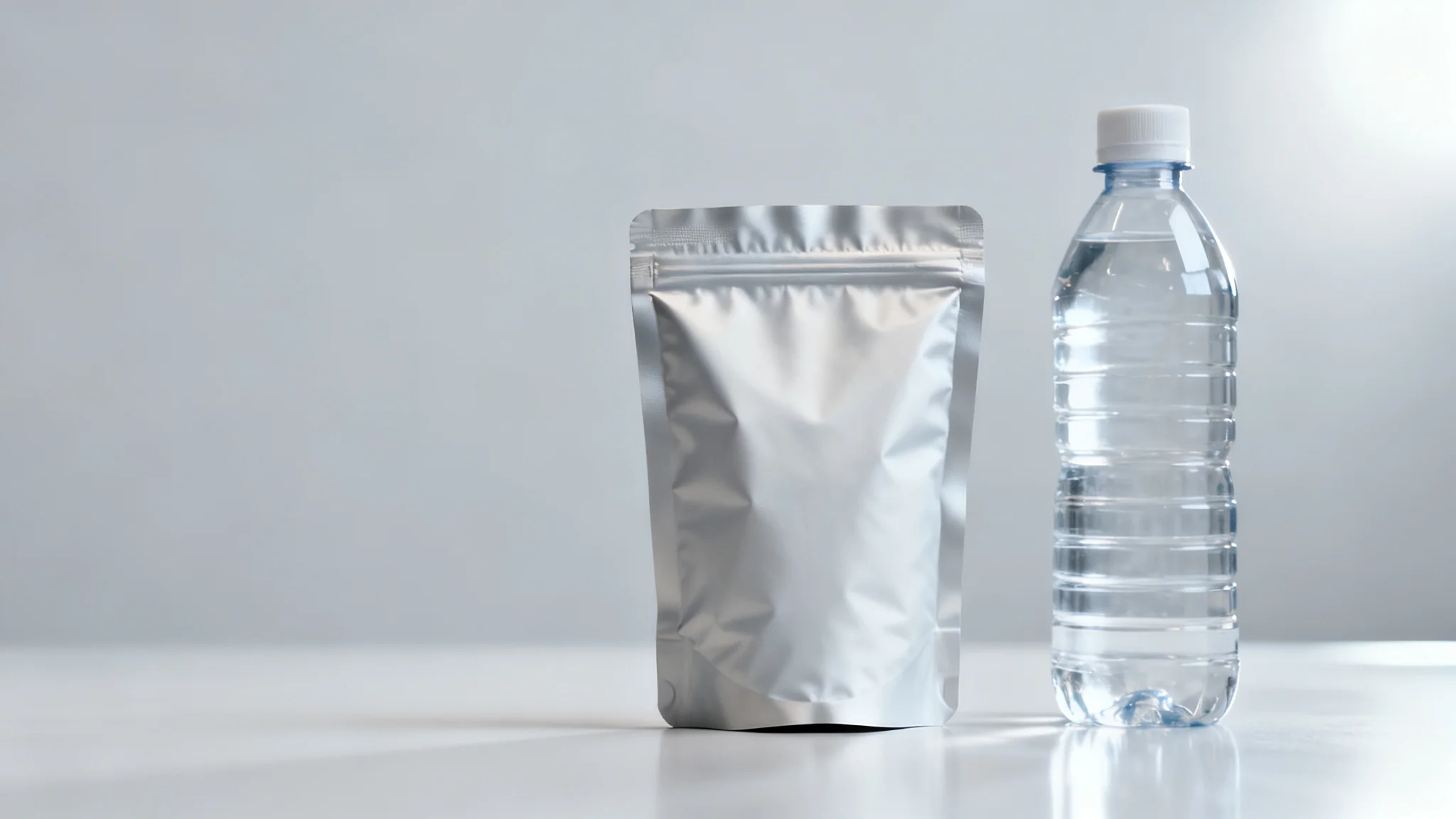
A liquid packaging pouch and a rigid bottle can carry the same product, yet they place the cost in different parts of the chain. The pouch removes container mass and empty-container freight; the bottle removes secondary packaging and most line changeover. Which one costs less per litre depends on fill volume, pallet pattern, filling equipment and retail format, so the decision belongs on cost per filled litre delivered, not on price per unit. The variables below decide which way it goes.
Where the Two Formats Diverge
Both are food-contact containers, and in the United States the polymer components fall under 21 CFR Part 177. The divergence is physical. A pouch is a thin multilayer film sealed into a flexible body; a bottle is a thicker moulded wall of HDPE, PET or PP with a separate closure. That changes how much material travels per litre, how much air moves with the packaging before filling, and how much support the pack needs on a shelf.
Material mass per litre
Because the film wall is thin, packaging mass per litre of product is usually lower for a pouch than for a bottle of the same volume. The gap is not a fixed percentage. It depends on fill volume, film structure, closure type and whether the pouch needs a spout, valve or zipper. Small packs erode part of the advantage, because the seal area and the fitment take a larger share of the total material.
Empty volume in the supply chain
Pre-made pouches ship nested and rollstock ships on a core, so a case of empty pouches holds far more packs than the same case of empty bottles. It is the largest logistics difference in the comparison.
Does a Liquid Packaging Pouch Cost Less per Litre Than a Bottle?
Often on material and inbound freight, but not automatically on total cost. Three lines have to be compared together: packaging material per filled litre, freight and storage per filled litre, and the cost of running the filling line. A pouch that wins the first two can still lose the third if the line must be replaced.
The pouch usually takes the material line, and most of the empty-freight line, which is why the format is common for products shipped long distances before filling. The bottle answers with a different advantage: PET preforms are light and dense, so they can be blown close to the filling site, which removes much of the empty-container freight that a simple pack-to-pack comparison assumes. A buyer comparing a locally blown bottle with an imported finished pouch may find the freight gap has largely closed.
Where the pouch is strongest is in formats that already need a fitment — spouted packs for juice, dairy drinks and liquid concentrates. The beverage packaging solutions page sets out how those formats are specified, including the spout and cap combinations that decide pouring behaviour.
Freight Volume, Pallet Yield and Warehouse Space
Filled packs behave differently from empty ones, and the second comparison matters more for recurring distribution cost.
Filled cube against empty cube
A filled pouch conforms to its contents, so the air inside a case is smaller and a pallet can hold more product per cubic metre — provided the case is designed for it. A filled bottle keeps a fixed shape, and the space around the shoulder and neck is lost unless the packs nest.
The gain is not free. A flexible pack deforms under load, so the case, tray or shrink wrap has to carry the compression, and the pallet pattern has to be tested rather than assumed. Distribution performance is normally verified against a practice such as ASTM D4169, which sets a test sequence for shipping containers and systems.
What Has to Change on the Filling Line?
Almost everything that touches the pack. A bottle line fills and caps a container that stands on its own. A pouch line has to present the pack, open it, hold it during filling, and close it under tension. Pre-made pouches need a filler with a gripper system, seal jaws and, for spouted formats, a cap torquer. Rollstock needs a form-fill-seal machine that makes the pack from film on the line. Fill heads, change parts, checkweighing and operator training all move with the format.
A spouted pack such as the juice pouch is filled through the spout and capped immediately, which suits low-viscosity liquids. Die lines, seal width and film stiffness are usually settled during sampling, before equipment is ordered — the custom packaging process covers that stage.
Seal zone behaviour with liquids
Liquid in the seal area is the most common cause of a weak seal on a pouch line. Foaming products, viscous sauces and products carrying particles need fill level, nozzle cut-off and seal timing set together; a seal that looks closed can still leak under pressure. Seal strength is measured with a method such as ASTM F88, and the acceptance range should be agreed before the first production run rather than after a leak complaint. A pouch also has no rigid headspace, so fill level decides drop behaviour as much as shelf appearance.
When Is a Rigid Bottle Still the Better Choice?
Not every liquid should move to a pouch. The boundaries of the format are set by the product and the line, and four situations push the decision back to a rigid bottle.
- Carbonated products. A standard pouch has no rigid wall to resist internal pressure, so a carbonated drink needs a structure designed for that load or a different format.
- Repeated pouring from an open mouth. Large household chemical bottles are handled by the neck and poured many times; a pouch changes that handling.
- Short campaigns on an existing line. For a limited run, changeover, spare parts and trial time can outweigh the material saving.
- Shelf formats that must stand unaided. Where secondary packaging is not allowed, a bottle removes the problem.
The practical rule: if the product needs pressure resistance, rigid pour control, or the line is already committed to bottles for a short run, the bottle stays. If the product is a still liquid and freight or material dominates cost, the pouch is the format to test.
Frequently Asked Questions
Can a liquid packaging pouch run on an existing bottle line?
No. A liquid packaging pouch cannot run on an existing bottle line: a bottle line fills and caps a rigid container that stands by itself, while a pouch has to be held, opened, filled and sealed under tension. Pre-made pouches need a pouch filler with grippers and seal jaws, and rollstock needs a form-fill-seal machine. Some liquids transfer easily, but the filling equipment, change parts and settings do not.
Which liquids are a poor fit for a pouch?
Carbonated drinks are the clearest case, because a standard pouch has no rigid wall to resist internal pressure. Products filled very hot, and products with large sharp particles that can puncture the seal area, also need a specific structure before a pouch is realistic. Thick pastes that trap air at the seal are workable, but they usually slow the fill cycle.
How do you compare pouch and bottle freight on the same basis?
Compare cost per thousand filled litres per pallet, not cost per pack. Count the packaging that actually moves — film rolls or nested pouches against empty bottles or preforms — and then count the filled pallet, including the case or tray the pouch needs. Use your own pallet footprint and container loading, because the answer changes with fill volume and case design.
Does a pouch need secondary packaging to stand on a shelf?
Only some formats do. A stand-up pouch with a shaped base gusset is designed to stand unaided, while a flat or three-side-seal pouch needs a carton, tray or hanging support to be presented at retail. If the pack cannot stand, the secondary packaging belongs in the comparison, and at small volumes it can absorb much of the material saving that made the pouch attractive.
Conclusion
The pouch-versus-bottle question is really a question about where cost and space sit in your chain. Compare material per filled litre, freight per filled litre and the real cost of the filling line together, then test the pallet pattern and the drop performance before committing to a format. Where pressure, pour control or an existing bottle line dominate, the bottle remains the practical answer.





