





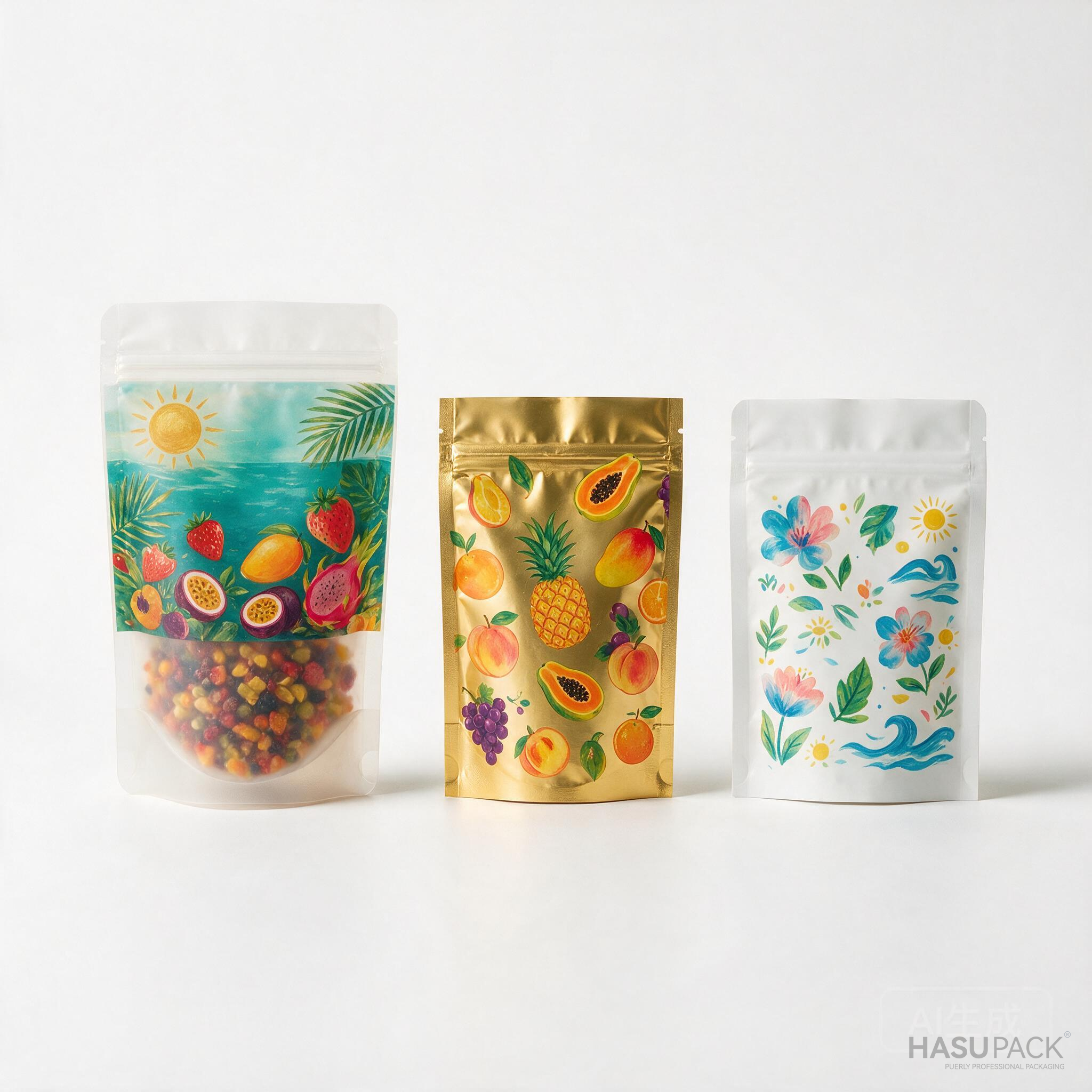
In the food, daily-chemical, and e-commerce industries, packaging bags do more than hold the product—they are a direct expression of the brand image. Yet many buyers face a thorny question: how to choose a custom pouch manufacturer? The market is crowded with suppliers, quotes vary widely, and quality is uneven. Drawing on real-world experience, this article summarizes eight core evaluation dimensions to help you find a reliable custom pouch supplier.
I. Qualifications and Certifications: Compliance Is the Baseline
When selecting a custom pouch manufacturer, the first step is to review its qualifications. Food packaging enterprises must hold a Food Production License (QS/SC), which is a mandatory national requirement. In addition, ISO 9001 quality management system certification is a basic requirement, while export-oriented companies also need FDA certification, BRC packaging certification, or EU 10/2011 compliance. Taking HASUPACK as an example, we hold both QS and FDA certifications, meeting the needs of domestic and international brands.
During evaluation, always require the supplier to provide the original or a copy of its qualification certificates and verify their validity. If a supplier lacks even the most basic compliance qualifications, the risk of future cooperation is very high.
II. Production Equipment: Hardware Sets the Ceiling
Equipment level directly determines the capacity ceiling and quality stability of a custom pouch manufacturer. Focus on the following types of equipment:
- Printing equipment: Gravure, flexographic, or digital printing press? Gravure suits large-volume orders with high color requirements; digital printing suits small batches and fast sampling.
- Lamination equipment: Solvent-based, solvent-free, or both? Solvent-free lamination is more eco-friendly and is an industry trend.
- Pouch-making equipment: Three-side seal, four-side seal, eight-side seal, stand-up pouch, zip-lock pouch—different pouch formats require different pouch-making machines.
- Testing equipment: Gas chromatograph (for residual solvents), tensile tester (for heat-seal strength), oxygen transmission tester (for barrier properties), and so on.
Quality manufacturers keep investing in equipment upgrades. For example, Fuji gravure presses from Japan and solvent-free lamination equipment from Italy are both high-end industry configurations.
III. Production Experience and Case History: Past Performance Is the Best Proof
The experience level of a custom pouch manufacturer can be judged from the clients it has served and its industry cases. Ask the supplier to demonstrate the following:
- Well-known brands served—whether it has worked with leading food, beverage, or daily-chemical brands.
- Product types it specializes in—coffee bags, stand-up pouches, high-temperature retort pouches, vacuum pouches, etc.; different pouch formats have different technical thresholds.
- Problems it has solved—such as lamination of special materials, high-precision registration, or fast delivery cases.
Some suppliers specialize in high-volume generic packaging, while others have an edge in small-batch customization and complex processes. Understanding whether the supplier’s “strengths” match your needs is the key to selection.
IV. Quality Control System: Full-Chain Control from Raw Material to Finished Product
Quality is not inspected in—it is produced. A responsible custom pouch manufacturer should have a sound quality control system:
- Incoming inspection (IQC): Every batch of raw materials (film, ink, glue) is tested on arrival; non-conforming materials are not stocked.
- In-process control (IPQC): Quality checkpoints are set at every stage—printing, lamination, pouch making—with online monitoring.
- Outgoing inspection (OQC): Full-range testing including appearance, dimensional tolerance, seal strength, and residual solvents.
V. MOQ and Price: Lower Is Not Always Better
The minimum order quantity (MOQ) of custom packaging bags is the question buyers ask most. A low MOQ is of course attractive, but note: too low an MOQ often means a higher unit price or the use of generic semi-finished stock. The sensible approach is to evaluate based on annual usage:
- Large batch (100k+): Gravure printing is most economical, but plate-making cost is high (CNY 3,000–5,000 per color).
- Medium batch (10k–100k): Flexographic printing or mid-range gravure is suitable.
- Small batch (1k–10k): Digital printing is a good choice, with zero plate-making cost.
On price, don’t look only at the unit price. Evaluate comprehensively: whether freight is included, whether sampling fees are included, payment terms, credit period, and other hidden costs.
VI. Sampling and Communication: The Trial Phase Reveals True Professionalism
Sampling is the best window into a custom pouch manufacturer’s professionalism. A good supplier will:
- Proactively confirm artwork specifications—including bleed, color mode, and text outlining.
- Provide a sampling timeline—3–5 working days for first samples is the industry standard.
- Communicate exceptions proactively—flag unachievable effects early and propose alternatives.
At this stage, if the supplier is slow to respond, passive in communication, or vague on technical issues, proceed with caution.
VII. Lead Time and Capacity: Reliability Matters More Than Speed
Lead time is one of the issues buyers care about most. To assess a supplier’s lead-time assurance, note:
- Actual capacity: How many tons of film or how many tens of thousands of bags per month? How is capacity utilization during peak season?
- Historical on-time delivery rate: Can it provide average delivery-cycle data for the past 6 months?
- Contingency plan: What is the supplier’s response if facing power outages, equipment failures, or raw material shortages?
A reliable supplier would rather quote a longer lead time than casually promise and then fail to deliver.
VIII. After-Sales Service: Good Cooperation Is Long-Term Partnership
The last and often overlooked link—after-sales service. This includes return/exchange policies for quality issues, technical support after batch delivery, and long-term price adjustment mechanisms.
Summary: Choosing a custom pouch manufacturer is not a one-off transaction, but a process of building a long-term strategic partnership. From qualifications, equipment, experience, quality, price, communication, lead time, to after-sales—none of the eight dimensions can be omitted. For brands cooperating for the first time, we recommend starting with small-batch sampling, then gradually scaling up after one or two rounds of collaboration.
If you are looking for a professional custom pouch supplier, contact HASUPACK. We offer free sampling and technical consultation.





