





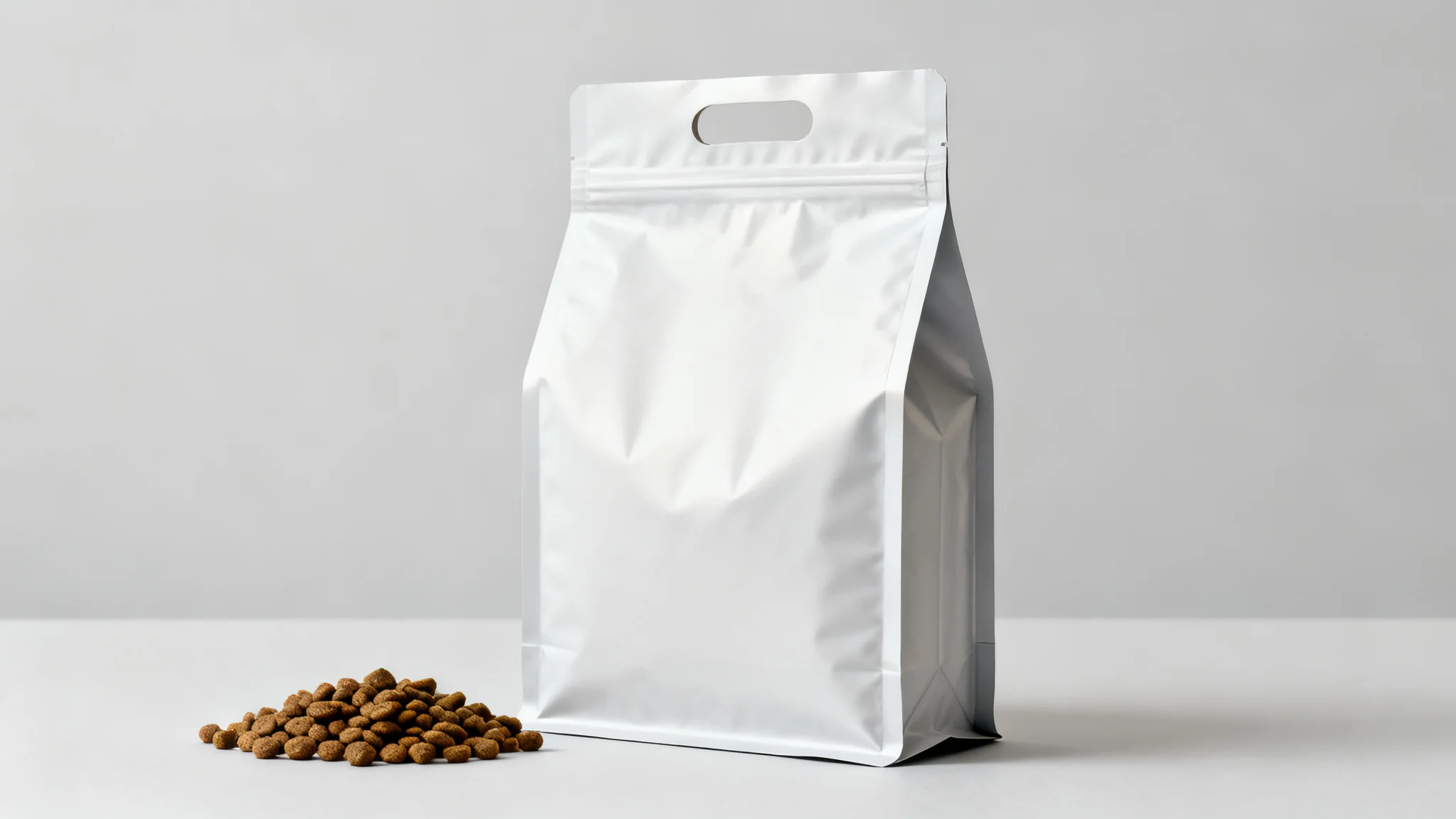
Complaints about pet dry-food packaging rarely focus on “the material is not good enough”; they concentrate on a few very specific spots: tearing near the handle, leakage at the bottom seal, deformation once stacked to the eighth layer, off-flavor two weeks after opening, or users complaining that the bag mouth is too narrow to scoop from. These problems can be anticipated at the bag-selection stage, provided you first settle the net content, stacking height, and usage method before discussing pouch format.
Many teams do it in reverse: first see what pouch format competitors use, then have the factory copy it. The risk is that the same stand-up pouch loaded with 2 kg versus 12 kg has completely different load paths — the former is about shelf appearance, the latter about structural strength.
Work backward from net content and stacking, not from pouch format first
The specification bands for dry food are clear. Trial and experience packs are usually under 1 kg; daily retail concentrates at 1 to 5 kg; multi-pet and stock-up packs start from 10 kg upward. Once the weight band is set, the dominant load is set.
Light-spec pouches bear almost no static load, so selection focuses on layout, opening, and resealing; heavy-spec pouches become part of the handling system, with the handle, bottom seal, and side seals all carrying load. We recommend writing down three numbers before sampling: the maximum net content per pouch, the planned stacking layers, and the longest storage time from factory to end. These three numbers directly decide all subsequent trade-offs.
What each pouch format solves
Side-gusset pouch: the workhorse for medium-to-heavy specs
The folded side panel of a side-gusset pouch makes the bag rectangular, giving a stable cross-section when stacked and high space utilization when containerized. The cost is that the fold position forms stress lines, and the seal at the fold root needs separate confirmation — it cannot be judged together with ordinary seals. For pouch-format and structure notes, see Pet Food Packaging Solutions.
Flat-bottom pouch and eight-side seal: standing stability and layout first
The flat-bottom structure stands independently, offers a complete print area, and reads as more premium on shelf. The cost is an extra layer of material and a forming step at the bottom, where the four bottom corners are most prone to problems during drops. The eight-side seal also folds the sides, making the whole bag more squared with good stacking neatness, but it has more pouch-making steps, and the allocated cost rises for small batches.
Stand-up pouch: the standard solution for small-to-medium specs
The stand-up pouch dominates the 1 to 5 kg range. What usually limits it is the bottom seal: it must bear the fill weight and perform through repeated access. As specifications go higher, widening the bottom and thickening the film are common trade-offs, but they bring changes in cost and opening feel.
Rollstock film: the cost solution when specs are stable
Rollstock film has a low unit price, provided the production line can make the pouches itself. It requires the web width, heat-seal layer, and the packaging machine’s dwell time to match each other, and offers poor flexibility for changing specs and layouts. When orders are sporadic or layouts update frequently, rollstock film is often not cost-effective.
From the production line’s view: do the bag and equipment match?
The same bag can perform quite differently on different filling equipment. Drop height, seal time, cooling method, and clamping method all affect seal quality.
Dry food is mostly granular, with high drop impact, so bag-mouth positioning must be stable; formulations with freeze-dried chunks or coating powder generate crumbs and dust that easily contaminate the seal zone. A viable direction is to separate the drop port from the seal zone and set a fixed cleaning rhythm on the line, rather than only tightening judgment at final inspection. Heat-seal temperature, pressure, and time compensate for each other, and adjusting any one alone can leave the seal at a critical state; for related process notes see Packaging Process Instructions.
Stacking and transport: what the bag endures in the warehouse
Dry food is dense; once bags of 10 kg or more per pallet are stacked to a certain number of layers, the bottom layer must bear the weight of the entire column above for a long time. Compressive load, warehouse humidity, and time act together: standing for a week may be fine, but that does not mean the whole storage cycle is fine.
Transport distance further changes the conditions. Domestic full-truckload transport is mainly short-time vibration and multiple forklift moves; export containers add long-time vibration, wider temperature swings, and the high-humidity environment during sea freight. The bag’s tensile properties can be discussed per ASTM D882, and seal strength can refer to ASTM F88, but more valuable is obtaining data while clearly seeing where the bag actually fails.
More effective actions are usually to change the stacking method and outer-packaging constraints: adjust the number of stacked layers, switch to a more stable arrangement, add stretch wrap or dividers, and let the outer box share part of the load. Simply thickening the film rarely solves the creep problem caused by stacking height.
The weeks after opening are the real test
Once a large-spec dry-food bag is opened it is used for weeks, and from that moment barrier performance is no longer the deciding factor — what remains is whether it can be resealed effectively and how much air is exchanged with each access.
A zipper handles repeat sealing, but consider the relative position of the zipper and top seal, the open-close force, and whether granular dust will jam the teeth. A wider opening is easier to scoop but exchanges more air; a narrower opening better preserves flavor but worsens the experience with large-kibble-and-big-scoop combinations. These trade-offs must be discussed alongside real feeding habits, not judged only on the artwork.
The handle is the same kind of issue. A die-cut handle is low cost and suits medium specs; as specs grow, an independent handle or a widened body gives better force distribution. If the handle cuts into the hand, users will drag instead, and the bag’s failure time actually moves earlier.
Sampling confirmation checklist
We recommend not passing on appearance alone; record the following items:
- The actual net-content upper and lower limits run on the production line, not the nominal value.
- Seal condition at the fold root, bottom corners, both ends of the handle, and the bag mouth — check them separately, not just the middle of the seal.
- Measure dimensions 24 hours after filling; film relaxation changes the actual footprint.
- Stack a full pallet at the planned layers and, after pressing for a while, inspect from the bottom up.
- Run open-close cycles with real dry food, not substitute material.
For the customization process and sampling steps, see Custom Packaging; for common specifications, see the product center.
A few easily overlooked judgment points
Should you even add a handle?
If the end use is hand carrying, you need one — but the handle must be designed for the real weight, not just patched as a die-cut hole onto a retail pouch format. If it goes through full-pallet mechanical handling, designing the bottom and seals for mechanical handling is more practical than forcing on a handle.
Is thicker always better?
No. Stacking performance depends more on bottom geometry, the film’s creep characteristics, and the stacking method than on thickness alone. Thickening raises cost and may narrow the sealing window, so it is best used as a last step after all structural options have been tried.
Can trial packs and stock-up packs share one structure?
Generally not recommended. Small specs care about shelf appearance, opening feel, and print detail; large specs care about load path and seal reliability. One structure covering too wide a weight range compromises both ends. The safer approach is to split the weight bands and define a structure for each.
Frequently asked questions
Which material combination is reliable for pet dry-food bags?
There is no single answer. The combination depends on net content, whether nitrogen flushing is needed, whether light protection is required, and whether recyclable design must be considered. Common candidate directions include nylon-layer structures for puncture resistance and metallized or EVOH-layer structures for barrier. Once the direction is set, sampling confirmation against the actual product and distribution conditions is still required — do not conclude from the material name alone.
How many stacking layers are generally set?
There is no universal value. It relates to post-fill dimensions, film and fold structure, warehouse temperature/humidity, and stacking time. A workable approach is to run a full-pallet test at the planned layers, inspect the bottom layer after sitting under set conditions for a period, then decide whether to adjust the arrangement or add outer-packaging constraints.
Why do problems still appear after seal parameters are tuned?
Rollstock batches have normal variation in heat-seal-layer formulation and thickness tolerance, and workshop temperature/humidity and equipment wear also change. The same parameter set will not necessarily stay within the process window across batches. We recommend fixing a validation method and re-testing after batch changes and long stops, rather than confirming only once at initial setup.
What extra should export orders watch for?
Sea freight involves wider vibration, temperature swings, and humidity than domestic transport, and longer transit times, so the stacking plan needs re-evaluation. Also, different markets have their own requirements for pet-food labeling and ingredient claims, so the packaging layout must reserve space for them. See FEDIAF’s pet food guidance for the basic framework of the European market; specific clauses still need to be confirmed country by country against the target market.





