





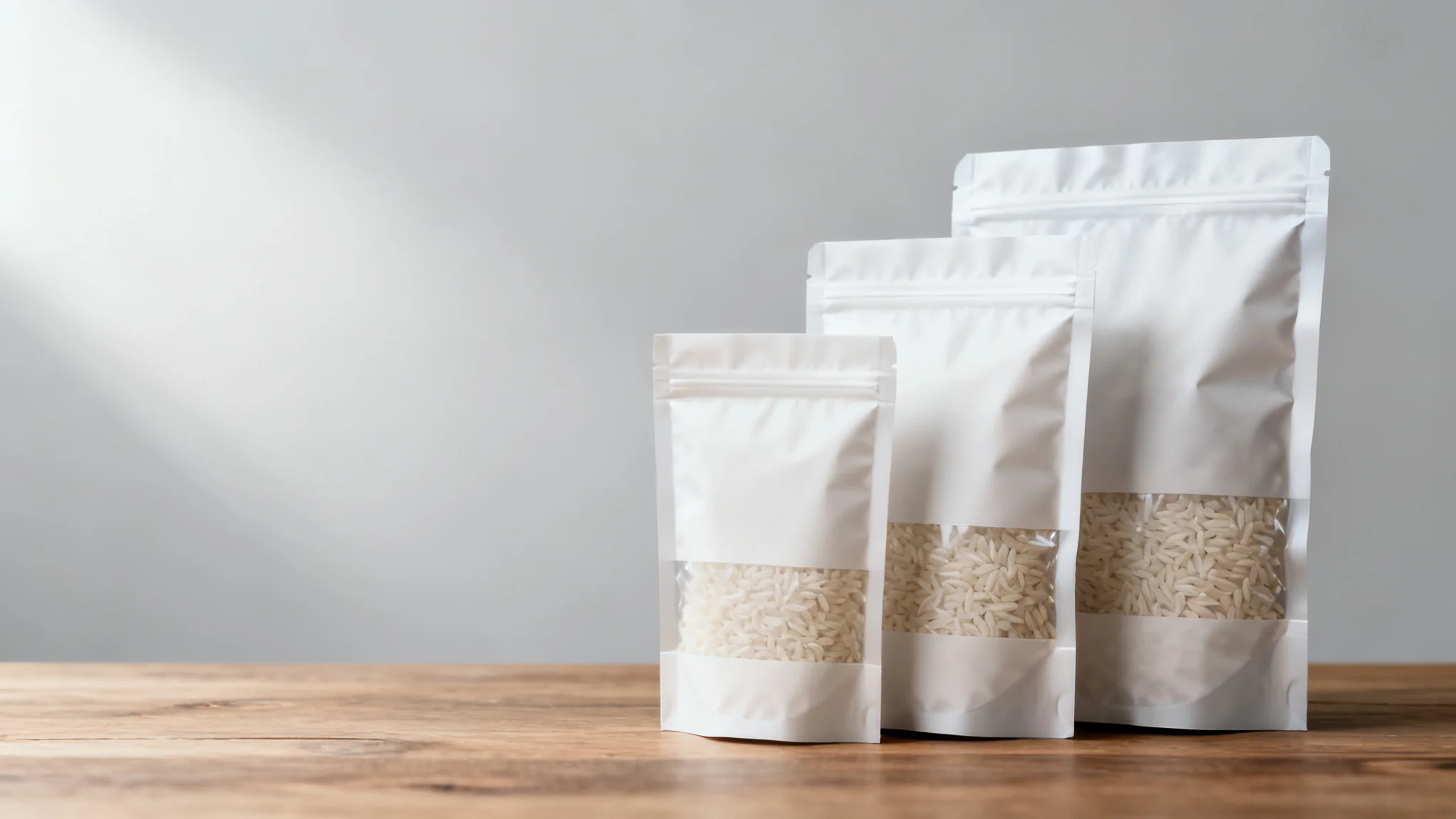
A rice packaging bag is specified on three variables before any artwork is discussed: pack weight, the moisture and insect risk of the destination market, and whether the bag will be vacuumed. Milled rice is hygroscopic, so film structure, seal geometry, handle placement and filling method all follow from one question — how long the grain must stay below the moisture level at which mould and weevils become active. This guide covers retail packs, bulk bags and the points where a format that looks correct on paper fails on a real filling line.
What does a rice packaging bag actually have to block?
A bag that handles moisture but ignores abrasion still arrives with broken grains and a leaking seal.
- Water vapour. Milled rice equilibrates with ambient humidity. Once grain moisture rises, mould, caking and off-odours follow.
- Oxygen. The lipid fraction in the bran layer oxidises, which produces stale, cardboard-like notes in older packs.
- Insects. A sealed bag keeps weevils out, but it cannot remove eggs already present in the grain.
- Abrasion and puncture. Rice is dense and has sharp ends that work against the film from the inside.
Retail packs from 1 kg to 5 kg: format and barrier choices
At retail size, shelf behaviour decides the format before barrier does. A stand-up pouch with a clear window suits buyers who inspect grain length before purchase, but the window costs print area and removes the foil layer from that zone. A four-seal grain pouch offers more front-facing print and better vertical stability. A vacuum brick from 2 kg upward saves shelf space, provided the film survives grain pressure.
Typical candidate structures are PET/PE for short-life packs, PET/PA/PE where puncture resistance matters, and PET/AL/PE where the market expects a longer ambient shelf life. These are starting points, not guarantees: the structure that suits a 2 kg pack in a dry climate is rarely right for a 5 kg pack shipped through a humid port.
Bulk 10 kg to 25 kg: handles, gussets and load
Above roughly 10 kg the bag stops being a marketing surface and becomes a handling device: handle tear-out, top-seal peel, gusset cracking and pallet compression take over.
A quad-seal bag with a die-cut handle is the usual format for machine-filled rice at this weight. The handle must hang the load below the seal rather than across it, and the top seal needs enough land area to carry that weight without creeping. Gusset depth controls how squarely the filled bag sits on a pallet; a shallow gusset stacks badly. Laminated woven polypropylene remains common for 25 kg export bags because it tolerates rough handling, though its weak moisture barrier usually needs an inner liner.
When should rice be packed under vacuum?
Vacuum is the right choice when the pack must hold a compact shape for a long ambient period and the film can take the abrasion. It removes most headspace oxygen, which slows lipid oxidation and limits insect activity.
It is the wrong choice in three situations. Long-grain aromatic varieties can crack under compression, and cracked grains read as quality loss. Bone-dry rice abrades film aggressively, so a thin sealant layer develops pinholes at fold lines. And a brick changes the shelf presence of a format built around a soft pillow shape.
Why do weevils and moisture damage appear after packing?
Almost always because the problem entered before the bag was sealed, or because the seal is not continuous.
Infestation carried in with the grain. Eggs and larvae present at milling survive sealing. A sealed bag stops re-infestation but does not sterilise the contents, so low-oxygen storage or a controlled treatment before packing is what reduces the risk.
Channel leaks in the seal. Rice dust and broken grains trapped in the seal area prevent polymer-to-polymer contact. The bag looks sealed, passes a visual check, then leaks slowly over weeks. De-dusting before the jaws and a seal-through-contamination trial catch this before mass production.
Condensation during transport. A container moving between climate zones can drop below dew point, and the bag is then blamed for moisture created by the shipping environment.
How to choose a rice packaging bag in five steps
- Fix the weight and format. Choose retail pouch, vacuum brick or bulk bag from pack weight and shelf space, not film cost.
- Map the risk profile. Note transit time, port humidity and expected shelf time; that sets how much barrier is justified.
- Shortlist two or three structures. Keep one option without aluminium for cost and recyclability, one with it for the worst-case market.
- Test rather than assume. Measure water vapour transmission to ASTM F1249, check seal leaks by bubble emission to ASTM D3078, and confirm food-contact suitability of the polyolefin layers under 21 CFR 177.1520 for the US market.
- Trial on the filling line. Run the actual rice at production speed. Seal contamination, dust generation and bag opening behaviour only appear at line speed.
Scope and boundaries: when to use a barrier bag and when not
A high-barrier structure is worth its cost when transit and storage are long, humid or unpredictable. It applies to export shipments, vacuum bricks held for months, and retail packs sold through a wet season.
It does not fix three things. It cannot dry grain packed above target moisture, replace cleaning and insect control at the mill, or compensate for a line that leaves rice dust in the seal. Aluminium laminates also work against recyclability targets, so a mono-material or paper-based structure may suit markets that accept a shorter shelf life. The boundary is simple: barrier buys time, and time is only useful if the grain and the seal are already correct.
Conclusion
Choosing a rice bag is a sequence, not a catalogue lookup. Weight and format come first, then the moisture and insect risk of the destination, then the structure that survives both, and finally the tests that prove the seal holds. The common mistake is upgrading the film while leaving seal contamination and grain moisture untouched, which produces a more expensive bag with the same complaint. Buyers get further by sending pack weight, transit route, shelf-life target and line details. Related formats sit under agricultural product packaging solutions, and non-standard sizes are handled through custom packaging.
Frequently Asked Questions
Does a rice packaging bag need an aluminium layer?
No, not always. A rice packaging bag needs foil only when the pack must hold quality through a long ambient shelf life in a humid market, because foil blocks light and water vapour far better than a clear laminate. For a 1 kg pack sold within a few months in a dry climate, a PET/PE or PET/PA/PE structure with a sound seal is often sufficient. Let measured transmission data and the actual route decide. Foil also removes the clear window and complicates recycling.
What causes pinholes in a 5 kg vacuum rice bag?
Sharp grain ends abrading the film at fold lines, in most cases. Vacuum pulls the film tight against the grain, so every pointed end becomes a load point, and gusset folds concentrate it on a narrow band. Thicker sealant layers, a nylon layer for puncture resistance and rounded corner geometry reduce the risk. Film thickness alone does not settle it: a seal-through-rice trial at production vacuum level shows whether the structure survives. Pinholes appearing only after transport usually point to handling.
Can a stand-up pouch hold 10 kg of rice?
Rarely, and it is usually the wrong format above about 5 kg. A stand-up pouch relies on a bottom gusset for stability, and at 10 kg the filled pouch bulges, the bottom panel fatigues and the bag no longer stands reliably on a pallet. Bulk weights are better carried by quad-seal bags with a die-cut handle or by laminated woven bags with an inner liner, both of which spread load over a wider seal land.
Which tests should a rice bag pass before mass production?
Seal integrity and moisture barrier come first, because those are the two failure modes that reach the consumer. Run a bubble emission leak test on finished bags, measure water vapour transmission rate on the laminate, and put a filled pallet through a distribution test if the route is long. Add a drop test at the intended pack weight and a shelf-life check under real storage conditions. Any result that fails should send the structure back to trial, not to print.





