





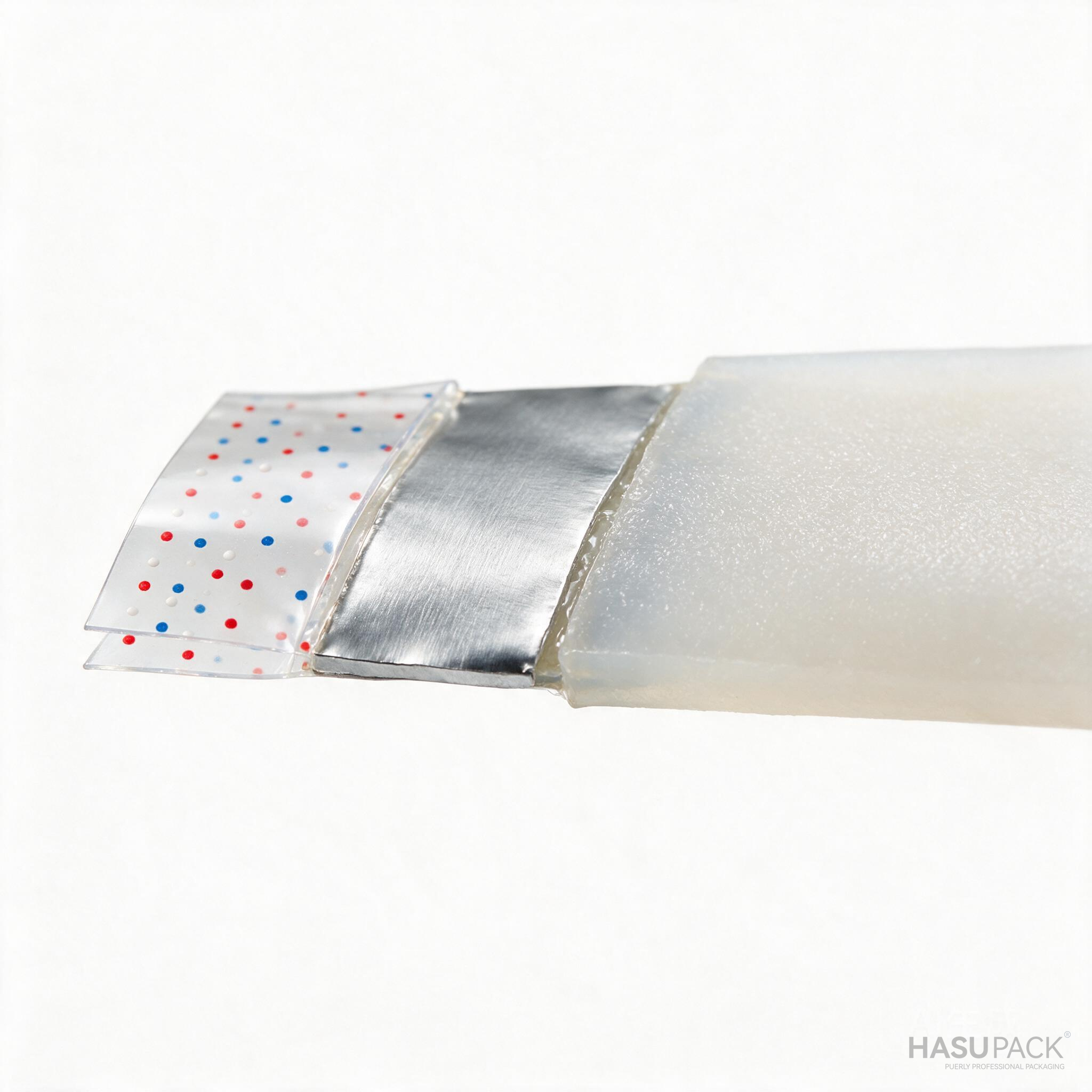
Walk down a supermarket aisle, from chips bags to coffee bags, from milk cartons to seasoning packaging—the vast majority of packages are not made from a single material. Why don’t food packages just use one layer of plastic, instead going to the trouble of laminating multiple layers? This article lifts the veil on laminated packaging materials, systematically explaining the mysteries of multi-layer lamination from structural design to practical application.
I. Why Isn’t a Single Material Enough? The “All-Round Contradiction” of Packaging
An ideal food packaging bag must simultaneously meet several seemingly contradictory requirements: it must block oxygen and moisture to stay fresh, yet be heat-sealable; it must have sufficient mechanical strength, yet good printability; it must be safe and non-toxic, yet cost-controllable. Unfortunately, no single-layer material can satisfy all these needs at once.
Take the PE bag as an example: polyethylene has excellent heat-sealability and flexibility, but very poor barrier against oxygen and aroma. Aluminum foil has exceptional barrier properties, but cannot be heat-sealed, is not bend-resistant, and is opaque. PET film prints well and is strong, but has poor heat-sealability and only moderate moisture barrier. Every material has its “strengths” and “weaknesses,” and the core idea of flexible lamination is to combine the advantages of different materials so that 1+1>2.
A typical laminated packaging structure contains three layers: an outer layer (print layer, such as PET or BOPP), a middle layer (barrier layer, such as aluminum foil or EVOH), and an inner layer (heat-seal layer, such as PE or CPP). Each layer does its job, together forming a comprehensively performing packaging solution.
II. Common Combinations of Laminated Packaging Materials
There are many laminated packaging materials and combinations on the market. Here are several classic combinations and their applications:
(1) PET/AL/PE three-layer lamination: The most classic high-barrier laminate structure. PET provides good printability and strength, AL provides ultimate oxygen and moisture barrier, and PE handles heat-sealing. This structure is often used for foods needing long-term freshness, such as coffee bags, tea bags, and seasoning packaging. The downside is that the aluminum foil makes it opaque and difficult to recycle.
(2) PET/EVOH/PE transparent high-barrier structure: EVOH (ethylene-vinyl alcohol copolymer) is a transparent high-barrier material with extremely low oxygen transmission rate while keeping the package transparent and visible. This combination suits scenarios that need to show the product, such as premium meat packaging and cheese packaging. The downside of EVOH is that its barrier drops after absorbing moisture, so it is usually sandwiched between PET and PE for protection.
(3) BOPP/CPP all-PP lamination: BOPP (biaxially oriented polypropylene) is rigid and highly transparent; CPP (cast polypropylene) has good heat-sealability. The all-PP structure is a representative of mono-material packaging. Although its barrier is inferior to aluminum-foil structures, its recyclability is excellent, making it the fastest-growing lamination approach under eco trends.
(4) PET/VMPET/PE metallized lamination: VMPET (metallized polyester film) has an extremely thin aluminum layer vapor-deposited on the PET surface; its barrier is second only to pure aluminum foil, while costing less and being lighter and thinner. It suits medium-barrier packaging such as snack bags and frozen food outer bags.
III. Production Processes for Laminated Packaging Materials
Sticking different materials together is not simple; the mainstream lamination processes today are three:
Dry lamination: Adhesive is coated on the film surface, the solvent is dried in an oven tunnel, then the film is pressed against another layer. Dry lamination is the most mature process, suitable for almost all material combinations, but uses organic solvents, posing residual-solvent risk and environmental pressure. Its peel strength is high, suiting high-quality food packaging.
Solvent-free lamination: Uses 100% solids solvent-free adhesive, pressed directly onto two films without a drying step. Solvent-free lamination is the upgrade direction under eco trends—no solvent emissions, low energy use, and higher food safety. But its initial peel strength is lower, demanding finer production control.
Extrusion lamination: Molten PE resin is extruded directly between two films, acting as both adhesive and middle layer. Extrusion lamination suits high-volume, cost-sensitive packaging such as detergent bags and rice bags. Its advantages are no solvent and low cost; the downside is limited material choice and lamination precision.
Which lamination process to choose depends on the product’s combined requirements for food safety, peel strength, and production efficiency. For more professional information on lamination processes, refer to our article Lamination Process Explained.
HASUPACK operates two production lines—fully automatic dry lamination and solvent-free lamination—and can recommend the optimal lamination solution based on your product needs.
Get a Quote →IV. Key Quality Indicators for Laminated Packaging Materials
Judging the quality of laminated packaging materials mainly comes down to these key indicators:
1. Peel strength: The adhesion between layers. Insufficient peel strength causes delamination and blistering, severely affecting barrier performance and appearance. Quality laminates typically have peel strength ≥1.5 N/15 mm.
2. Residual solvent: Organic solvents used in dry lamination, if not fully dried, leave residual toluene, ethyl acetate, and similar substances that migrate into food and cause safety problems. Total residual solvent in food laminates should be ≤5 mg/m².
3. Heat-seal strength: The inner layer’s heat-seal strength determines whether the package stays intact during transport and storage. Heat-seal strength ≥20 N/15 mm is the basic requirement for most food packaging.
4. Barrier performance: Including oxygen transmission rate (OTR) and water vapor transmission rate (WVTR). High-barrier packaging should have OTR ≤5 cm³/(m²·24h·atm) and WVTR ≤2 g/(m²·24h).
V. Industry Trends for Laminated Packaging Materials
Looking ahead, laminated packaging materials are developing toward greater sustainability and higher performance:
Mono-material recyclability: Markets in Europe, the US, Japan, and Korea increasingly demand packaging recyclability. All-PE or all-PP mono-material laminates have become a research hotspot; although their barrier still lags multi-material laminates, coating technology and new materials keep improving it.
Bio-based material adoption: Bio-based materials such as PE derived from sugarcane and PLA derived from corn are entering laminated packaging. These can reduce dependence on fossil fuels and lower carbon footprint.
Down-gauging and light-weighting: By optimizing structure design and material selection, total film thickness is reduced without hurting performance, achieving reduction and cost savings. Taking three-side seal pouches as an example, reducing thickness from 120 μm to 90 μm saves about 25% of material usage.
HASUPACK has specialized in R&D and production of flexible lamination materials for 15 years, providing customers with full-chain service from material selection to finished-product delivery. Contact us now for the laminated packaging solution best suited to your product.
Free Consultation →From “single layer” to “multi-layer lamination,” every material upgrade is a relentless pursuit of food freshness and packaging efficiency. Understanding the basic principles of laminated packaging materials will help you make more scientific and economical decisions when procuring packaging. For sample testing or technical consultation, feel free to contact the HASUPACK team at any time.





