





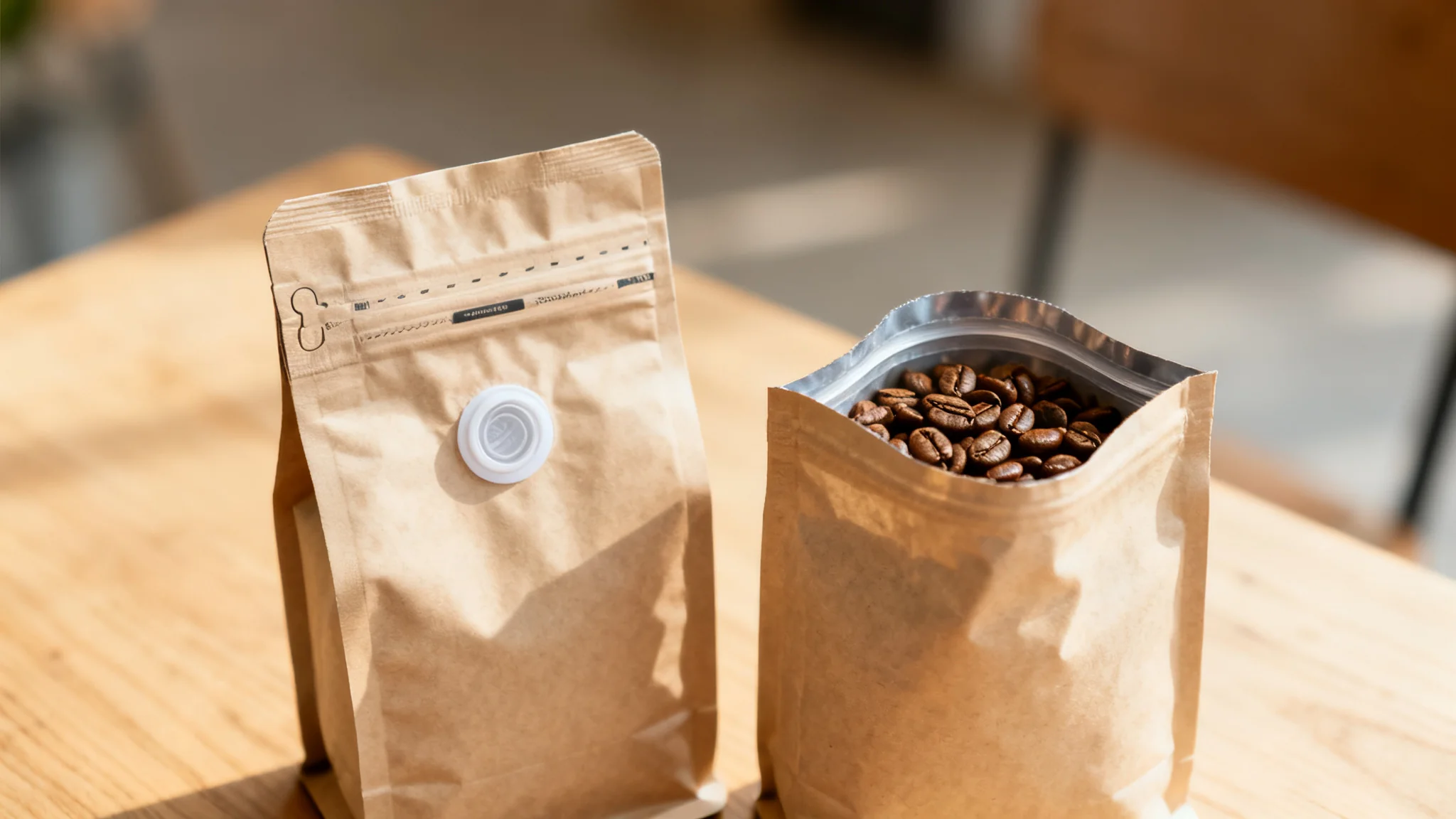
The starting point of custom coffee bean packaging is not the pouch format but the product itself: roast level, shipment cadence, and display method should be settled first, so that degassing, light protection, and pouch format have a basis for judgment. Clarify these three items in order before moving to pouch format and material, and the chance of rework drops significantly. Below, starting from product requirements, we break down the decision chain for custom coffee bean packaging.
Key Points
- Customization starts with roast level and shipment cadence, not with pouch format.
- Freshly roasted beans keep releasing gas; the degassing plan determines whether a one-way valve is needed.
- Prioritize light protection, oxygen barrier, and moisture barrier according to shelf life and display method.
- Determine the filling line before the pouch format; small-batch solutions should not be over-built.
Custom Coffee Bean Packaging: Start with Roast Level and Shipment Cadence
The same bag of coffee beans—light and dark roasts have different packaging requirements. The darker the roast, the greater and longer-lasting the CO₂ release; beans loaded into a fully sealed bag right off the roaster will build internal pressure. Shipment cadence also matters: products with fast turnover, intended for in-store use or near-field delivery, have shorter storage times and can use a lighter structure; products that go through distributors, cross-region transport, or long-term display need light protection and oxygen barrier moved up the priority list. Roast level plus the interval from “roast to shipment” is the first set of judgment criteria. For coffee industry roasting and quality references, see the SCA Coffee Standards and Research.
How Does Roast Level Determine Degassing and Barrier Needs?
Degassing needs come from CO₂. Freshly roasted beans keep releasing gas; a fully sealed bag traps the gas inside, so most custom coffee bean packaging plans add a one-way degassing valve at this stage to let CO₂ out while keeping outside oxygen from entering easily. The longer the shipment interval, the earlier the degassing peak passes and the lower the valve’s necessity—but always evaluate against the worst case.
Barrier needs come from oxidation and light. Coffee oils easily go stale when exposed to oxygen, and light accelerates this process, so the structure usually needs a light-protection and oxygen-barrier layer. How high a barrier is needed depends on the shelf-life target; you can compare structural differences in how light-blocking bags are made, but material selection must still be confirmed by actual shelf-life testing.
What Pouch Formats Are Available for Custom Coffee Bean Packaging?
Common options include valved stand-up pouches, flat-bottom pouches, four-side seal pouches, and outer bags for drip coffee. Stand-up pouches are easy to fill and stand on shelves, making them the most common choice for retail whole beans; flat-bottom pouches offer a complete display face and stable stacking; four-side seal pouches have a neat, rectangular shape, suitable for tidy display or gift boxes—see roasted coffee four-side seal packaging; drip coffee usually pairs with a three-side seal outer bag.
Pouch format is tied to the filling line. A premade-pouch line uses formed pouches; a rollstock line forms them on the spot—each supports different formats and speeds. Confirm the filling method first, then choose among the formats it can produce; this is easier than fixing the format first. For pouch-format comparisons in export markets, see the coffee packaging category.
How to Define the Material Structure?
The structure must simultaneously satisfy oxygen barrier, light protection, moisture barrier, and puncture resistance, while also accommodating the print surface. The outer layer carries printing and mechanical strength, the middle layer carries the barrier, and the inner layer handles heat sealing and content compatibility. For products with a valve or zipper, the coordination between the inner layer and the seal must be confirmed separately, because the valve and zipper change the stress on the seal edge.
Coffee is a food; materials in contact with the contents must meet general food-contact material requirements. You can search GB 4806 in the National Public Service Platform for Standards Information to understand its scope. We recommend proposing two or three candidate directions first, then running shelf-life comparisons with real beans.
How to Configure the Degassing Valve, Zipper, and One-Way Degassing?
A one-way degassing valve lets gas out but not in; it is usually positioned toward the top and to one side of the body, away from the main display face and seal edge. Installation is divided into applied (sticker) valves and embedded valves; applied valves have less impact on appearance, while embedded valves demand more from the seal surface. The valve’s opening pressure must match the gas release volume—too low and it vents frequently, too high and the bag balloons.
The zipper solves resealing after opening. Retail products that need repeated access suit a zipper; the zipper usually sits below the valve to avoid crowding the same area. When both valve and zipper are present, reserve a larger unprinted area on the body and adjust the layout accordingly. The coordination logic of the two is explained in more detail in custom flexible packaging.
How to Define the Packaging Solution for Small-Batch Shipments?
The main constraints for small batches are plate-making cost and sampling cadence. Gravure printing requires cylinder engraving; when volumes are small, amortization pressure is high, so digital printing or hand-made sample pouches to validate the structure are more appropriate. Customization does not have to get printing right in one shot—defining structure and format first, then adding printing later, lowers upfront investment.
Another point is not to over-build the solution. Small batches usually correspond to shorter storage times, so barrier and degassing requirements can be evaluated against the real turnover cycle rather than copying a long-shelf-life configuration. If volumes later increase, keeping the structure and format stable while only switching the printing method is a smoother transition.
Checklist Before Sampling and Mass Production
- Roast level and the time interval from roast to shipment.
- Target shelf life and transport distance.
- Filling method: premade pouch or rollstock forming.
- Pouch format, capacity, and whether to include a one-way degassing valve.
- Whether to include a zipper, and the relative position of valve and zipper.
- Target level of light protection and oxygen barrier.
- Printing method, number of colors, and layout whitespace area.
Confirm the checklist before arranging sampling. Sampling mainly checks three things: whether the body is stable after filling with beans, whether the valve position affects appearance, and whether the seal edge remains reliable after handling. A single sampling round cannot cover all shelf-life issues; long-term performance is still judged by shelf-life testing.
Conclusion
The decision order for custom coffee bean packaging is roast level and shipment cadence, shelf-life target, pouch format and filling method, material structure, and only then printing. The three needs—degassing, light protection, and oxygen barrier—are determined by the product itself, not by the pouch format. For small-batch products, securing the structure first and adding printing later is more stable. The specific choice of material and barrier grade should be based on shelf-life testing with real beans; this article only provides candidate directions.
Frequently Asked Questions
Does custom coffee bean packaging always need a one-way degassing valve?
It depends on the roast level and shipment interval. Freshly roasted beans keep releasing CO₂; a fully sealed bag traps the gas inside, so a one-way degassing valve is usually needed to let gas out and block oxygen. When the interval from roast to shipment is long, the degassing peak has passed and the valve’s necessity drops—but always evaluate against the worst case. Whether to include a valve is a structural choice in custom coffee bean packaging and is best confirmed during the sampling stage.
Are there differences between custom pouches for light and dark roasts?
Yes, mainly in degassing and structural strength. Dark-roast beans release more gas for longer and demand more from the degassing plan; the valve’s opening pressure and position must be re-evaluated. Light-roast beans release less gas, so the packaging can be lighter. The material structure, valve configuration, and shelf-life target of coffee pouch customization must be judged together; you cannot apply a single roast level across the entire product line.
How to balance light protection and display in custom coffee bean packaging?
Light protection must block light, while display must reveal the design—the two are weighed on the layout. A common approach is a light-protective or high-barrier structure for the body, with a printed area and window reserved on the front. The window’s position and size must avoid the valve and seal edge, or it will affect degassing and sealing. The longer the shelf life, the more cautious the window area must be—this must be settled at the structure-confirmation stage of custom coffee bean packaging.
Is small-batch coffee pouch customization cost-effective?
The main cost for small batches is in plate-making and sampling cadence; gravure printing is not mandatory. At low volume, you can first use digital printing or hand-made sample pouches to validate structure and format, then switch to gravure printing once the structure and shelf-life performance are confirmed and volume grows—this lowers upfront investment. Coffee pouch customization does not have to get printing right in one shot; securing structure first and adding printing later is the more stable order.





