





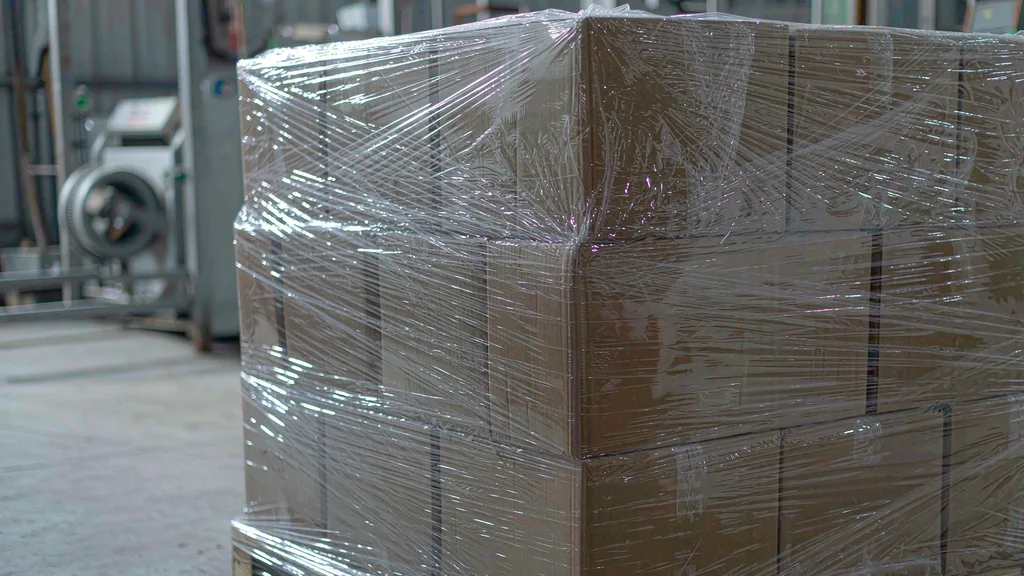
Choosing stretch film starts with three variables: the pallet weight and corner sharpness set the film’s puncture and toughness requirements; the number of handling cycles sets the residual holding force after stretch decay; and the packaging method (machine or hand) sets the pre-stretch ratio and roll-weight spec. Selecting in the order ‘calculate usage first, then set performance, then accept’ holds total cost down better than comparing by thickness and unit price.
What Stretch Film Carries in Pallet Packaging, and What Failure Looks Like
The role of stretch film (stretch wrap) is not to ‘wrap’ the cargo but to apply continuous holding force to the pallet load, keeping goods and pallet relatively still through handling, hard braking, and stacking vibration. Its failure modes are typical:
- Loosening recoil: over-stretched film loses recoil, and the whole pallet load shifts in transit—the number-one stretch-film complaint.
- Web break: the film is punctured by cargo corners at turns or snaps from unstable tension during wrapping; the operator can only wrap more turns as a fix, raising usage instead.
- Puncture failure: sharp cargo corners or pallet splinters poke through the film, and the damage point grows under vibration.
The remedies differ by failure type: looseness points to pre-stretch ratio and residual holding force; web breaks point to machine tension matching; puncture points to film toughness and thickness distribution. Before selection, find out which failure costs you most. Export goods need one more consideration: combined temperature-humidity changes and stacking vibration at sea make the protection focus different from domestic sales—HASUPACK’s Why Flexible Packaging Fails in Export Container Shipping gives dedicated analysis of condensation and stacking scenarios.
How to Distinguish Machine and Hand Stretch Film
Machine and hand stretch film are not the same roll with a different width, but two different performance orientations:
| Comparison Item | Machine Stretch Film | Hand Stretch Film |
|---|---|---|
| Typical spec | 500 mm × 15–23 μm × 1500–3000 m | 450–500 mm × 17–23 μm × 300–400 m |
| Pre-stretch ratio | 150%–300% (pre-stretch carriage machines) | 30%–70% (manual stretch) |
| Roll weight | 15–30 kg | 3–5 kg (suited to hand operation) |
| Performance focus | Tension consistency, residual holding force, break rate | Easy tear, cling feel, no hand strain |
| Core metric | Break rate (rolls per hundred pallets) | Wrap time and usage per pallet |
To decide which you need: above 300 pallets/month with uniform pallet size and stable load shape, machine film usually pays back the equipment investment within a year; for multi-variety small batches, irregular pallet shapes, or space limits, hand film remains the reasonable choice. Mixed scenarios (mostly machine-wrapped, hand touch-up on irregular pallets) are common among industrial customers—just procure the two films separately by use. Note that stretch film solves ‘goods-to-pallet fixing’; bulk heavy packaging above 25 kg is a different problem—see HASUPACK’s How to Choose a 25 kg Heavy-Duty Bag for that selection logic, and do not conflate the two.
How to Set the Pre-Stretch Ratio: Choosing Among 150% to 300%
The pre-stretch ratio is the most technical parameter in stretch-film selection. As the film is stretched, it thins, the material per area drops, and the mechanical properties redistribute:
- 150%–200%: suited to heavy loads (over 800 kg), sharp-cornered cargo, and export pallets with many handling cycles. Large residual holding-force reserve; corners less prone to breaks.
- 200%–250%: the mainstream range for most standardized domestic pallets, balancing film use and safety.
- 250%–300%: needs a pre-stretch carriage and good film (usually a metallocene polyethylene formulation); suited to light bulky goods and fully regular pallet loads. Once pallet corners are sharp or weight distribution uneven, the insufficient recoil problem quickly surfaces.
Key reminder: a higher pre-stretch ratio is not always cheaper. Each step up in the stretch level—roughly a 50 μm nominal-thickness increment—thins the film by the corresponding ratio, and corner puncture risk rises in step. The correct evaluation method is ‘same-pallet comparison’: wrap the same real pallet load at different pre-stretch ratios, then run vibration or drop validation, record load shift and damage locations, and set the level by data rather than by the supplier’s maximum stretch number.
How to Test Puncture, Cling, and Toughness
Three performance indicators correspond to three failures; all have standard test methods:
- Puncture performance: simulates a cargo corner poking through the film. Refer to ASTM D5748, the puncture test method for stretch wrap film, using a probe to puncture and record peak force and burst energy. Pallets with many sharp corners (metal parts, wooden crates, paper-wrapped corners) should focus on burst energy rather than peak force.
- Tensile performance: tensile strength and elongation at break per GB/T 1040.3 for plastics film tensile properties—the basic data for pre-stretch levels; films of the same thickness but with elongation at break differing by 50 percentage points tolerate completely different pre-stretch ratios.
- Cling: the adhesion after film layers bond, which decides the end-of-wrap fixing. Too high cling sticks during rewind and unwind; too low lets the tail lift and the load come apart in transit. At acceptance, a simple two-layer peel comparison suffices; the absolute value is not needed—relative difference from the current film is more meaningful.
How to Calculate Cost per Pallet: Don’t Just Look at Price per kg
The true cost of stretch film is ‘film cost per pallet’; the formula is simple:
Film usage per pallet (kg) = pallet perimeter × number of wraps × film-width-equivalent length × film density ÷ (1 + pre-stretch ratio)
Example: a 1.2 m × 1.0 m pallet, base perimeter about 4.4 m, two wraps top and bottom plus four in the middle for about 8 wraps total, 20 μm machine film, 250% pre-stretch—usage usually falls at 180–260 g per pallet. When comparing quotes on this basis, convert price per kg into cost per pallet, then add two hidden variables: downtime and re-wrap waste from breaks per roll (typically 2%–5% in machine scenarios), and the gap between actual and nominal pre-stretch ratio (a poor film rated 250% but running 180% makes the cheaper-per-kg film actually more expensive).
Incoming Inspection and Routine Checks
Incoming inspection of stretch film can be simple; four actions cover most risk:
- Appearance and roll build: flat end face with no telescope misalignment, no crushed core, no end-face damage.
- Thickness spot-check: per GB/T 6672 or a micrometer, spot-check end-face thickness; keep deviation within ±10% of nominal. Uneven-thickness film breaks at thin spots after pre-stretch.
- Stretch spot-check: take a strip for a simple stretch comparison, pulling it beside the retained-sample film to break; batches with clearly lower elongation at break are rejected.
- Wrap trial: wrap 3–5 pallets with the first roll of each batch on a real pallet; check corners, tail fixing, and load shift.
Customers using stretch film in volume should keep about a 2 m retained sample per batch, marked with batch number, filed with the incoming inspection record, so batch looseness or breaks can be traced quickly. For a more complete flexible-packaging incoming inspection framework, see HASUPACK’s How to Do Flexible-Packaging Incoming Inspection: 8 Acceptance Standards for Both Buyers and Factories.
FAQ
Can machine stretch film and hand stretch film substitute for each other?
Long-term interchange is not recommended. Machine film is designed for the high pre-stretch of a pre-stretch carriage; hand wrapping under-stretches and wastes holding force. Hand film’s roll weight and length are sized for hand holding; on a machine its tension control mismatches and causes frequent breaks. Temporary emergency use is fine, but for volume use, buy separately by packaging method.
Does a higher pre-stretch ratio always save money?
No. The higher the stretch ratio, the thinner the film and the weaker the corner puncture resistance; once the film breaks or the load shifts, the re-wrap usage eats the saved material. The correct approach is a same-pallet comparison test across pre-stretch ratios, setting the level by load shift and damage, usually 150%–200% for heavy or sharp-cornered loads.
Why does stretch film break?
Four common causes: uneven thickness causing thin spots to break first, machine tension mismatched with film performance, sharp cargo corners puncturing, and elongation at break below spec. The troubleshooting order is: first measure incoming thickness and elongation, then check the wrapper’s pre-stretch and tension settings, and finally see whether the load shape needs corner protectors.
What standard tests puncture performance?
Refer to ASTM D5748, the puncture test method for stretch wrap film, using a probe to puncture the film and record peak force and burst energy. For loads with sharp corners, focus on burst energy rather than peak force, as it reflects the total energy the film absorbs before puncture and predicts corner performance better.
How to estimate stretch film usage per pallet?
Formula: film usage per pallet (kg) = pallet perimeter × number of wraps × film-width-equivalent length × film density ÷ (1 + pre-stretch ratio). For a 1.2 m × 1.0 m pallet, about 8 wraps, 20 μm machine film, 250% pre-stretch, usage is about 180–260 g per pallet. Compare quotes by cost per pallet rather than price per kg to reflect true consumption.
What to check when stretch film arrives?
Four items: end-face appearance and roll build (no misalignment, no crush), thickness spot-check (within ±10%), stretch spot-check (compare elongation at break with the retained sample), and wrap trial (first roll on a real pallet, 3–5 pallets). Keep a 2 m retained sample per batch with batch number recorded, so batch anomalies can be traced quickly.





