





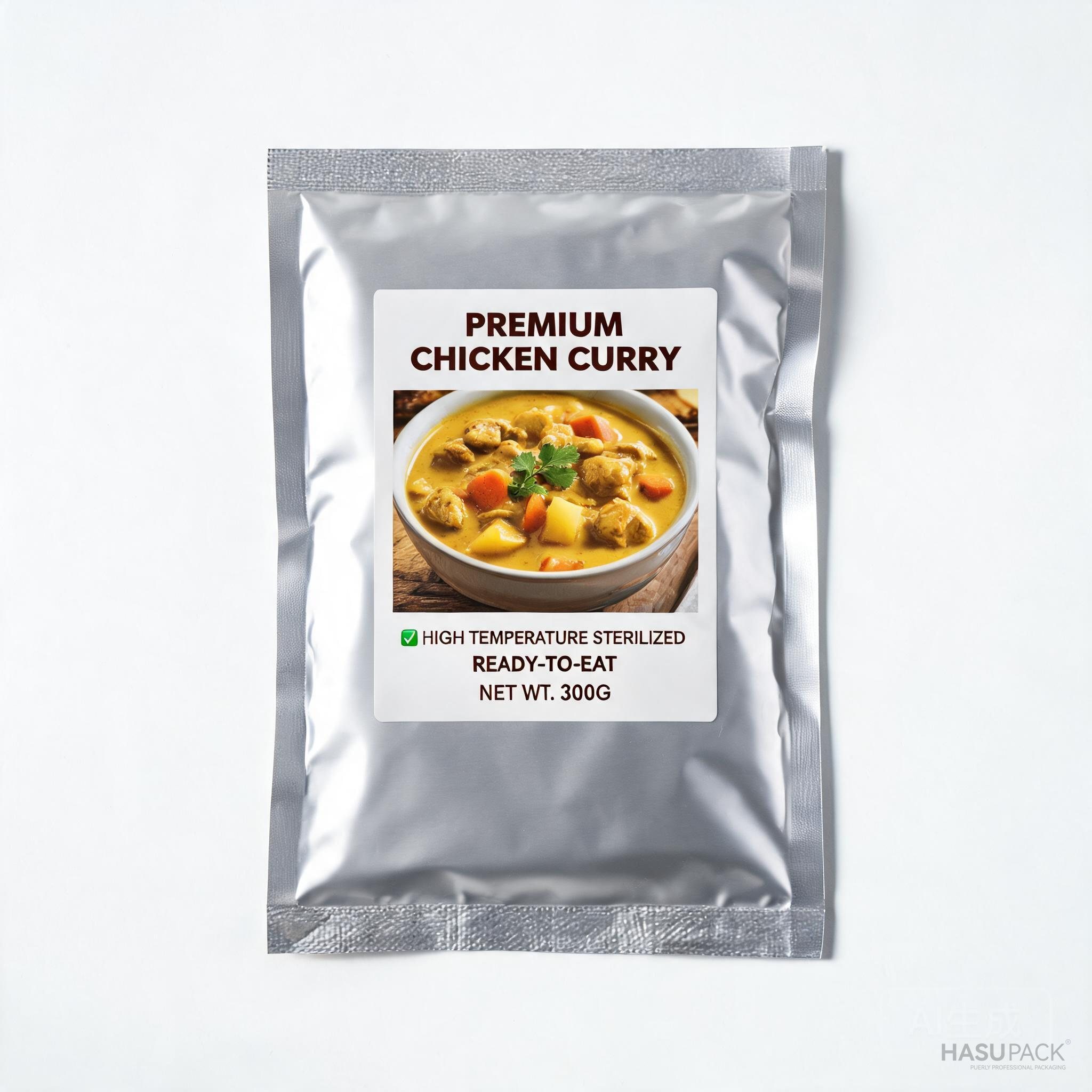
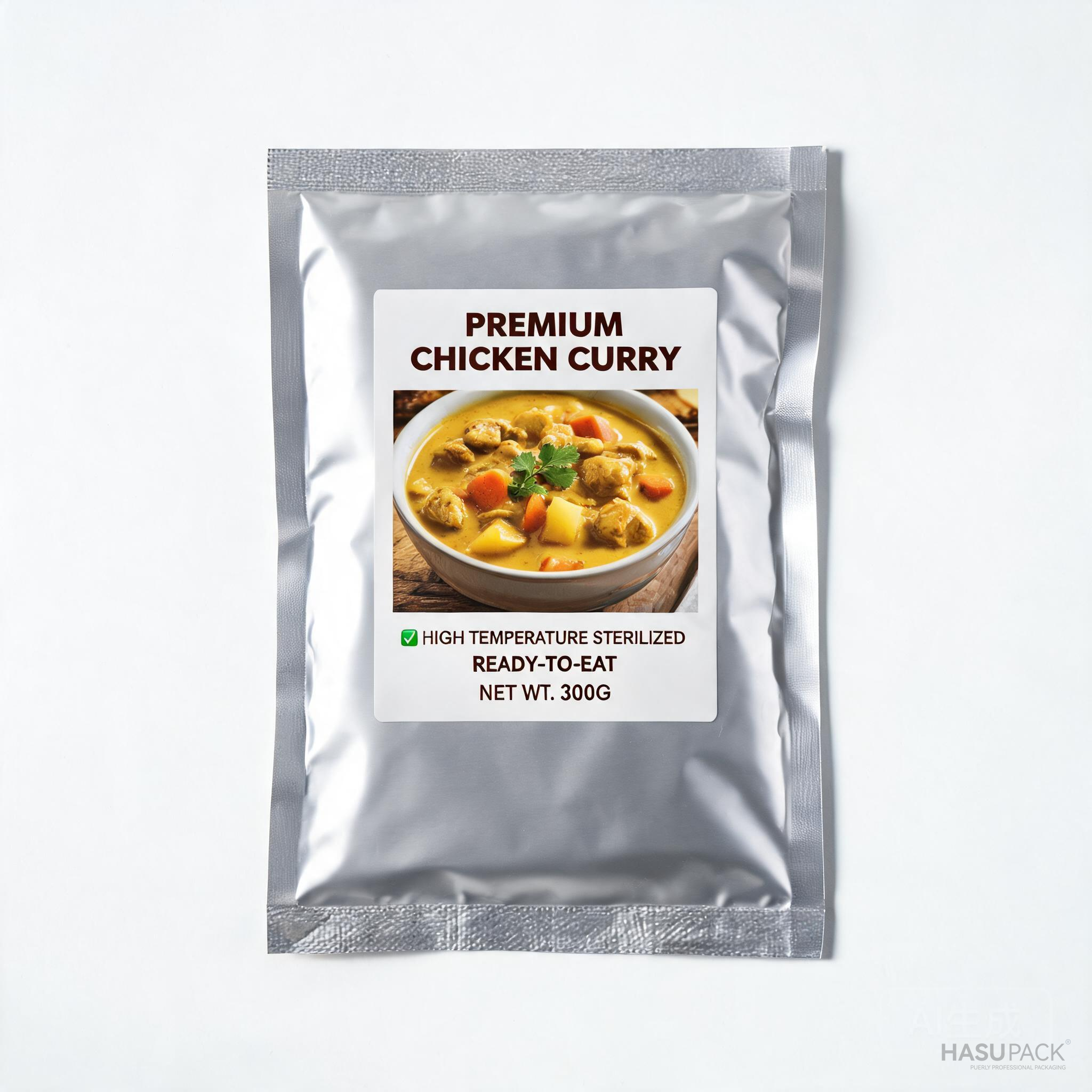
High-temperature retort pouches are among the most widely used high-temperature sterilization packages in the food industry. From braised meat products and ready-to-eat meals to wet pet food, this type of flexible packaging—which can complete sterilization at temperatures of 121℃ or even 135℃—is indispensable. Many customers ask when selecting a format: an ordinary plastic bag would deform and melt in a hot retort, so why can a retort pouch withstand 121℃ sterilization? What is special about its structure, materials, and production process? From a manufacturing perspective, this article gives you a complete explanation of how retort pouches work, their materials, applications, and key selection points.
Why Retort Pouches Resist 121℃: Materials and Structure Explained
The secret to a retort pouch withstanding 121℃ lies in its multi-layer laminate structure. A typical high-temperature retort pouch is built from the outside in as follows: an outer polyester (PET) film that provides stiffness and the printing surface; a middle layer of aluminum foil (AL) or nylon (PA) that provides barrier properties and puncture resistance; and an inner layer of cast polypropylene (CPP) or high-density polyethylene (HDPE) that handles heat sealing and food-safe contact. These three layers are bonded by dry lamination or solventless lamination, each performing its own role: PET resists high temperature and prints well; AL fully blocks oxygen, light, and moisture; and the CPP heat-seal layer retains its seal strength in a 121℃ steam environment without delaminating or softening.
It should be noted that the adhesives and inks used in retort pouches are high-temperature grades. Adhesives in ordinary laminated pouches may hydrolyze under high heat, causing the pouch to delaminate or blister, whereas retort-grade adhesives are specially formulated to maintain stable bond strength even at 121℃ for 30 to 40 minutes under high pressure. This is also the fundamental reason retort pouches cost more than ordinary laminates—every layer and every auxiliary material is selected for high-temperature resistance. For more on heat-resistant materials, see our earlier article, Heat-Resistant Packaging Materials: From 121℃ Retorting to Microwave Heating.
Three Main Types of Retort Pouches and Their Applications
Based on whether they include aluminum foil, retort pouches fall into two main categories: transparent retort pouches and aluminum-foil retort pouches. A transparent retort pouch is made of PET, PA, and CPP, allowing the contents to be seen; it suits products with moderate barrier requirements such as ready-to-eat vegetables, braised eggs, and snack foods. An aluminum-foil retort pouch adds a foil layer for the highest barrier level, suited to oxygen- and light-sensitive products like meat, fish, and curry that need long-term ambient storage, with a shelf life of 12 to 24 months. By pouch format, common options are three-side seal pouches, stand-up pouches, and side-gusset pouches; a stand-up retort pouch also supports shelf display.
In terms of applications, retort pouches cover almost every food category that requires “ambient-temperature long shelf life”: Chinese prepared-meal kits, braised meat products, snack braised foods, wet pet food, military rations, and emergency food. Compared with frozen food, retorted products need no cold chain, sharply lowering storage and transport costs—which is exactly why the foodservice chain and prepared-meal industries adopt retort pouches in large volumes.
Four Key Metrics for Selecting Retort Pouches
First, check barrier performance. For meat products requiring long-term ambient storage, choose an aluminum-foil structure with an oxygen transmission rate below 5 cm³/m² per day. Second, check seal strength. After retorting, seal strength should remain above 40 N per 15 mm; otherwise the pouch is prone to bursting during transport and handling. Third, check puncture resistance. Bone-in meat or freeze-and-reheat products need a thickened PA layer to prevent bones or sharp objects from puncturing the pouch. Fourth, check compliance credentials. Food-contact retort pouches must comply with the GB 4806 series of national food-safety standards; the manufacturer should hold the relevant food-packaging production license, and migration test reports should be requested when necessary.
Summary and Recommendations
A retort pouch withstands 121℃ sterilization through the coordinated roles of multiple material layers—PET, aluminum foil, PA, and CPP—together with high-temperature-resistant adhesives and inks. When selecting, do not look only at unit price; pay closer attention to the four hard metrics of barrier performance, seal strength, puncture resistance, and food-safety compliance. With the right structure, your product can deliver the commercial value of “ambient long shelf life and ready-to-eat convenience.”
Need custom retort pouches? Contact HASUPACK—we have mature retort-pouch production experience and a complete testing system. For more flexible packaging solutions, you can also visit OMOPACK.





