





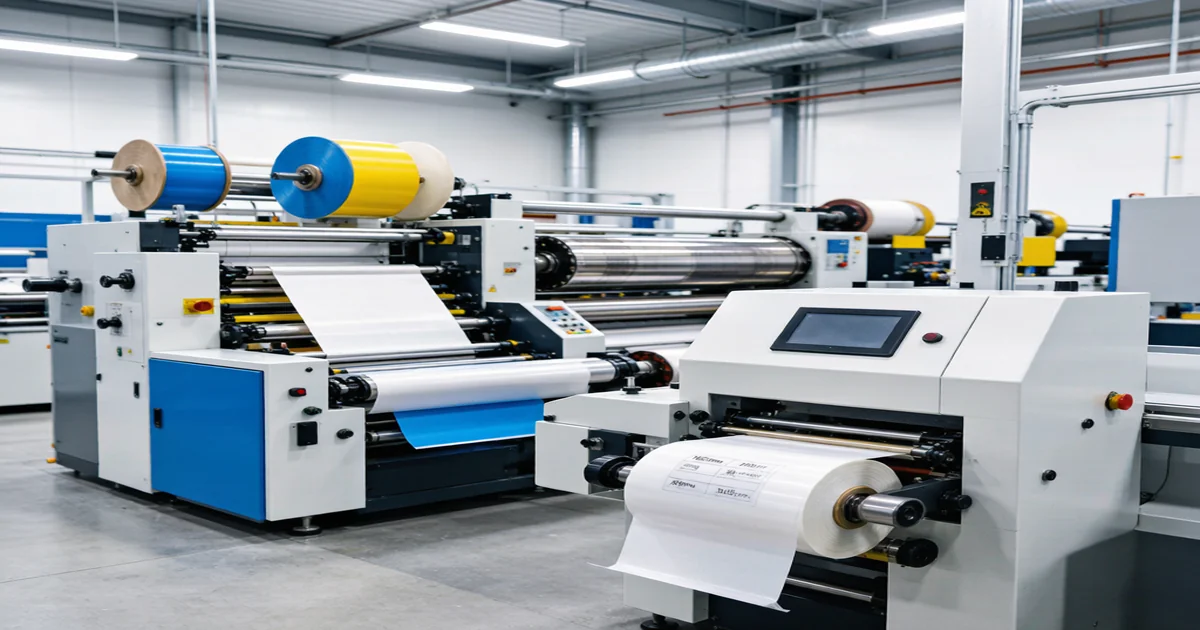
Many brands first encounter the question of “printing process” when ordering packaging: what exactly is the difference between gravure, flexographic, and digital printing? You do not need to memorize specifications. By following a clear packaging-printing-process decision chain, most orders can lock in a solution within ten minutes. This article organizes the factory’s typical judgment sequence into a decision tree, narrowing down from quantity, color, material to total cost, layer by layer.
Layer 1: Order Quantity Defines the Process Boundary
The first dividing line for printing processes is quantity. Digital printing has no plate-making cost, and its unit-price advantage is clear for runs under a few thousand, making it suitable for sampling, small-batch test marketing, and seasonal limited editions. Gravure printing requires plate-making costs and longer setup, but once a certain volume is crossed, unit cost drops rapidly, making it the mainstream choice for orders in the hundreds of thousands. Flexographic printing sits between the two, performing steadily on medium-to-long runs and paper-plastic laminate structures, especially for categories with moderate precision requirements but cost sensitivity.
The threshold is not a fixed value. The simpler the artwork and the fewer the colors, the lower gravure’s minimum order threshold; conversely, when there are many colors, gradients, and high registration requirements, the variable-data advantage of digital printing truly shows. Before deciding, ask three questions: how long will this batch be on sale? If it doesn’t sell, can the artwork be changed? Will the next revision require new plates?
Layer 2: Color Complexity and Registration Precision
Color is the second variable. Four-color (CMYK) printing suits photo-grade gradients and complex illustrations; spot-color printing is more reliable for brand-color consistency, especially for large background areas, metallic, and fluorescent colors. The criterion is straightforward: if the brand’s primary color tends to shift in four-color overprinting, or if there is a hard requirement against a color swatch, consider spot color, or a combination of spot plus four-color.
Registration precision determines the process ceiling. Film is stretched by tension during printing, and poor control causes registration drift. Gravure offers the most stable tension control and suits fine artwork; flexography adapts to a wider range of materials but is slightly weaker on fine lines and dot gradations. Therefore process selection is essentially a trade-off between artwork precision and cost, not a question of which is absolutely better.
Layer 3: Material Structure and Post-Press Process Compatibility
Processes never exist in isolation. For multi-layer structures such as PET/AL/PE and PET/VMPET/PE, decide the sequence of lamination and printing first, as the order directly affects print quality and appearance. If the finished product will undergo high-temperature retort, vacuum, or nitrogen flushing, the ink’s heat resistance, abrasion resistance, and low-migration properties must be confirmed in advance; otherwise the finished pouch will fail post-press testing.
For how to combine multi-layer structures, refer to our Composite Packaging Bag Layer Structure Guide; if you are still unsure what the final pouch will look like, we recommend reading the Pouch Making Process Explained first, then revisiting the printing plan.
Quick Comparison of the Three Main Processes
| Dimension | Gravure printing | Flexographic printing | Digital printing |
|---|---|---|---|
| Economical MOQ | Hundreds of thousands | Tens of thousands | Hundreds to a few thousand |
| Plate-making cost | High | Medium | None |
| Color performance | Fine gradation | Moderate | Rich gradients |
| Variable data | Not supported | Not supported | Supported |
| Plate change speed | Slow | Medium | Very fast |
Common Pitfall: Looking Only at Unit Price, Not Total Cost
The most common pitfall is comparing unit prices from quotes directly. Digital printing has a higher unit price but saves plate-making costs, so small batches are actually more cost-effective; gravure has a lower unit price, but if the order doesn’t reach the MOQ, the amortized actual cost can double. Also factor in sampling rounds, scrap rate, plate-change downtime, and inventory turnover. Total cost is the real basis for decisions.
A more hidden pitfall is ignoring material utilization. Different imposition layouts for the same artwork can differ by several percentage points in yield, which becomes a significant amount at scale. Therefore the final printing-process decision should be discussed together with pouch size and imposition plan.
A Decision Checklist You Can Use Right Away
- Quantity under a few thousand, artwork may be revised → prioritize digital printing
- Quantity in the hundreds of thousands, fine artwork, high color requirements → prioritize gravure
- Medium-to-long run, simple structure, cost-sensitive → prioritize flexographic printing
- Brand spot color or metallic color present → spot color, or spot plus four-color
- Requires high-temperature retort, vacuum, or nitrogen flushing → first confirm ink and laminate structure resistance
If your project is stuck at the crossroads of process selection, send us the pouch format, volume, and artwork requirements together, and our engineers will evaluate layer by layer against the decision tree and provide a quotation suggestion. Contact HASUPACK here. Acceptance criteria for printed products and laminated film can be checked against the GB/T 10004 standard for laminated film and pouches in the National Standards Full-Text Public System.





