





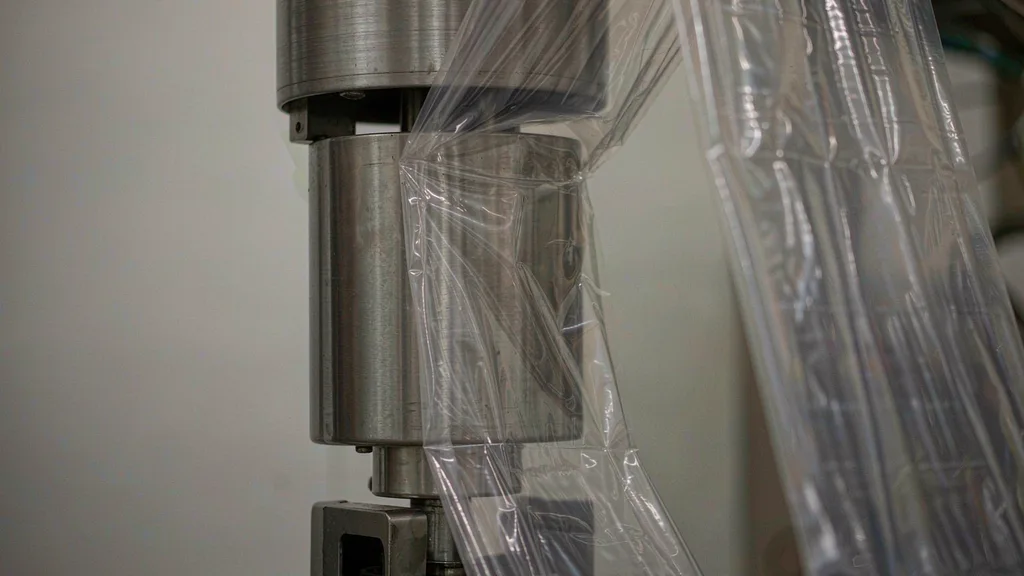
The packaging coefficient of friction (COF) is the first gate for whether rollstock film runs stably on an automatic packaging machine: if the outer dynamic COF is out of control, the film either slips on the rollers—causing print registration drift and seal misalignment—or “jams,” causing abnormal unwind tension and stops. For food plants running automatic lines, COF is not a decorative number on the converter’s datasheet; it is a key incoming spec on the same level as seal temperature and tensile strength.
This article covers the full technical line of packaging COF—from definition and test method to slip-agent mechanism and on-machine troubleshooting.
What Is the Packaging Coefficient of Friction
The coefficient of friction (COF) is the ratio of friction to normal force between two contacting surfaces, divided into static COF (μs) and dynamic COF (μk). For flexible packaging, what really decides on-machine performance is the dynamic COF, which describes the resistance level during relative sliding of the film surface.
The test method domestically follows GB/T 10006, “Plastics—Film and sheeting—Determination of the coefficients of friction,” corresponding to ISO 8295 and ASTM D1894. Standard conditions: at 23℃ and 50% relative humidity, the film sample slides against a stainless-steel sled (or film-on-film) at a specified speed, and the force curve is recorded to calculate the coefficient.
One often-overlooked point: COF is a property of “this pair of surfaces,” not of the film alone. The same roll against stainless steel and against another PE layer has completely different COF, so the spec must state “against what surface.” What matters on-machine is usually the outer film surface against the metal former and rollers; roll-to-roll blocking looks at film-on-film.
How Much COF Does the Machine Need
Experience: keep the outer dynamic COF of rollstock film between 0.15–0.35 for most high-speed VFFS and pillow-pack machines to run stably. Below 0.15, the film slips on rollers and formers, tension feedback distorts, and print alignment drifts; above 0.40, unwind resistance rises clearly, showing as “jamming” and film wrinkles on high-speed lines.
| Scenario | Outer dynamic COF reference range | Behavior |
|---|---|---|
| High-speed VFFS / pillow-pack machine | 0.15–0.25 | Stable film travel, steady registration |
| Medium-speed packaging machine | 0.20–0.30 | General-purpose range |
| Auto cartoning / product-handling conveyor | 0.25–0.40 | Needs some “grip” to prevent sliding |
| Low-temp cold fill / frozen line | Confirm by test | Passing at room temp ≠ passing at low temp |
Note a counter-intuitive point: slippery is not always better. Finished pouches stacked on a pallet need some pouch-surface friction to prevent slip and collapse, and single pouches on a conveyor need friction for separation. So incoming specs must be defined per “which surface, against what, used where”—exactly what HASUPACK confirms case by case when planning a packaging solution.
How Slip Agents Work
Polyolefin film (PE, CPP) has high surface energy and high friction by itself and needs slip agents to reach the on-machine range. The mainstream slip agents are erucamide and oleamide, typically added at 800–1500 ppm (about 0.08%–0.15%).
The mechanism is called “migratory lubrication”: amide molecules have limited compatibility with polyolefin and, during cooling and storage, keep migrating from inside the film to the surface, forming a monomolecular lubricant film. This means three things:
1. COF is a value that changes with time. Freshly produced film has high COF; after 24–72 hours of storage the slip agent migrates to the surface and COF drops to the design value. Film run right after lamination and film run after a week of curing can behave completely differently. 2. Temperature decides migration speed. Higher cure temperature and enough time let the slip agent migrate fully; in winter cold migration slows and the surface is “not slippery enough”—why the same film runs fine in summer but slips in winter. 3. Over-migration also has side effects. Excess slip agent blooms to the surface as haze and may contaminate the heat-seal face, lowering seal strength, or hurt later print and converting adhesion.
Working with slip agents is also the anti-block agent (opening agent)—inorganic silica particles that hold tiny gaps between roll layers to prevent blocking after winding, but they raise surface roughness slightly and nudge COF up. One manages sliding, the other manages layer separation; the formulation must balance them.
Why Winter and Summer Behave Differently
Low and high temperature are the two peak scenarios for COF complaints:
- Winter cold: the slip-agent migration rate drops markedly with temperature, the surface lubricant layer is incomplete, showing as outer slipping and high former resistance. Countermeasures: raise slip-agent dosage appropriately (confirm formulation with the converter), extend film storage/cure time, or let the roll condition at 23℃ for 24 hours before use.
- Summer heat and sun exposure: in transit the trailer can exceed 50℃, accelerating slip-agent migration and possible local bloom, showing as a sticky surface, higher haze, and heat-seal contamination. Countermeasure: avoid long sun exposure of rolls, and store in a cool place after intake.
Troubleshooting Order for On-Machine Anomalies
When the automatic packaging machine shows unstable film travel, follow this order to avoid the detour of “change the film first, find the cause later”:
1. Classify the symptom: slipping (film slides on rollers, registration drifts) or jamming (unwind tension alarm, film wrinkles)? Opposite directions, opposite fixes. 2. Measure outer dynamic COF: sample per GB/T 10006, measure film vs. stainless steel at 23℃/50%RH. For slipping, first see if this value is below 0.15. 3. Check film storage time: film cured within 48 hours has unstable COF; let it rest and re-test before rejecting. 4. Check the equipment side: roller parallelism, roller wear and contamination, unwind tension setting—these cause over half of actual complaints. 5. Look at ambient temperature: cold season → insufficient slip-agent migration first; hot season → bloom contamination first. 6. Confirm inner-layer blocking: if roll layers will not separate, that is the anti-block agent and winding tension, not outer COF.
Corresponding incoming-inspection wording: outer dynamic COF (23℃, vs. stainless steel) 0.15–0.30, tested per GB/T 10006, with measured values attached per batch. This spec is executable and leaves room for formulation adjustment—far more effective than the vague “surface feels slippery.” For the full incoming-inspection framework, see our flexible packaging incoming inspection: 8 acceptance standards for buyers and plants; for puffed-food lines sensitive to friction, also read puffed snack packaging: breakage control from filling to transit together, planning film-travel stability and finished-product breakage as one.
Common Questions FAQ
What is the packaging coefficient of friction (COF)? COF is the ratio of friction to normal force between two contacting film surfaces, divided into static and dynamic COF. The dynamic COF describes the resistance level during sliding and is the key metric for whether rollstock film runs stably on an automatic packaging machine.
By what standard is the packaging COF tested? Domestically per GB/T 10006, corresponding to ISO 8295 and ASTM D1894, standard conditions are 23℃ and 50% relative humidity, with the film sample sliding against a stainless-steel sled at a specified speed.
What outer dynamic COF is suitable for rollstock film? Most automatic packaging machines require outer dynamic COF in the 0.15–0.35 range; high-speed vertical form-fill-seal machines should stay within 0.15–0.25. Below 0.15 it slips easily; above 0.40 it jams and the film wrinkles.
How do slip agents make the film slippery? Erucamide, oleamide, and similar slip agents added to polyolefin film gradually migrate from inside the film to the surface, forming a monomolecular lubricant layer that lowers COF. This changes with time and temperature, so a freshly produced film and one stored for days have different COF.
Why does the film slip easily on the machine in winter? At low temperature the slip-agent migration rate drops markedly, the surface lubricant layer is incomplete, and COF is high. Countermeasures include confirming slip-agent dosage with the converter, extending storage/curing time, and letting the film roll condition at 23℃ for 24 hours before running.
Is more slip agent always better? No. Excess slip agent blooms to the surface, raising haze, contaminating the heat-seal face, lowering seal strength, and possibly hurting later print adhesion. Typical addition is 800–1500 ppm and must be balanced with the anti-block formulation.
How should COF criteria be written for incoming inspection? State “outer dynamic COF (23℃, film vs. stainless steel) 0.15–0.30, tested per GB/T 10006, with measured values attached per batch,” specifying test conditions, mating surface, and batch requirement, avoiding vague “surface slippery” wording.





