





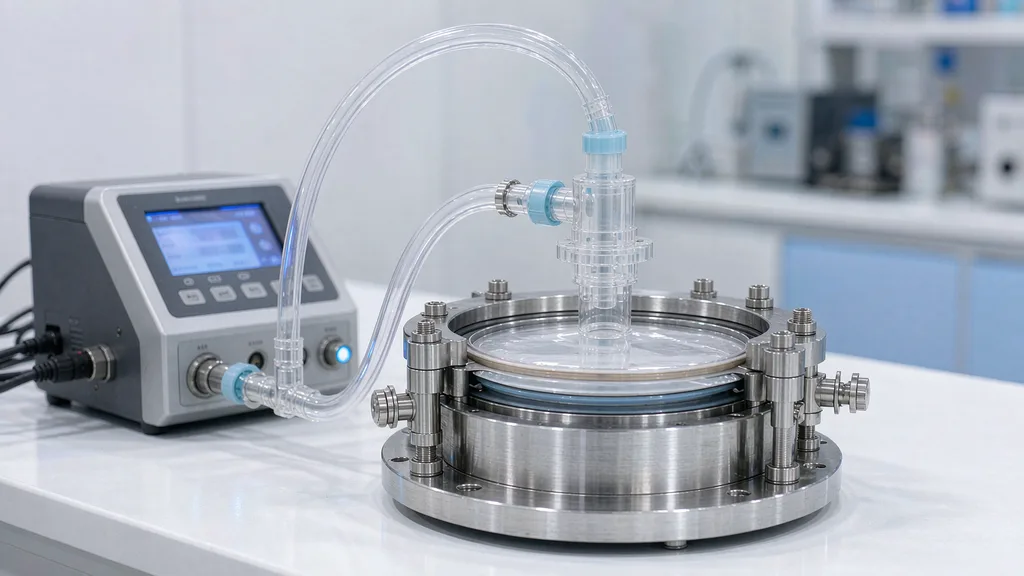
Flexible packaging barrier testing mainly measures two things: oxygen transmission rate (OTR) and water vapor transmission rate (WVTR). When reading the data you must look at three things together—the value, the test conditions (temperature and humidity), and the test method standard. A test report that gives only a number without conditions has no comparison value for selection.
What Does Barrier Property Testing Actually Measure?
Barrier property describes the rate at which gas or water vapor passes through the packaging material. It is not an “inherent property” of a material, but the result of structure, thickness, temperature, and humidity acting together.
- Oxygen transmission rate (OTR): the volume of oxygen passing through a unit area of film per unit time. Lower is better oxygen barrier.
- Water vapor transmission rate (WVTR): the mass of water vapor passing through a unit area per unit time. Lower is better moisture barrier.
- For oily, nut, coffee, and baked products, oxygen is the main enemy; for powders, crisps, biscuits, and freeze-dried products, water vapor is the main enemy; many products need both.
The selection logic for barrier is “reverse”: first set the shelf life and acceptable quality change, then work backward from the product’s sensitivity to OTR and WVTR limits, and only then choose the material structure. The reverse (choose material first, then see how long it lasts) often causes over-packaging or failing the shelf life.
Units and Conversion: Don’t Let cm³/(m²·24h·atm) Confuse You
The easiest place to err in barrier data is inconsistent units. Common forms:
| Item | Common unit | Meaning |
|---|---|---|
| Oxygen transmission rate | cm³/(m²·24h·atm) | Oxygen volume through 1 m² per day (1 atm pressure difference) |
| Oxygen transmission rate | cm³/(m²·24h·0.1MPa) | Nearly the same numeric value as the previous unit (1 atm ≈ 0.101325 MPa) |
| Oxygen transmission rate (US) | cm³/(100 in²·24h) | 1 cm³/(100 in²·24h) ≈ 15.5 cm³/(m²·24h) |
| Water vapor transmission rate | g/(m²·24h) | Water vapor mass through 1 m² per day |
| Water vapor transmission rate (US) | g/(100 in²·24h) | 1 g/(100 in²·24h) ≈ 15.5 g/(m²·24h) |
| Thickness-normalized | cm³·µm/(m²·24h·atm), g·mm/(m²·24h) | For comparing intrinsic material performance; not for comparing finished products |
Conversion error is a common cause of selection accidents. US and metric units differ by over 15×; if a supplier quotes in US units but the buyer reads them as metric, the barrier ability can be misjudged by an order of magnitude.
Also separate “intrinsic material value” from “finished-product value.” Thickness-normalized data compares the resin or film itself, but a finished pouch’s barrier depends on total laminate thickness, layer order, adhesive layer, creases, and seals—the two must not be mixed.
Test Conditions Must Be Read Together: Temperature and Humidity Decide the Value
The same film measured under different conditions can differ several-fold—the most misread part of barrier data.
- Temperature effect: transmission rises markedly with temperature. Roughly every 10℃ rise multiplies transmission by about 1.5–2×. Chilled products (0–4℃) usually transmit well below the 23℃ test value, while ambient-distribution products (25–35℃) may exceed it.
- Humidity effect: OTR is usually labeled 23℃/0%RH or 23℃/50%RH; WVTR common condition is 38℃/90%RH. For hydrophilic materials (EVOH, nylon) humidity matters hugely—EVOH’s oxygen barrier in high humidity can drop by over an order of magnitude.
- Test method difference: equal-pressure and differential-pressure methods on the same film give different results. Differential-pressure is more sensitive to sample sealing; equal-pressure (coulometric) is closer to real use.
Therefore, when requesting quotes and comparing, unify the supplier’s data to the same standard and same conditions, and note the standard number.
Test Methods and Corresponding Standards
| Item | Common method | Standard | Note |
|---|---|---|---|
| Oxygen transmission rate | Equal-pressure (coulometric sensor) | ASTM D3985, ISO 15105-2 | Stable result, most used for flexible packaging |
| Oxygen transmission rate | Differential-pressure | GB/T 1038, ISO 15105-1 | Suits high-barrier materials; watch sample sealing |
| Water vapor transmission rate | Infrared sensor | ASTM F1249, ISO 15106-2 | Fast; common for film spot checks |
| Water vapor transmission rate | Cup (gravimetric) | GB/T 1037, ISO 15106-1 | Traditional reference method; slower |
| Finished pouch | Headspace oxygen, whole-pouch leak | Reference GB/T 10004, industry method | Verifies structure and seal, not single film |
Emphasis: film data cannot replace finished-pouch data. A finished pouch’s barrier is also affected by seal width, creases, and pouch format (stress concentration at bottom gussets); transmission at the crease zone can be over 50% higher than on flat areas.
Barrier Grade Reference for Common Film Structures
The following are common order-of-magnitude references (actual data vary with thickness, process, and test conditions; for judging the tier at selection only).
| Structure (example) | OTR order of magnitude | WVTR order of magnitude | Use case |
|---|---|---|---|
| LDPE / PE monolayer | 1000–2000+ | 8–15 | Short-term moisture barrier, no oxygen requirement |
| BOPP | 1500–2500 | 5–8 | General packaging, puffed-food outer bag |
| PET / PE | 50–120 | 8–15 | Regular food, medium shelf life |
| BOPA / PE | 30–50 (dry) | 100–200 | Puncture priority, bone/shell products |
| VMPET / PE (metallized) | 1–5 | 1–2 | Mid-to-high barrier, needs light protection |
| PET / EVOH / PE | 0.1–1 (dry) | 3–8 | High oxygen barrier, mid-to-long shelf life |
| PET / AL / PE (pure aluminum) | ≈0 (<0.01) | ≈0 | Long shelf life, very high barrier, needs light protection |
From the table: nylon has decent oxygen but very poor moisture performance, suiting puncture structures not moisture barrier; metallized is the “cost-effective barrier” but creases can form pinholes that worsen the numbers; pure aluminum foil nearly fully blocks but costs microwave-unsuitable and non-recyclable. For structure and selection discussion, see this high-barrier packaging material guide; for coffee and coffee powder that fear both oxygen and moisture, the barrier focus after grinding is covered in coffee powder packaging barrier focus.
Six Common Misconceptions
- Only look at single-film values: the finished product is a laminate; adhesive layer, print face, and creases all change real barrier.
- Ignore thickness normalization: comparing samples of different thicknesses directly gives a wrong conclusion.
- Ignore seal and crease: insufficient seal width or micro-cracks at creases are frequent real failure causes.
- Report only a number without conditions: WVTR at 38℃/90%RH vs 23℃/50%RH can differ several-fold.
- Only look at initial value: barrier after creasing, after chilling, and at end of shelf life reflects real performance.
- Use film data to infer shelf life: shelf life must be verified by physical accelerated or real-storage tests.
Applying Test Data to Selection and Shelf-Life Estimation
- Set internal limits: write OTR and WVTR internal limits into the purchase spec and require per-batch test data.
- Post-crease testing: crease the finished pouch as specified then re-measure, closer to real distribution state.
- Separate chilled and ambient: the same structure’s equivalent shelf life in cold chain vs ambient can differ several-fold; verify separately.
- Accelerated testing: commonly 30℃/65%RH or 40℃/75%RH for acceleration, building a shelf-life model with transmission data, then correcting with real storage data.
- Finished-end verification: for high-value products, periodically sample headspace oxygen and whole-pouch leak, forming a closed loop from film to finished pouch.
- Watch aluminum foil structure’s real performance: pure aluminum foil has very high barrier, but pinholes, seal contamination, and creases markedly weaken real performance; see the aluminum foil pouch buying guide for judgment methods.
FAQ
What is the difference between oxygen transmission rate (OTR) and water vapor transmission rate (WVTR)?
OTR is the rate oxygen passes through the film, usually written cm³/(m²·24h·atm); WVTR is the rate water vapor passes through, usually g/(m²·24h). They address different spoilage mechanisms: oily products mainly fear oxygen; powders, crisps, and freeze-dried products mainly fear moisture; many products need both controlled.
Why do the same film’s barrier numbers differ so much between reports?
Because test conditions and methods differ. Roughly every 10℃ rise multiplies transmission by about 1.5–2×; WVTR at 38℃/90%RH vs 23℃/50%RH can differ several-fold. Equal-pressure vs differential-pressure, infrared vs cup methods also have systematic differences, so comparison must unify standard and conditions.
Is nylon (PA) film suitable for moisture-barrier packaging?
No. Nylon’s strength is puncture resistance and temperature tolerance, with mid-to-upper oxygen performance but very high WVTR, making it moisture-sensitive. Bone-in, shell-on, puncture-prone products suit nylon as outer or middle layer, but need a separate moisture-barrier layer.
Is EVOH’s oxygen barrier affected by humidity?
Yes, greatly. EVOH is hydrophilic; in high humidity its oxygen barrier can drop by over an order of magnitude. So EVOH is usually sandwiched in the middle, protected on both sides by hydrophobic layers like PE, avoiding direct contact with high-humidity contents or outside moisture.
Why does a pure aluminum foil pouch with near-zero barrier data still leak?
Because real failure comes from structural defects, not the material. Seal-zone contamination, pinholes at creases, and insufficient seal width push actual transmission far above the film’s nominal value. So pure aluminum foil structures also need whole-pouch leak and seal-integrity verification.
How should a finished pouch’s barrier be tested?
Not film-only. Recommend headspace oxygen measurement and whole-pouch leak test on finished pouches; if needed, crease the finished pouch then measure transmission. Sample periodically to build the link between film data and finished-pouch data.
What information must a test report include?
Must include: test standard number, temperature and humidity conditions, sample spec and thickness, test method and equipment type, and units. Missing any one makes the data impossible to compare across suppliers or use to set purchase limits.





