





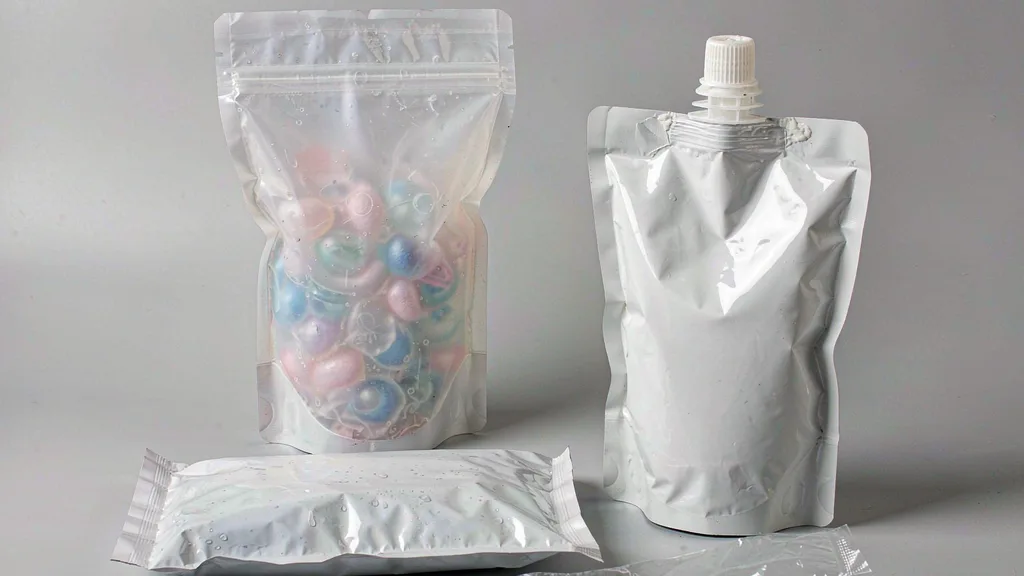
The material-selection logic for daily-chemical flexible packaging differs fundamentally from food packaging: most daily-chemical contents are not oxygen-sensitive; what they fear is water, solvents, and migration or leakage from prolonged contact. The outer pouch of laundry pods must do everything possible to block moisture; wet-wipe pouches must prevent water from slowly escaping under the resealable lid; refill pouches must withstand the flexing stress of repeated emptying. When customizing packaging for daily-chemical clients, HASUPACK first clarifies the product’s failure modes before fixing the structure. This article breaks down the four most common failure modes—leakage, moisture loss, fading, and seal contamination—one by one, to help you decide where your budget should go within the structure.
Three Special Requirements Daily-Chemical Contents Place on Packaging
First is resistance to content attack. Surfactants, alcohol-based solvents, and fragrances permeate ordinary PE film far more readily than the water or oil found in food systems; over prolonged contact they migrate outward from the inner layer—at best causing blistering of the printed layer, at worst “eating” channels through the seal. Daily-chemical structures therefore often require an inner layer with better chemical resistance, or an extra margin of thickness. Second is fragrance retention. Half of a daily-chemical product’s shelf competitiveness comes from its scent; fragrance compounds are chemically complex with a wide molecular-weight range, and low-molecular-weight esters and aldehydes slowly penetrate ordinary PE, so a pouch with weak scent barrier shows noticeably faded aroma after six months. Third is the mechanical demand of the use scenario: daily-chemical packaging must endure high-humidity bathroom environments, repeated opening and closing, and emptying actions—factors that determine seal width, lid adhesive properties, and bottom construction.
Failure Mode 1: Leakage and Moisture Uptake in Laundry Pods
Laundry pods are among the most demanding categories in daily-chemical flexible packaging, because the contents are vulnerable “from both sides.” The pod skin is a polyvinyl alcohol (PVA) water-soluble film that dissolves on contact with water, so the outer pouch must keep moisture out for the entire shipping and storage cycle. Once the outer pouch’s moisture transmission exceeds limits and the skin becomes damp and sticky prematurely, the whole pod cluster can fuse together on the shelf—the single most common source of pod complaints. Conversely, pod contents have high water content (formulation moisture is typically around 10%), so if the outer pouch’s moisture barrier is insufficient, slow outward moisture loss causes the pods to lose weight and the skin to become brittle.
The common material approach is a high moisture barrier structure for the outer pouch—typically PET//aluminum foil (pure AL)//PE or PET//metallized//high-barrier PE—holding moisture vapor transmission below 1 g/m²·day, with foil structures going even lower. At the same time, the PE film in direct contact with the pods must be confirmed resistant to surfactants, to avoid slow content seepage that leaves an oily film on the pouch surface. Filling is equally critical: residual moisture and liquid retained at the fill neck after dosing create weak zones in the seal where it is contaminated, so pod pouches are usually sealed with an alcohol-content check or a moisture-purge step. To understand why barrier data is specified this way, this article on interpreting oxygen and moisture transmission test data explains the metrics in detail.
Failure Mode 2: Emptying Stress and Seal Fatigue in Refill Pouches
For liquid detergent and fabric-softener refill pouches, the core conflict is “lightweight packaging carrying a large-volume contents.” During emptying a 2 kg refill, the pouch endures dozens of repeated flex cycles, concentrated at the bottom and side seals; if the PE layer’s fatigue resistance is insufficient, fine cracks appear and eventually leak. For large-capacity refills, the common material choice is a thickened PE inner layer or a PA/PE structure to improve fold resistance, with a rounded-corner die-cut at the bottom to reduce stress concentration.
Another decision point for refills is the cap type. A spout cap costs significantly more than a flat-edge pouch, but delivers two experience upgrades—clean emptying and upright storage—suitable for products with large single-use doses that hang beside the washing machine. A flat-edge pouch with a tear notch is cheaper and suits one-time, single-use refills. Details of the pour experience (cap type, orifice diameter, and leak prevention) are covered in HASUPACK’s article on choosing spout-pouch caps. Cost-sensitive buyers can also consult the layer count and structure diagrams for laminated pouches to judge whether a three-layer structure is needed for their refill.
Failure Mode 3: Moisture Lock and Repeated Opening of Wet-Wipe Pouches
Wet wipes are a classic “contents don’t spoil, but the packaging fears moisture loss” category. Wipe moisture content is typically between 180% and 250%; once it drops below 100%, the wiping experience falls off a cliff. Wet-wipe pouches therefore rank at the top of all daily-chemical categories for moisture-barrier requirements. The mainstream structure is PET//AL//PE or PET//high-barrier metallized//PE, holding moisture vapor transmission to the order of below 0.5 g/m²·day.
But the real difficulty with wet-wipe pouches is repeated opening and closing: the lid tape is peeled off and pressed back dozens of times a day, and once the adhesive degrades, moisture transmission at the lid edge far exceeds the film’s designed value. When selecting, look at three details: the lid adhesive’s durability (a good lid stays sealed after hundreds of open-close cycles), the flatness of the lid-to-pouch bond (wrinkles are a shortcut for moisture), and the match between lid size and pouch width. The industry standard is to accept the pouch by its whole-pouch moisture transmission after the lid is applied—not by the film’s MVTR report alone. Once the lid is on, whole-pouch performance and bare-film data are two different things.
Failure Mode 4: Fading and Ink Migration
Daily-chemical products sit under retail-store lighting and beside bathroom windows far longer than food, so fading is amplified. The countermeasures work on three levels: choose inks with a higher lightfastness rating, especially for the main visual color; switch from surface printing to reverse (subsurface) printing so the ink is sandwiched between film layers and shielded from direct light; and add a UV-blocking layer or select a film with UV absorbers. In addition, fragrances can extract plasticizers from the ink, so the bond strength of reverse-printed structures should be spot-checked periodically to prevent layer separation caused by extraction—this is most common in high-fragrance hand washes and shampoos.
FAQ
Why must the laundry-pod outer pouch use an aluminum-foil structure?
Because the pod’s PVA skin dissolves on contact with water, the outer pouch must hold moisture transmission to an extremely low level throughout the shelf life, and aluminum foil is the only conventional material that approaches zero transmission. A metallized-plus-high-barrier-PE combination is also common for cost-sensitive products, but its shelf performance must be validated by sampling.
Why does the bottom of a refill pouch crack easily after emptying, and how to fix it?
Bottom cracks come from repeated flex-fatigue. The fix is to thicken the inner layer or switch to a PA/PE structure to improve fold resistance, add a rounded-corner die-cut at the bottom to reduce stress concentration, and keep the fill volume within the designed capacity.
How low must a wet-wipe pouch’s moisture transmission be?
The mainstream requirement is on the order of below 0.5 g/m²·day, and it must be measured as the whole-pouch transmission after the lid is applied. Lid-adhesive degradation is the number-one cause of moisture loss in wipes; passing the film’s data does not mean the whole pouch passes.
How to prevent fading in daily-chemical packaging?
Three approaches together: use inks with a higher lightfastness rating, adopt reverse printing so the ink avoids direct light, and add a UV-blocking layer in the structure. High-fragrance products also need periodic bond-strength checks to prevent layer separation from fragrance extraction.
Are seal-strength standards for daily-chemical pouches the same as for food?
The core test methods are the same, but the acceptance values are usually higher, because surfactants and solvents in daily-chemical contents continuously attack the seal throughout shelf life. When customizing, provide the content formulation to the factory for compatibility testing rather than simply adopting food acceptance values.
For refills, choose a spout pouch or a flat-edge pouch?
It depends on how it is used. Products that need repeated access and upright storage should choose a spout pouch—clean emptying and good experience. One-time refills should choose a flat-edge pouch with a tear notch, at lower cost. Trade-offs of cap type and orifice diameter are covered in our dedicated spout-pouch article.





