





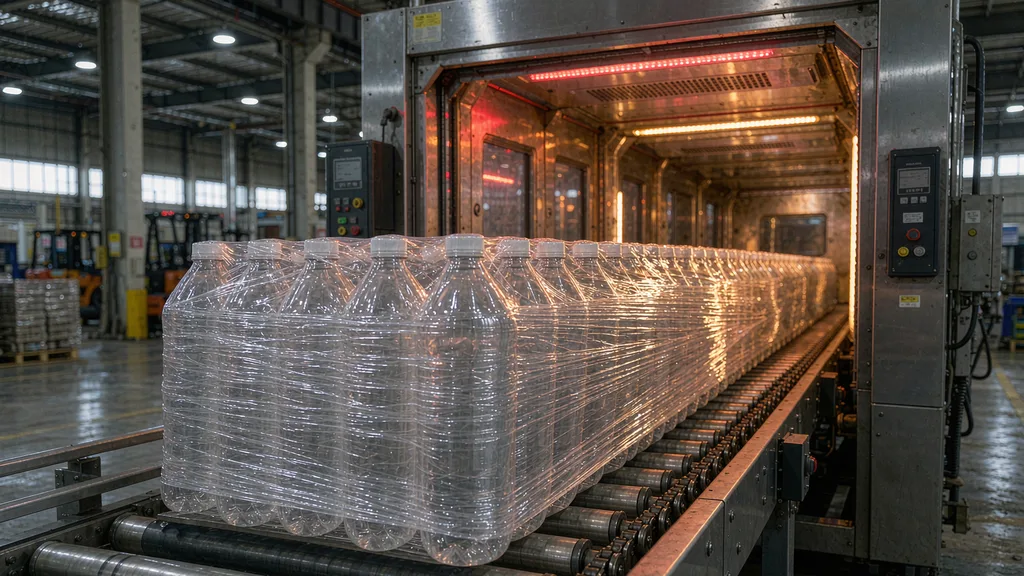
Choosing heat shrink film starts with three parameters: shrinkage rate (viewed separately for transverse and machine directions), shrink temperature window, and shrink tension. Food multipacks mostly use POF (shrinkage 60%–70%, initial shrink temperature about 110–130 ℃), while pallets and heavy goods use PE shrink film (thickness 50–150 μm, shrinkage 20%–40%); PVC is being phased out of food-contact applications due to chlorine content and plasticizer concerns.
How Does Heat Shrink Film Work?
The principle of heat shrinking is “orientation—setting—recovery.” After extrusion the film is stretched and oriented in the rubbery state; the pulled-apart molecular chains are then rapidly cooled and frozen. When reheated above the orientation temperature, the frozen chains recoil to their original disordered state, which manifests macroscopically as shrinkage.
With this understood, the three key indicators become clear:
- Shrinkage rate = (length before shrink − length after shrink) ÷ length before shrink × 100%. Test method per ASTM D2732 (free linear heat shrinkage of film).
- Free shrinkage differs from restrained shrinkage. In real packaging the film is restrained by the contents and cannot reach the free-shrinkage value; the remaining shrinkage converts into shrink tension. Excessive tension tears the film or deforms the pallet load.
- Transverse (TD) and machine-direction (MD) shrinkage are not equal. Multipacks need large transverse shrinkage and small machine-direction shrinkage, so the film hugs all four sides while the length does not pinch into a “wasp waist.”
Parameters Compared Across Four Mainstream Heat Shrink Films
| Material | Common Thickness | Shrinkage | Shrink Temperature Window | Key Advantages | Key Limitations |
|---|---|---|---|---|---|
| POF (multi-layer co-extruded polyolefin) | 12–30 μm | 60%–70% | 110–180 ℃ | Good toughness, low-temperature resistance, high seal strength, recyclable | High shrink-tunnel energy use, limited max thickness |
| PE (LDPE/LLDPE) | 40–200 μm | 20%–50% | 150–220 ℃ | High strength, tear resistance, suitable for heavy packaging | Lower clarity and gloss than POF |
| PVC | 12–25 μm | 40%–60% | 100–150 ℃ | Low cost, low shrink temperature | Chlorine content, plasticizers and odor, hard to recycle |
| PETG (shrink sleeve) | 30–70 μm | Transverse 60%–75% | 80–110 ℃ | Suited to full-wrap labels on irregular containers | Sleeves only, not for multipacks |
The selection boundary in food is already clear: for direct-contact food multipacks prefer POF; use PE to wrap whole pallets or heavy goods tightly; keep PVC only where it does not contact food and local regulations allow. EU-bound orders must also check Regulation (EU) 10/2011 on plastic food-contact materials, and domestic orders check GB 4806.7 and GB 9685.
How to Choose Thickness and Material by Scenario
| Scenario | Recommended Material | Recommended Thickness | Notes |
|---|---|---|---|
| Beverage and condiment multipacks | POF | 15–19 μm | Balances clarity and cost; replaces traditional outer carton |
| Outer multipack for frozen food | POF | 19–25 μm | POF does not embrittle at low temperature, withstanding below −40 ℃ |
| Whole-pallet wrap (stacking) | PE shrink film | 80–120 μm | High shrink tension, good stack stability |
| Heavy goods such as building materials, fertilizer | PE shrink film | 150–200 μm | Puncture and tear resistance prioritized |
| Full-wrap labels on irregular bottles | PETG sleeve film | 40–50 μm | High transverse shrinkage fits complex curves |
| Small-batch manual shrink | POF | 19–25 μm | Completed with a heat gun |
Thicker is not always better. Increasing thickness raises cost, lowers clarity, and demands a higher shrink temperature and longer dwell time. The basis for judgment is the sharpness of the contents’ edges and the post-stack stress, not the weight itself.
Shrink Equipment and Process Window
The same roll performs very differently on different machines; the core variables are three: temperature, dwell time, and air velocity.
- Hot-air circulation shrink tunnel (most common): even temperature, suited to continuous production. The key is in-tunnel air velocity and outlet layout; insufficient velocity causes incomplete local shrinkage.
- Steam shrink tunnel: high heat-transfer efficiency, even shrinkage, suited to heat-sensitive products and sleeves on irregular containers.
- Heat gun: only for small batches and field repairs; manual consistency is poor.
The recommended approach when setting up the machine is: fix the air velocity, start from the recommended lower temperature limit, raise 5 ℃ each step, observe the film’s surface state and fit, find the point that is “just tight, no orange peel, no tear,” then add 5 ℃ as the production setpoint.
Air release from the film also matters. Air inside the pack must escape during shrinking, otherwise bubbles and “fish eyes” form. The common practice is to micro-perforate the film; hole positions should avoid high-stress areas and the main printed graphics, and hole diameter and spacing should match line speed and shrink speed.
Common Failures and Troubleshooting
| Symptom | Primary Cause | Remedy |
|---|---|---|
| Incomplete shrink, loose | Low temperature or short dwell | Raise temperature or lower line speed; check in-tunnel air velocity |
| Orange-peel surface, wrinkles | Uneven temperature or insufficient air velocity | Adjust outlets; lower heating ramp rate |
| Holes, bursting | Excessive temperature or film too thin | Lower temperature, increase thickness, check contents’ sharp corners |
| Whitened, cloudy film | Temperature far above window upper limit | Lower temperature; verify material’s recommended temperature |
| Seal/cut line cracking | Seal-bar temperature or silicone pad anomaly | Adjust seal-cut parameters; check cutter condition |
| “Rabbit ears” at corners | Excessive transverse shrinkage or insufficient length allowance | Adjust film width and TD/MD shrink match |
| Contents deformed by constriction | Excessive shrink tension | Lower shrinkage rate or switch to a thicker, lower-tension film |
Procurement and Acceptance Key Points
Heat shrink film is usually quoted by weight or by square meter, but the real cost drivers are the film consumption per pack and the reject rate. At acceptance, clearly specify these six items:
- Thickness and tolerance: take multiple points with a thickness gauge; tolerance generally within ±8%.
- Shrinkage rate: spot-test per ASTM D2732, record transverse and machine directions separately.
- Area weight and roll length: convert to film cost per thousand packs.
- Seal strength and puncture resistance: especially for heavy and sharp-cornered products.
- Clarity and haze: affects shelf appearance; an upper haze limit can be agreed.
- Compliance documents: food-contact use needs GB 4806.7 and GB 9685 declarations of conformity; exports need Regulation (EU) 10/2011 or FDA-related documents.
If you also use stretch wrap film for pallet securing, do not mix their scenarios: How to Choose Stretch Film: Machine vs. Hand Use, Pre-Stretch Ratio, and Puncture Performance describes a system fixed by self-adhesion and stretch recovery—a completely different logic from heat shrinking. If the shrink film is run as rollstock on a machine, the basics of film feed and tension are in What Is Packaging Rollstock Film? A Full Guide to the Feedstock of Automatic Packaging Machines. Heavy outer packaging also needs overall consideration of seal strength and stacking—see How to Choose a 25 kg Heavy-Duty Bag: Trade-offs Among FFS Heavy Film, Valve Bags, and Seal Strength.
HASUPACK supplies custom slitting, printing, and perforation for POF and PE heat shrink film, matching shrinkage rate and thickness to line speed and contents shape, and provides food-contact compliance documents.
FAQ
What is the most essential difference between POF and PE shrink film?
POF is thin, high shrinkage, good clarity—suited to food multipacks; PE is thick, high strength, high shrink tension—suited to pallet wrap and heavy goods. They are not substitutes but divided by load level.
Is a higher shrinkage rate always better?
No. The higher the shrinkage rate, the greater the restrained shrink tension, which easily deforms or tears the contents. Irregular, fragile, or soft contents should use a moderate shrinkage rate with ample longitudinal allowance.
Can PVC shrink film still be used in food packaging?
Direct food-contact applications have largely phased out PVC, due to chlorine content, plasticizer migration, and recycling difficulty. EU, Japan, and other markets impose clear restrictions on chlorine-containing packaging; export orders should prefer POF.
Why is POF recommended for frozen food?
POF retains good flexibility and puncture resistance at low temperatures and does not embrittle at −40 ℃, whereas PVC tends to embrittle and crack at low temperature.
Why shouldn’t the shrink tunnel temperature be set very high at once?
Exceeding the upper window limit clouds and whitens the film and causes local holes, which usually appear at the highest-stress corners. The correct approach is to raise from the lower limit step by step to find the minimum temperature that fits well without defects.
How to tell whether the thickness is chosen correctly?
Watch two signals: whether corners tear after shrinking (too thin), and whether cost is clearly above comparable solutions (too thick). If both are normal but the stack loosens, raise the shrinkage rate or switch to PE rather than adding more thickness.
Is perforation necessary?
High-speed shrinking and highly sealed films usually need micro-perforations for air release, otherwise bubbles and fish eyes appear. At low speed or when the film is sufficiently breathable it can be omitted, but confirm with an actual line-speed trial first.





