





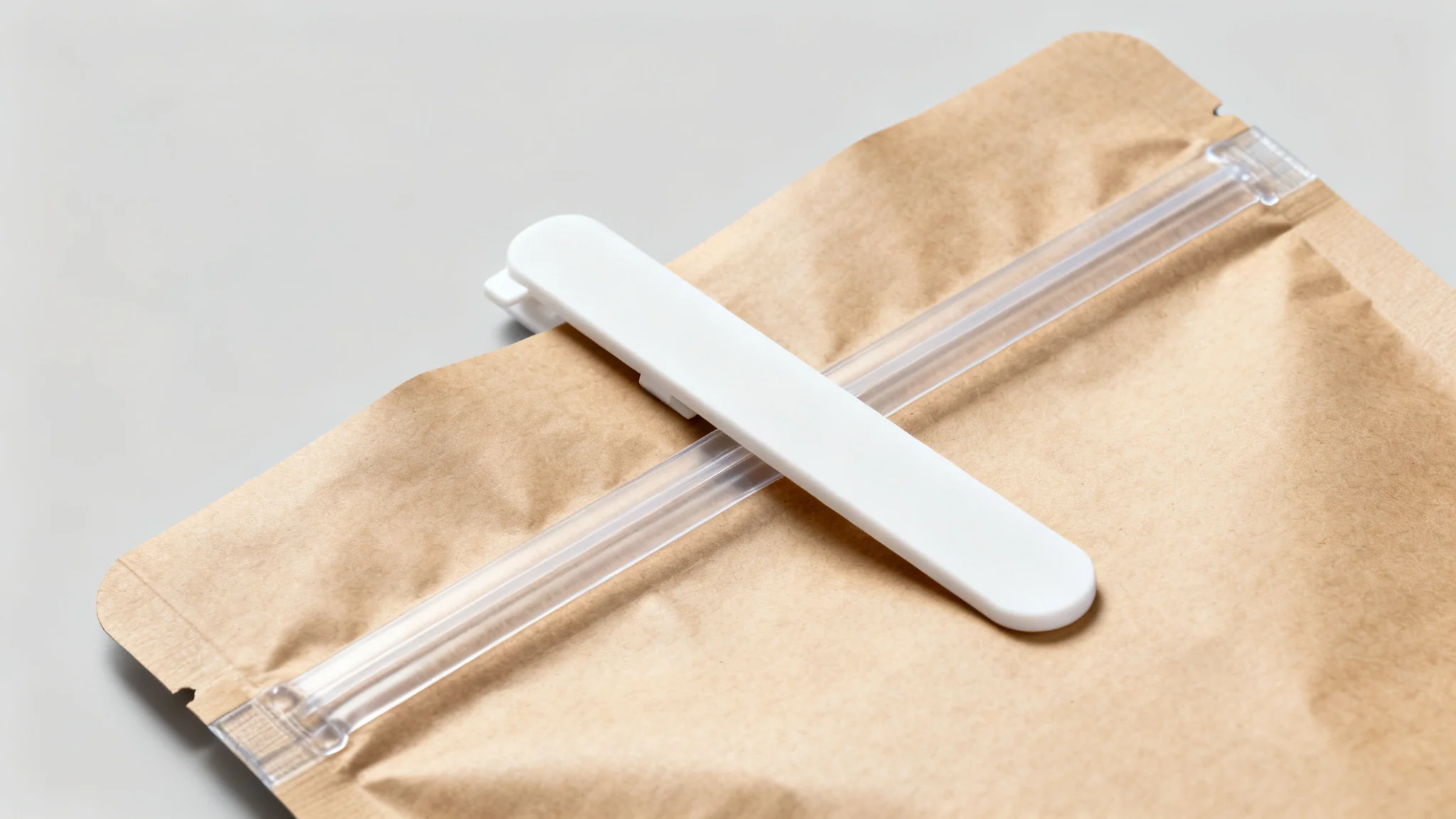
A slider zipper pouch moves the closing action from a press-to-close track into a moulded slider that rides along the track and locks the two profiles together. The visual change is small. The effect on filling, closure tolerance, opening force and tooling is not. This guide compares a slider zipper pouch with a press-to-close zipper on the points that decide a specification, and it marks where the extra hardware stops paying back.
Opening Mechanism: Track, Slider Body and Crimp Zone
Both formats use two interlocking profiles welded to the inside of the film. With press-to-close, the consumer aligns the profiles by hand and presses along the whole length, and a missed section becomes a leak path. With a slider, a moulded body sits over the track and an internal wedge forces the profiles together as it travels, so the closing force comes from the hardware instead of the hand.
The track needs end stops or a crimped zone so the slider cannot run off. The top seal loses width, because the track and the slider park zone sit below it. And the wider mouth helps a scoop get in, which is why treat and kibble packs such as this pet snack pouch use it.
Powder Contamination Inside the Track
Powder in the track is the most common field failure of any resealable powder pack. A few grams of fine product lodged between the profiles hold them apart by a fraction of a millimetre, and moisture or gas moves through that gap. The pack still looks closed, so the complaint arrives as caking or lost aroma.
Press-to-close depends on the consumer pressing along the full length, and nobody presses into a dirty section. A slider applies force progressively from one end to the other, so a light dusting is displaced instead of trapped. That tolerance is relative: heavier contamination still jams it, and the fill line still needs a clean fill zone, a de-dusting step such as an air knife, and an inspected seal area.
One-Handed Opening and the Senior-Consumer Requirement
Slider closures are easier to open with one hand or with limited grip, because the tab is pinched and pulled rather than picked apart. That matters for pet food, frozen goods and any pack opened while the other hand is busy, and it is why sliders appear on packs for older shoppers.
The advantage depends on the tab. A small flat slider on stiff film can be harder to grip than a generous press-to-close lip, especially after freezer storage. If ease of opening is a design goal, specify the tab size and check it against the actual film stiffness. A slider is also not a child-resistant closure; child resistance is a separate mechanism with its own test route under 16 CFR 1700.20.
What Do Slider Closures Add in Tooling and Unit Cost?
Slider hardware is a moulded part, so it adds material and a separate application step. Pre-made pouches usually arrive with the slider seated and the track ends sealed, so the filling line only opens, fills and seals. Form-fill-seal lines need an applicator and a jaw with clearance for the slider body, and the sealing sequence changes, as described in the packaging process instructions.
The useful cost comparison is per good pack, not per pouch. A slider adds unit cost and often a higher order minimum. In return it removes the leakers caused by an incompletely closed track. For a low-cost dry good opened once that trade rarely works; for a multi-serve bag reopened daily it usually does.
When Is a Slider Zipper Pouch Worth the Added Cost?
Use cases for a slider zipper pouch are packs reopened many times, filled with product that dusts the track, or handled in cold and wet conditions: multi-serve pet food and treats, frozen portions, powdered drink mixes, and larger retail bags where the closure matters. The pet food packaging solutions page shows the formats used in that segment, including a gusseted dog food zipper pouch.
The boundary sits on the other side. A single-serve sachet, a pack opened once and thrown away, a small bag where the slider body eats front panel space, or a limp film that cannot hold a track flat all point away from the slider. When to use one is a question about reopening frequency and contamination risk, not about perceived quality.
How Do You Test a Slider Closure Before Production?
Test the closure as a system, in this order, and keep all samples from one production run:
- Seal strength of the track-to-film weld and the top seal, on strips cut across the closure, following ASTM F88.
- Leak detection on filled packs by bubble emission under water following ASTM D3078, with the slider closed as a consumer would close it.
- Repeated open-and-close cycles on the same pack, checking that the slider still parks at the end stops and the film has not torn at the track end.
- Distribution simulation following ASTM D4169, then a repeat leak test on the tested packs.
A sample that passes leak testing but has never been cycled open and closed has not been tested against the failure consumers actually cause.
What Fails First on a Slider Track?
The end crimp is the usual first failure. If the track ends are not sealed and crimped squarely, the slider travels past the last profile and the pack cannot be closed at the corner. Film tearing at the track end comes next, normally where the track meets a stiff film with no transition. Slider pop-off is third, and it is a seating problem at the bag maker rather than a film problem.
Powder jam and slider cracking in frozen storage complete the list. Troubleshooting follows that order: end crimp, then seal parameters and film stiffness, then fill zone cleanliness, then the slider lot. Changing the film before checking the crimp usually wastes a trial.
Conclusion
Choose a slider zipper pouch when the pack is reopened often, when powder will reach the track, or when one-handed opening is a real requirement, and accept the extra hardware cost and tooling. Stay with press-to-close when the pack is opened once, the format is small, or the film cannot hold a track flat. Verify either choice with seal strength, leak and cycling tests on filled packs before artwork is approved.
Frequently Asked Questions
Is a slider zipper pouch stronger than a press-to-close zipper?
No, not in seal strength terms. Closure strength comes from the weld between the track and the film and from the top seal, and both formats use the same film and sealing window. A slider zipper pouch changes how the profiles meet and how much contamination the track tolerates, which affects how many packs fail in use. It does not raise the peel force of the closure.
Can a slider closure run on an existing filling line?
Usually not without a change. Pre-made pouches with the slider seated need only jaw clearance for the slider body and a fill opening wide enough for the product. Form-fill-seal machines need an applicator and a different sealing jaw, and changeover time rises. Confirm the machine model, fill weight and bag dimensions with the converter, because the applicator is chosen from those inputs.
Does a slider closure keep pet food odour inside the bag?
Only partly, and the closure is not the main factor. Aroma retention comes from the film structure, mainly the barrier layer and the completeness of the seals, so a slider on a metallised or foil structure holds odour better than a slider on plain polyethylene. The closure contributes by staying shut along its full length, and a track carrying powder lets vapour past whatever the mechanism. If odour is the complaint, check film specification and seal integrity first.
What should I send when requesting a slider closure sample?
Send the film structure, fill weight, opening width and expected reopening frequency. Those four items decide track stiffness and slider size, and they show whether the pack suits an applicator. Add the filling method, storage temperature and the test standard the buyer requires. Without fill weight and opening width, a sample can close well but fill badly, and the trial then blames the closure.





