





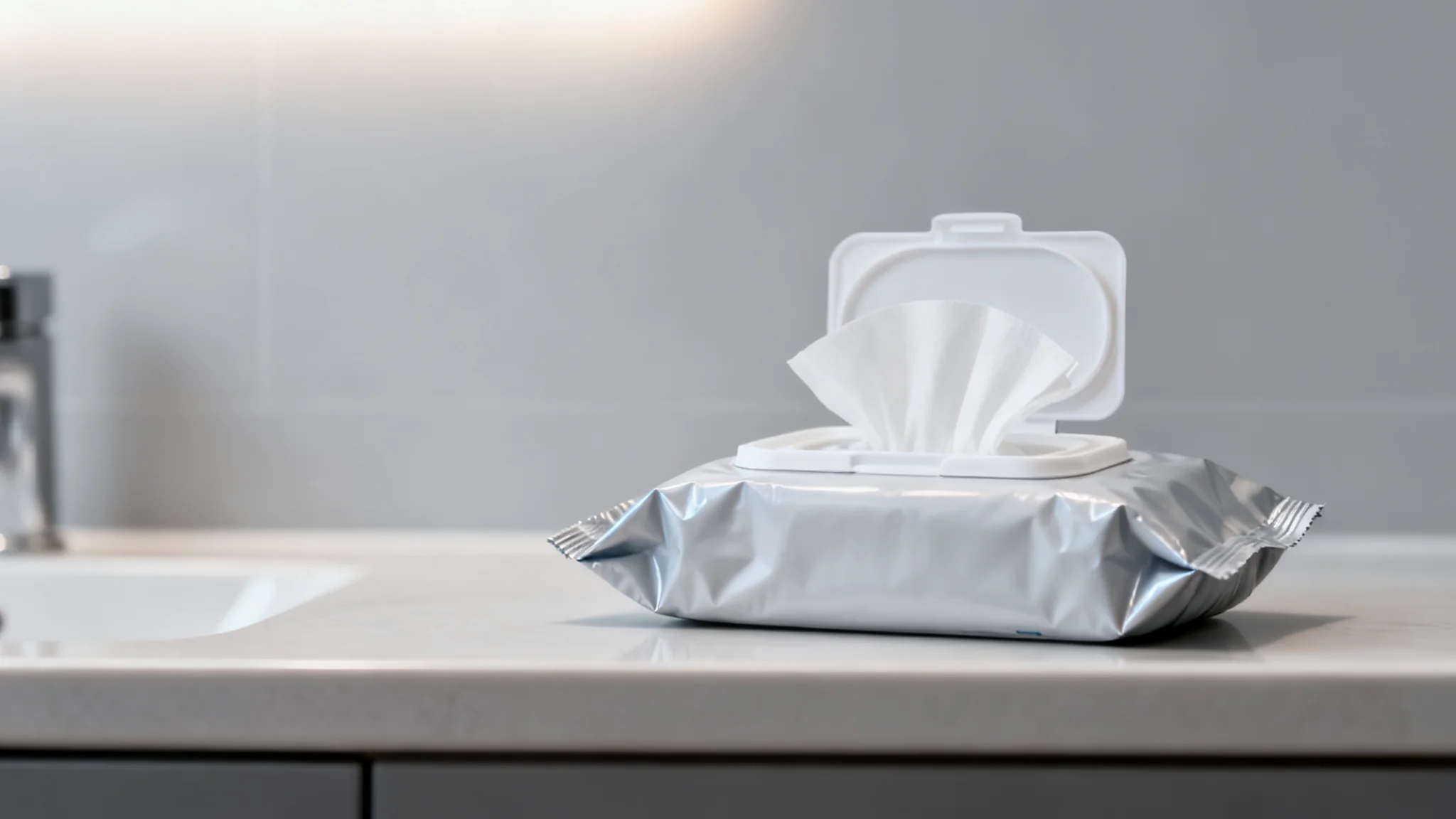
Wet wipes packaging is a moisture-retention problem before it is a printing problem: the pack has to hold a wet stack for months, survive repeated opening, and still peel open one-handed. Most complaints are a dry top wipe or a lid that stops sealing, not a burst seal. Four variables decide that outcome: the film laminate, the resealable label lid, the stack height and the lotion load. This guide covers those four, the format choices between flow-pack and canister, and what belongs on the specification drawing.
What Film Structure Keeps Wipes Wet?
A wipe pack is usually built from a polyester outer layer for print and stiffness, a white or metallised middle layer, and a polyethylene sealant that contacts the lotion. The outer layer resists scuffing in a handbag; the sealant has to tolerate surfactants, fragrance and preservatives for the life of the pack. Moisture leaves through the sealant and through pinholes, so a metallised or foil-bearing middle layer reduces water vapour transmission when the pack needs a long ambient shelf life. Flat-film transmission is measured to ASTM F1249, but the number that matters is pack-level weight loss. The cosmetic and personal care packaging solutions page lists the laminates used on this format.
Resealable Lid Mechanics: Label, Adhesive and Aperture
The lid is a pressure-sensitive label bonded to the film around a die-cut aperture. Three parts have to work together: the adhesive has to release cleanly and re-bond to the same spot, the film around the aperture has to stay flat, and the aperture edge has to be cut without leaving a burr the label cannot bridge. A semi-rigid label with a hinged spine holds its shape after the fiftieth opening, while a thin paper label curls at the corner and lifts. The lidding film range covers the coated film side of this pair. Seal strength between label and film is a peel measurement, and ASTM F88 is the reference method.
Why Does Moisture Loss Show Up at the Lid?
Because the aperture is the largest uninterrupted opening in the pack, and the only closure over it is a re-bonded adhesive line. A laminate can hold moisture for a year, yet the pack fails in weeks if the label lifts at one corner. Lotion residue is the usual cause: product that reaches the adhesive during filling or handling reduces tack, fibre from the wipes builds up along the aperture edge, and the next press seals onto contamination instead of film. Weight-loss trials at controlled temperature and humidity expose this faster than a visual check, and ASTM D3078 bubble testing separates a seal channel from a plain adhesive lift.
Film Thickness and Stack Strength
A wet stack pushes outward against the film, and the pack still has to stand on a bathroom shelf. Film stiffness carries that load together with the gusset geometry, so downgauging a laminate to save cost usually shows up as a pack that slumps and a label that wrinkles over the aperture. A wrinkle under the label is a leak path: the adhesive bridges air rather than film. Where the pack sits in a secondary carton, the film also has to resist scuffing at the fold lines. Thickness is best set by filling a production sample, standing it for a week and measuring the stack height against the drawing.
How Many Open-Close Cycles Should the Lid Survive?
There is no single number, because the count follows the wipe count in the pack and the way people use it. A 10-count travel pack may be opened and closed twenty times, a 120-count household pack more than a hundred, and each cycle deposits a little lotion and lint on the adhesive. Test on production samples rather than on flat film: cycle a pack by hand, press the label down as a user would, and inspect the aperture edge and the adhesive surface every ten openings. The cycle count at which tack drops or the corner lifts becomes the target.
Flow-Pack, Canister and Single Sachet Formats
Use cases for wet wipes packaging fall into three groups. A flow-pack pillow with a label lid is the lowest-cost option and suits 10 to 80 count packs sold on a peg. A canister with a rigid lid costs more but holds its shelf shape and reseals with a click, which matters where a pack is opened many times a day. A single sachet serves hotels, travel kits and samples, where one wipe per pack removes the reseal question entirely. The boundary sits on the other side: a large canister is awkward to ship and a flow-pack above roughly 100 wipes becomes heavy enough to distort the gusset, so they divide on weight and opening frequency. The custom packaging service covers size and artwork changes across all three.
What Belongs on the Wet Wipes Packaging Drawing?
One drawing should carry the film structure, the finished pack dimensions with the gusset, the aperture size and its position relative to the top seal, the label outline and adhesive type, the folded stack dimensions and count, the lotion load in grams, and the seal width. Aperture position is the item most often left vague: a lid set 3 mm too close to the end seal leaves the adhesive overlapping the seal ridge, and the label never sits flat. Print requirements belong on the same sheet, since the label and print panel share the top surface. The packaging process instructions page lists the proof and approval steps that follow.
Conclusion
A wet pack usually dries out for boring reasons: lotion on the adhesive, a wrinkle under the label, or a film too thin for the stack it carries. Three checks cover most of the risk:
- Weigh filled packs over four weeks at the intended storage condition and record the loss per pack.
- Cycle a production pack by hand until the label stops re-bonding, and note the count.
- Stand a filled pack for a week and compare the stack height and gusset against the drawing.
When those three hold, film structure and label choice become commercial decisions rather than quality risks. Send the wipe count, folded stack size, lotion load and target shelf life with any enquiry, because each shifts the film and label specification.
Frequently Asked Questions
Does a wet wipe pack need a foil layer?
No, not always. A wet wipes packaging laminate needs a metallised or foil-bearing layer only when the pack needs a long ambient shelf life or the lotion carries a volatile fragrance, because the sealant alone transmits water vapour steadily. For a pack sold within a few months in a temperate market, a white metallised laminate usually holds retention well enough. The decision should come from a four-week weight-loss trial on the actual pack at the actual storage temperature, not from a film data sheet.
Why does the top wipe dry out before the rest?
Because the top wipe sits against the aperture, where the only barrier is the re-bonded label. Every opening exchanges the humid headspace for room air, and the wipe nearest the label absorbs that dry air first while the stack below stays wet. A pack that has been opened and left loose for days will always show a dry top wipe. If the top wipe dries within a day of first opening, check the label adhesion and the aperture edge before blaming the film.
Can a flow-pack replace a canister for household wipes?
It can, up to the point where weight and opening frequency take over. A flow-pack pillow with a label lid handles 10 to 80 wipes and costs less per pack. Above roughly 100 wipes the stack mass distorts the gusset, and a household that opens the pack several times a day wears out an adhesive lid faster than a hinged rigid lid. Match the format to the count and the usage rhythm.
What causes the label to stop re-sealing after a few weeks?
Contamination on the adhesive, almost always. Lotion, talc, lint from the wipes and dust from a handbag all transfer to the adhesive surface, and once a layer of contamination sits there the label cannot wet out against the film again. A secondary cause is a wrinkle or a raised seal ridge under the label, which leaves a channel the adhesive cannot close. Wipe the aperture edge clean and press the label from the centre outward on a fresh pack to tell the two apart.





