





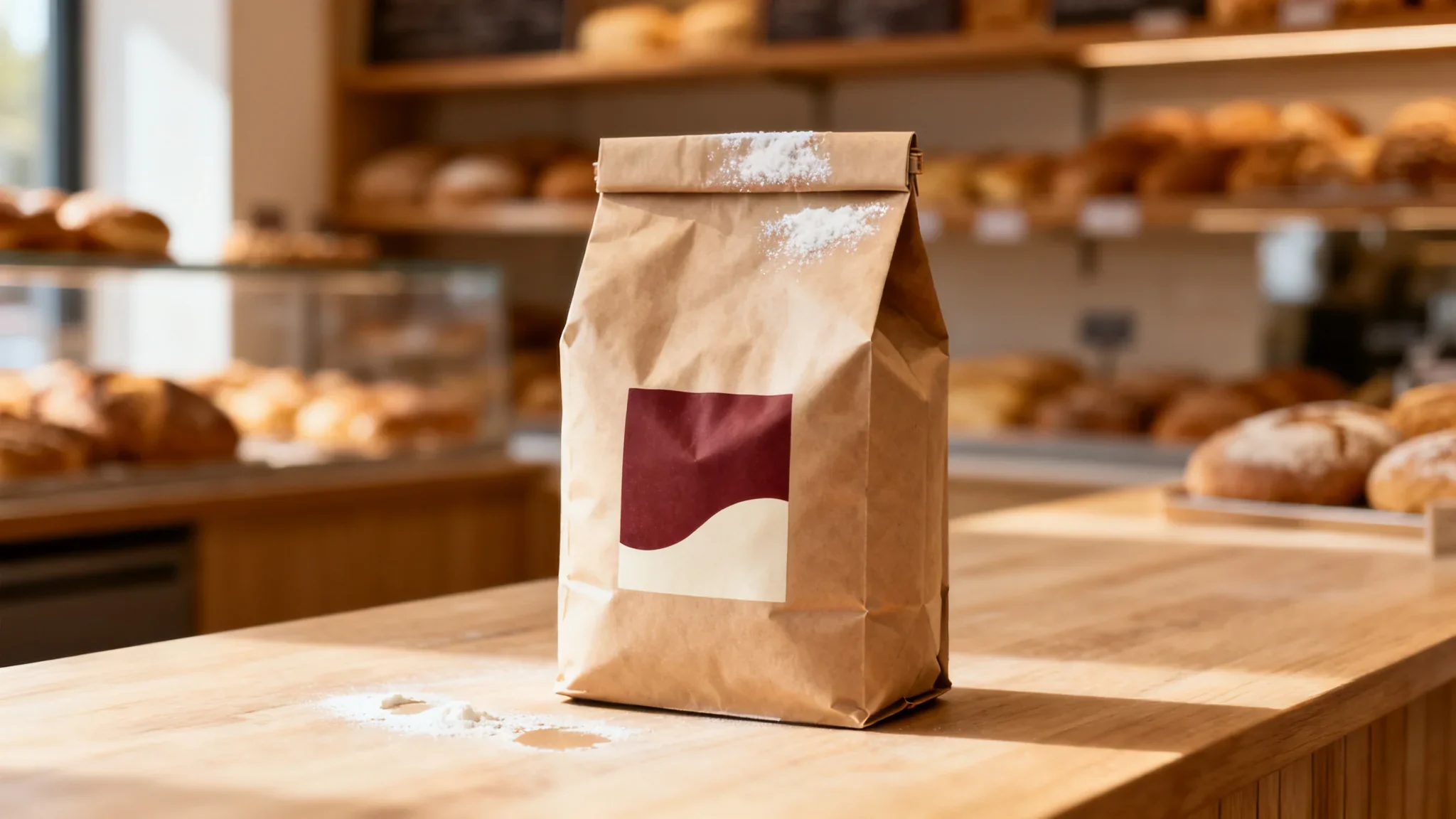
A flour packaging bag fails differently from a snack pouch. Flour is a fine, free-flowing powder that migrates into every fold, sticks to seal jaws and pulls moisture from the air, so most complaints trace back to the seal zone rather than to the laminate itself. Buyers who ask for a thicker film often need better dust control at the filling head and a seal geometry that tolerates a light dusting. This guide covers the leak paths, film structures and pallet behaviour that decide whether a 1 kg retail pack or a 25 kg sack arrives at the shop in saleable condition.
Why Do Fine Powders Punish a Standard Pouch?
Flour does not behave like a snack inside a pouch. Its particles are fine enough to stay airborne for minutes, so dust settles on the inside of the bag mouth as readily as on the machine frame. A seal holds only when two clean polymer surfaces are pressed together under heat, and a dust layer between them acts as a spacer. Compaction is the second problem: flour settles during transport and turns the pack into a dense block that pushes on the bottom seal and gusset folds. Moisture transfer is the third.
Where Flour Leaks First: Dust Paths and Seal Zones
Leaks rarely start in the middle of a printed panel. They cluster where the film is folded or where a seal crosses a fold, and each location points to a different fix.
Back Seal and Fin Seal
On a pillow or stand-up pouch the back seal runs the full height of the bag. Flour trapped in that seam leaves a line of unbonded film that opens under pallet pressure weeks after dispatch, not on the packing line.
Gusset Corners and Bottom Folds
The bottom gusset is folded several times before it is sealed, and each fold thins the sealant layer. A bag that stands well on a bench can still open at one corner once the fill settles and the base spreads.
Top Seal Over Dust
The top seal closes over a mouth that has just taken a dust-generating fill. If the mouth is not purged before the jaws close, the seal captures particles across its full width, passes a visual check and then fails a leak test.
Film Structures for Retail Packs and Bulk Sacks
For a 1 kg retail pack sold within a few months, a two-layer PET/PE or BOPP/CPP laminate is enough, provided the seal is clean. A three-layer PET/AL/PE structure buys moisture and light barrier for humid markets and long sea freight, at higher cost and with a stiffer feel. Paper-look structures are normally paper/PE or paper/PET/PE: the paper supplies the matte surface, the film supplies the seal and most of the barrier. Water vapour transmission rate is the figure to compare, measured by ASTM F1249. Packs that need a window and a flat base suit a stand-up format such as the almond flour stand-up pouch; grain buyers need a different build from the agricultural product packaging solutions range.
How Does Seal Contamination Start at the Filling Nozzle?
The seal is usually blamed for a leak that began upstream. An auger filler drops flour through the mouth and pushes a dust cloud upward as the bag is released. Dust extraction at the head removes the airborne fraction; without it, the cloud settles back into the mouth. De-aeration compacts the fill so the top seal closes on flat film instead of a mound. Jaw condition then decides the result: worn serrations, uneven pressure and short dwell produce seals that look right and measure weak; seal strength should be reported by ASTM F88.
Moisture, Insects and the Limits of a Paper-Look Pouch
Paper is a poor moisture barrier on its own and loses tensile strength as it takes up water. A paper-look pouch works around that by laminating paper to film, so the film does the sealing, but the paper still sits on the outside where it meets warehouse humidity. Two failure modes follow. Soft, sagging packs at the bottom of a pallet after a humid sea leg, because the paper has absorbed water. Insect damage: paper is easy for moths and beetles to chew, and a glued fold gives them an entry point. Where paper contacts food directly, its components fall under 21 CFR Part 176.
What Changes When the Bag Reaches 25 kg?
Above roughly 10 kg the pack behaves like a shipping container rather than a pouch. The bottom seal carries the fill weight plus everything stacked above it, so seal width, gusset depth and film stiffness have to increase together. Handle design becomes structural: a die-cut handle in one film layer tears at both ends, while a reinforced patch or a handled quad seal bag for grain and cereals spreads the load. Compression resistance is the property to test with ASTM D642, because a bag that survives one drop can still collapse in a container. Use cases for the heavier format are bakery bulk supply and mill-to-bakery sacks; the boundary is the pallet pattern your warehouse uses.
Is a Paper-Look Pouch Ever the Wrong Choice?
Yes, in three situations. It is the wrong choice when the pack will sit in high humidity for months, when the route includes a long sea leg with container condensation, or when the fill weight passes the point where paper cannot take the stacking load. It stays a good choice for short-shelf bakery retail and for markets where the matte paper surface carries the brand promise.
Conclusion
Three checks settle most flour packaging projects before artwork is approved.
- Fill one bag on the real line and inspect the seal zone for dust before the jaws close.
- Measure seal strength and water vapour transmission on that filled sample, not on a lab-made pouch.
- Stack a filled pallet at the height your warehouse uses, then examine the bottom layer.
When those pass, format and print become a budget question rather than a risk. Buyers can start at the custom packaging page and specify backwards from the fill weight and route.
Frequently Asked Questions
Does a flour packaging bag need an aluminium layer?
Not always. A flour packaging bag needs foil only when humidity or shelf life demands it. For a 1 kg pack sold within a few months in a dry market, a two-layer PET/PE laminate with a clean seal is normally sufficient. Foil earns its cost when the route includes long sea freight, when the destination is humid year round, or when the brand needs light barrier for a printed matt finish. The trade-off is stiffness and unit cost; check water vapour transmission on the actual structure.
Why does flour dust cause seal failures?
Because dust between two film surfaces stops them from bonding. Heat sealing depends on sealant layers melting into each other under pressure, and a particle layer keeps those surfaces apart. The result is a seal with full visual coverage and almost no peel strength, which opens in transit or under stacking load. The fixes sit upstream of the jaws: dust extraction at the filling head, a purged bag mouth before sealing, and correct jaw pressure and dwell.
Can a paper bag be used for 25 kg of flour?
Usually not on its own. An unlined paper sack absorbs moisture, loses strength and offers little resistance to insects at the folds, so heavy formats normally use a paper outer with a film liner or a woven structure. The decision rests on compression and handling rather than paper weight alone. Test a filled sack at the stack height your warehouse uses, and confirm how the handle is reinforced, since a 25 kg load concentrates at the handle ends.
How should a buyer verify a new flour bag before ordering?
Run a filled trial on your own line before approving artwork. Fill at production speed, then inspect the seal zone for trapped powder and measure seal strength on several bags rather than one. Store a few filled samples in the humidity and temperature your market actually sees, and open them after the intended shelf period. For heavy formats, add a compression test on a stacked pallet. A supplier who provides trial data and the test method used is easier to work with than one who only offers a specification sheet.





