





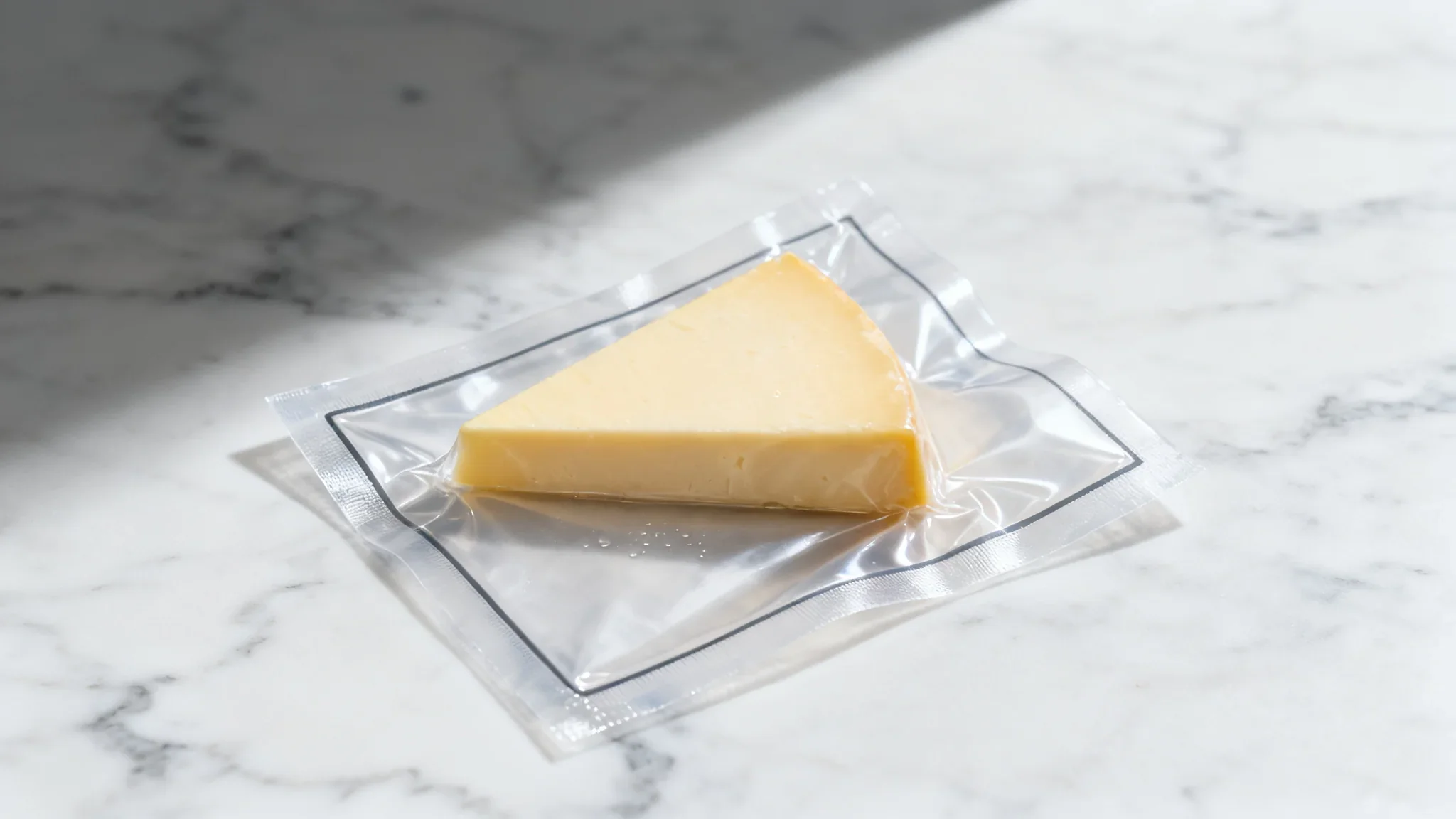
A cheese packaging pouch protects a product that keeps changing after it is sealed. Moisture migrates, oxygen turns the fat rancid, and mould spores already on the rind develop as soon as the atmosphere inside allows it. Film choice, headspace and seal integrity decide how long the pack holds, and no single structure serves both a hard block and a fresh curd. This article covers barrier needs by cheese family, the gas balance inside the pack, and the points that fail most often on a filling line.
Why Cheese Needs a Different Pouch Design From Other Dairy
Cheese has low water activity and high fat content, which breaks the assumptions used for milk or yogurt. Fat absorbs oxygen and turns rancid, so barrier requirements stay high even though the product is solid. Mould spores survive on the surface and need only oxygen and a damp headspace.
The film must also survive being compressed against the product. A hard wedge has sharp corners, and vacuum pulls them tight against the sealant layer. A milk pouch only holds a liquid; a cheese pouch holds a shape under vacuum.
Barrier Needs by Cheese Type
The three families below behave differently because their moisture and respiration differ. Treating them as one group is the most common cause of a pack that works in the trial room and fails in the warehouse.
Hard and Semi-Hard Cheeses
Hard cheeses lose moisture slowly and tolerate a moderate water vapour barrier, but still need oxygen control to protect the fat. A vacuum pack removes most headspace, limiting oxygen for mould and surface oxidation. The film needs an oxygen barrier layer plus a sealant that bonds through surface fat.
Semi-hard varieties sit between the extremes. They release moisture and small amounts of gas after packing, so a fully gas-tight structure can balloon within days. A controlled, slightly permeable structure is often more practical than the highest barrier available.
Fresh and Soft Cheeses
Fresh cheeses carry far more moisture and spoil through microbial growth rather than oxidation. They benefit from a high water vapour barrier against surface drying and weight loss, combined with modified atmosphere. Soft mould-ripened cheeses differ again: the surface culture needs some oxygen to keep ripening, so a near-zero transmission pack can stall that ripening.
Oxygen and Carbon Dioxide Balance in the Pouch
Modified atmosphere for cheese usually replaces oxygen with nitrogen or a nitrogen and carbon dioxide blend. Carbon dioxide suppresses many spoilage organisms but is absorbed into the fat and moisture of the product, pulling the pouch walls inward. A pack that looks tight on day one can look collapsed after a week without any leak.
The practical answer is to set the fill ratio, not just the gas mix. Too little headspace collapses the pack onto the product and stresses the seals; too much and the gas volume works against the film. A one-way valve may help, but it is no substitute for a correct film specification.
What Drives Mould Risk Inside a Sealed Pouch
Mould growth in a sealed cheese pack traces to four conditions: residual oxygen above target, a damp headspace, a seal channel, or contamination picked up before sealing.
A pack filled warm and then chilled forms droplets inside the film, concentrating moisture exactly where spores sit. Filling temperature, cooling time and film surface tension all influence how much water collects.
Oxygen transmission is measured on flat film under standard conditions, and real packs add corners, folds and seal edges where the rate is higher. Testing whole packs rather than film samples catches the difference. ASTM D3985 gives the film baseline; pack-level checks confirm what the pouch does.
Seal Integrity: Where Most Cheese Pouch Failures Start
A seal fails on a cheese pouch for mechanical reasons more often than material ones. Crumbs, surface oil and rind particles sit in the seal zone and stop the sealant layers merging, leaving a channel wide enough to pass gas but narrow enough to survive visual inspection.
Seal strength should be measured on production samples, not blank film, because contamination in the seal zone changes the number. ASTM F88 covers seal strength for flexible barrier materials and works as a routine check. Record pull direction, jaw pressure, dwell time and product in the seal.
Vacuum and Seal Interaction
Under vacuum the sealant is pressed against the product before the jaws close. Sealant that flows too readily thins at the corners, while stiff sealant will not close around a corner radius. A pouch leaking at the corners usually reflects a mismatch between pouch geometry and sealant grade, not a machine fault.
Which Format Fits Portion Packs and Which Fits Blocks?
Portion and block formats solve different problems. Portion pouches suit snacking and food service, where the pack is opened once; they need a peelable opening and a seal that survives handling. Block and wedge formats suit larger retail cuts and need puncture resistance at the product corner under vacuum; a vacuum pouch format shows how that sealant and geometry combine.
Both share one food contact requirement: polymers must comply with the regulation of the destination market. In the United States, olefin polymers in food contact layers fall under 21 CFR 177.1520, and the cheese identity standards sit in 21 CFR Part 133. Other markets set their own rules, so confirm the destination before freezing the structure.
When a Standard Barrier Pouch Is Enough
Use cases for a standard barrier pouch are narrower than most buyers expect: short shelf life, chilled distribution, and consumption within weeks. Once the product moves into ambient distribution, export transit or a shelf life in months, the structure must be re-specified.
Review the dairy packaging solutions range for the formats used across milk, yogurt and cheese, and packaging process instructions for how filling, vacuum and sealing interact. A cheese wedge structure often starts from a custom food vacuum packaging bag base adjusted for barrier and sealant grade.
Conclusion
Cheese packaging pouch design comes down to three decisions matched to the product family: the oxygen and moisture the cheese tolerates, the gas movement the pack allows or blocks, and how the seal behaves with product present.
- Classify the product by moisture and respiration before choosing any film.
- Specify barrier and headspace together, then confirm on finished packs rather than film samples.
- Test seal strength on production samples with real product in the seal zone.
Frequently Asked Questions
Does every cheese packaging pouch need an oxygen barrier?
No. A cheese packaging pouch only needs a high oxygen barrier when the shelf life is long or the fat sits exposed to air. Fresh cheeses sold within days under refrigeration can often use a simpler structure focused on moisture retention, while soft mould-ripened varieties may need deliberate oxygen transmission so the surface culture keeps working. The deciding variable is how long the product must hold character.
Why does a vacuum-packed cheese pouch sometimes look loose after a few days?
Because the product releases gas and moisture after sealing. Cheese keeps respiring and equilibrating with its own headspace, and carbon dioxide can be absorbed into the film and the cheese itself. The pack relaxes as that balance shifts and the film loses the tight look it had on the filling line. A pack that goes loose very quickly usually points to a leak rather than normal equilibration, so run a leak check on the finished pouch before blaming the film.
How should a filling line handle cheese crumbs in the seal zone?
By keeping the seal zone clear before the jaws close. Product in the seal area is the most common cause of channel leaks on cheese packs, and no film grade compensates for it. Practical measures include adjusting the fill pattern so product settles away from the seal, adding a light air knife or brush at the seal entry, and checking jaw alignment so the seal lands on clean film every cycle.
Can the same pouch structure be used for a wedge and for shredded cheese?
Usually not. A wedge pack is built around puncture resistance at the corners and a sealant that bonds under vacuum, while shredded cheese presents a different surface and far more exposed area for oxygen and moisture exchange. Shredded product also settles into the seal zone more easily. Treat them as two specifications and test each on finished packs, even when both run on the same filling machine.





