





Aluminum foil bags have long been among the pouch formats with the strongest barrier performance in flexible packaging, yet many buyers stall on the same question before ordering: pure aluminum bags and metallized bags both look like silver metallic packaging, but their quotes differ markedly–how exactly should you choose? This article clarifies the selection logic for aluminum foil bags across four dimensions–material structure, barrier performance, light protection, and cost–to help food, tea, pet-food, and similar brands avoid detours.
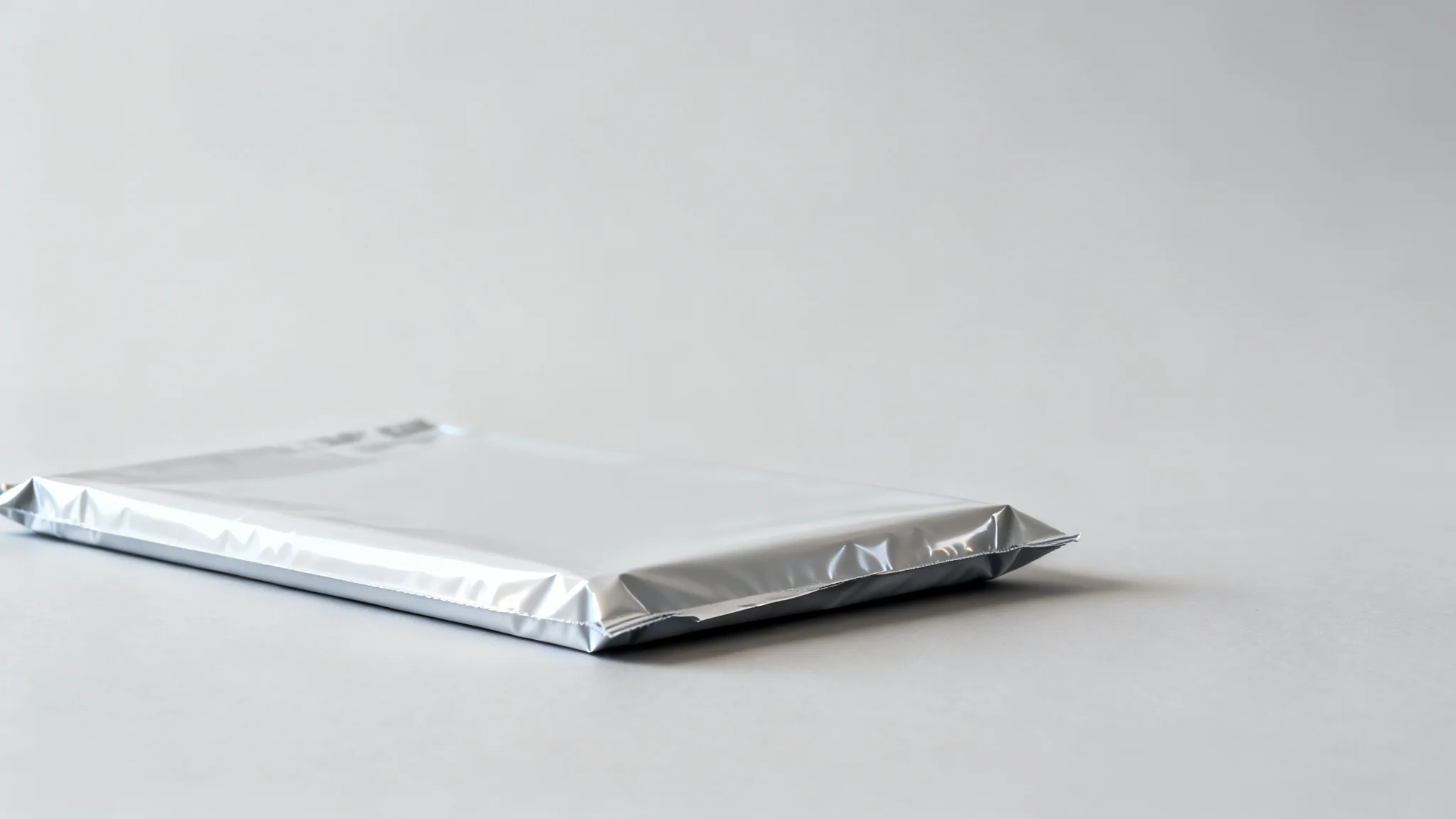
Two Main Structures of Aluminum Foil Bags
Products collectively called aluminum foil bags on the market actually fall into two categories. The first is the pure aluminum foil bag, whose middle layer is pure aluminum foil typically 7 to 9 um thick, laminated on both sides with films such as PET, PA, and CPP using laminating adhesive; typical structures are PET/AL/CPP or PET/AL/PA/CPP. The second is the metallized bag, whose middle layer is vacuum-metallized film (VMPET) with an aluminum layer only a few hundred angstroms thick, mostly structured as PET/VMPET/PE.
Their common points are a metallic appearance and reflectivity; the difference is whether the aluminum layer is a solid foil or a coating, which directly sets the ceiling on barrier capability.
Core Differences Between Pure Aluminum and Metallized Bags
In barrier performance, pure aluminum foil can be made virtually completely opaque to light, oxygen, and water vapor, with oxygen transmission rate near zero; although metallized film is far stronger than ordinary clear film, its coating has pinholes and micro-cracks, so long-term barrier still decays. In light protection, pure aluminum bags block almost all visible and UV light, while metallized bags only partially reflect strong light, leaving light-sensitive oils and pigments at risk of damage.
On cost, pure aluminum foil is more expensive as a raw material and harder to laminate, so its unit price is noticeably higher than the metallized structure; moreover the foil layer is relatively brittle and more prone to creases in transport, affecting appearance and shelf presentation.
Which Products Must Use Pure Aluminum Bags
If a product is oxygen- and light-sensitive and also requires a longer shelf life, the pure aluminum foil bag basically has no substitute. Typical cases include high-fat nuts and fried snacks, coffee beans and coffee powder, tea and spices, milk powder, pet freeze-dried and fresh-meat food, and retort pouches needing high-temperature sterilization. Their common trait is extreme sensitivity to oxygen and light; once barrier is insufficient, they develop rancid off-notes, fade, or cake.
Conversely, if the product itself has low moisture content and a modest shelf-life requirement, and cost and appearance texture matter more, the metallized bag is the more realistic choice–for example ordinary biscuits, candy, cosmetic sachets, and some dry goods.
How to Calculate the Cost-and-Lead-Time Account
Choosing an aluminum foil bag should not be based on unit price alone. Although the pure aluminum structure is expensive, if it extends shelf life from 6 months to 18 months, the reduced returns and spoilage often far exceed the packaging price gap; the metallized structure is cheaper, but once oxidation complaints appear, the hidden cost is actually higher. We suggest buyers compare three things at once: barrier cost per unit area, damage rate in full-carton transport, and whether vacuum or nitrogen flushing is needed. For the relationship between barrier layer and shelf life, refer to our barrier priorities for coffee powder packaging and our packaging print-process selection decision tree, viewing material and process together.
5 Things to Confirm Before Ordering
First, clarify the product’s oxygen sensitivity and shelf-life target; second, confirm whether light protection and high-temperature retort are needed; third, ask for the aluminum-layer thickness and the complete laminate structure; fourth, confirm whether structural parts such as zippers, spouts, and tear openings affect barrier; fifth, request migration and solvent-residue test reports. With these five items clear, quotations become comparable, and you are less likely to discover the wrong direction only after sampling.
Three Common Misconceptions
The first misconception is “thicker aluminum is always better.” Once barrier is already near zero, adding more foil barely helps shelf life and only raises cost. The second is “metallized bags can fully replace pure aluminum bags.” Under strong light and long storage, the metallized structure’s barrier decay is often faster than lab data suggest, and the risk is easily underestimated. The third is “compare unit price only.” What should really be compared is the packaging cost per unit of shelf life–the total account after factoring in barrier performance, transport damage, and potential customer complaints.
Can Aluminum Foil Bags Be Frozen or Heated?
This depends on the structure, not the “aluminum foil” itself. For freezing, the aluminum foil bag usually uses low-temperature-resistant PET or PA on the outer layer and low-temperature-resistant PE or CPP on the inner layer, and can be used stably below -18C; for high-temperature retort, the inner layer must switch to cast CPP resistant above 121C, with a retort adhesion test performed. If the product needs both freezing and microwave heating, this must be made explicit at the sampling stage so the laminate structure and adhesive meet both temperature requirements, rather than fixing it afterward.
If you are looking for an aluminum foil bag solution for an oxygen- and light-sensitive product, feel free to organize your product information and contact us; you can also visit the HASUPACK website to learn about our full custom flexible packaging capabilities, or view the cross-border packaging solutions of our sister site OMOPACK.





