





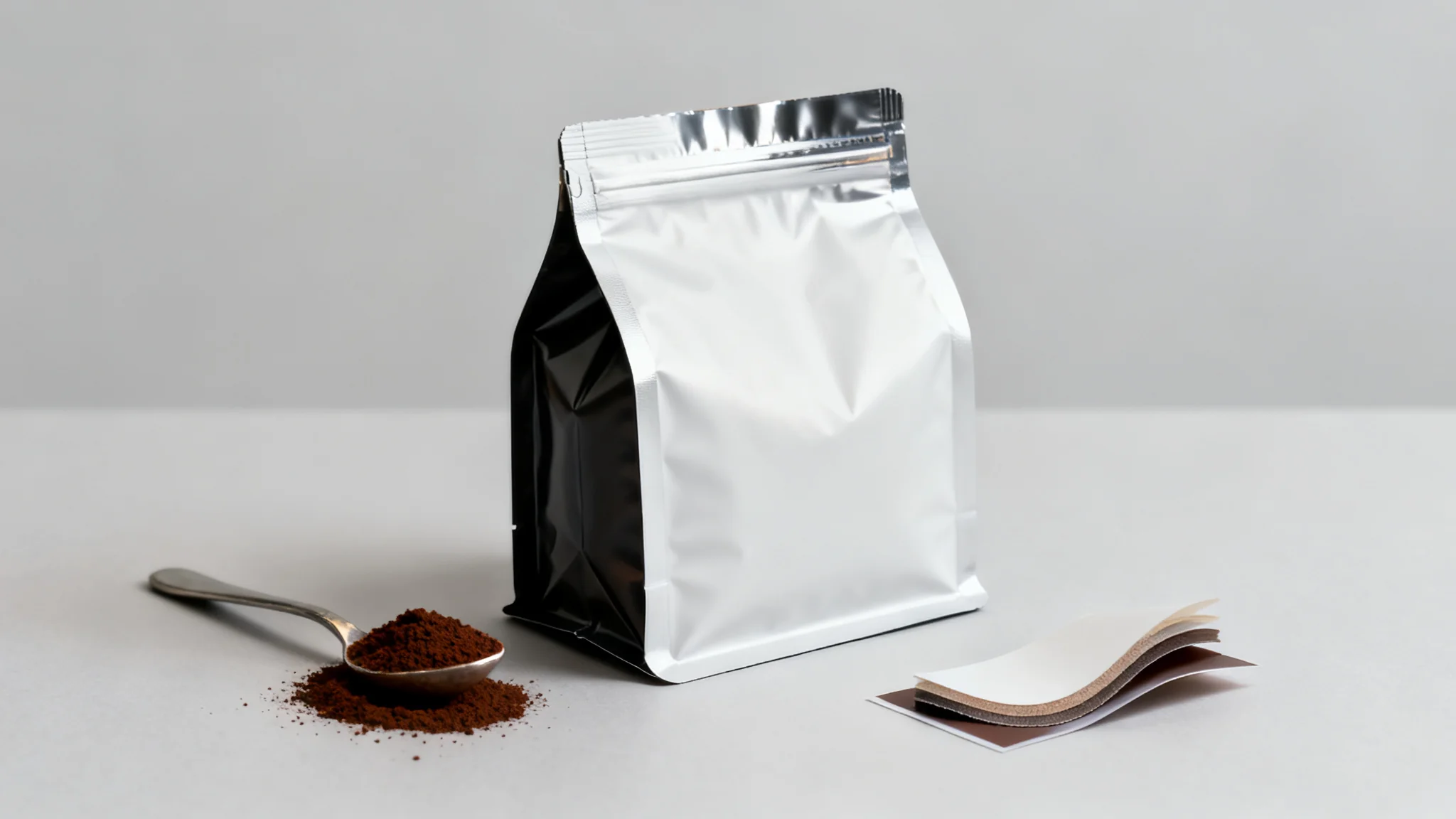
This article starts with the changes grinding brings, then moves to actionable selection and verification steps. The moment coffee is ground, the packaging task escalates. Whole beans hide aromatic compounds inside intact cell structures; after grinding, those same flavors are spread across vast new surfaces, directly contacting oxygen and beginning to fade. This is why a coffee powder packaging bag is first and foremost a barrier problem: pouch format, valve, and zipper all matter, but what decides the coffee’s taste in week six is those few layers of film.
What Grinding Changes
Grinding brings three direct consequences, each mapping to a packaging requirement. Explosive surface-area growth—aroma volatilization and oxidation accelerate sharply, so barrier requirements must be raised; powder characteristics—fine powder and oils migrate into the seal area during filling, so the sealing process must be designed for “contaminated heat sealing”; shorter gas-release cycle—CO2 trapped in the beans is released quickly after grinding, reducing the importance of the degassing valve. A film structure validated for whole beans may not suffice for ground coffee.
How to Choose a Barrier Structure: Three Routes
Coffee powder packaging bags on the market basically fall into three routes. Aluminum-foil laminate structure: the strongest barrier against oxygen, moisture, and light, at the cost of opacity and higher cost—suited to products with long distribution cycles and uncontrolled shelf environments. Metallized (VMPET-type) structure: a thin deposited aluminum layer provides near-foil light blocking and good oxygen barrier while the film stays flexible—a balanced cost-performance choice and the most common for coffee powder. Transparent high-barrier structure: relies on EVOH or coatings for oxygen barrier and shows the contents, but has almost no light-blocking ability—be cautious under direct shelf lighting.
Two practical selection questions: first, how long from filling to drinking—roaster-direct fast-turnover products can use a lighter structure; second, will the product sit under light for long periods—the “beauty tax” of a transparent bag is its light-blocking ability. Writing these two answers into the procurement spec is more useful than reading the film supplier’s brochure.
Another common myth is treating layer count as barrier capability. Layer count is only a construction method; what works is the combination and thickness of functional layers. Two three-layer structures can differ greatly in data if the inner seal material and middle barrier material differ. When comparing supplier proposals, require per-layer material and thickness labeling, then compare under identical-condition data—comparisons without aligned conditions are just number games.
Oxygen and Moisture Transmission Data: What You Need Is Conditioned Data
When requesting barrier data from suppliers, the key is not “whether there is data” but “under what conditions it was measured”: what temperature, what humidity, what film thickness, which layer combination. The same structure shows a large oxygen-transmission difference between 23°C/50%RH and 38°C/90%RH—and coffee encounters both environments, from the plum-rain season in East China to shipping containers in Southeast Asia. The sensible approach is to list the actual temperature and humidity range the product will experience and request data under those conditions; more strictly, run accelerated storage validation against the target shelf cycle with periodic brewing evaluation, closing the loop between the barrier plan and taste results.
Sealing: Coffee Powder’s Second Battlefield
For oily or strongly flavored coffee powder, a robust reseal structure is also an extension of the barrier: when the zipper is poorly pressed closed, aroma loss at the opening is fastest; for heavy specifications, choose a more reliable slider zipper, and the zipper material’s deformation at high temperature must match filling conditions—all to be verified on physical samples.
The barrier layer blocks enemies outside the bag; seal quality decides whether the interior defense line is complete. Coffee powder’s fine particles and oils enter the seal edge during filling, forming leak channels. Engineering must do three things: choose a contamination-resistant heat-seal material for the inner layer; give enough seal width, not competing with the zipper and tear notch for space; test seal strength per ASTM F88 on physical samples filled with the real product—seal data measured on clean empty bags is not representative for coffee powder.
Sampling and Testing Checklist
- Request oxygen- and moisture-transmission data from the film supplier under target temperature and humidity conditions, noting film thickness and layer structure.
- After filling physical sample bags with real coffee powder, measure seal strength per ASTM F88 and check for powder entrapment at the seal.
- Run a round of accelerated storage (high temperature, high humidity) with periodic brewing evaluation to validate the barrier plan.
- Stacking and parcel drop tests: coffee powder is dense, so the side-gusset root and bottom seal are stress-concentration points.
- Agree on change-re-test conditions with the supplier: a film-batch change, filling-process change, or sales-region change all count as change points requiring re-testing afterward.
Coffee industry research bodies (such as the Specialty Coffee Association’s SCA research and the Coffee Quality Institute’s CQI educational materials) agree on the basics: oxygen, moisture, and light are the three great enemies of flavor, and grinding makes all three battles harder. The barrier plan for a coffee powder packaging bag is the specification that translates these three battles onto film-layer structure and sealing process; more packaging knowledge is available in our compiled site resources.
When requesting data from suppliers, writing the methods into the specification saves much back-and-forth: test water-vapor transmission per ASTM F1249 and oxygen transmission per ASTM D3985; only when both reports’ conditions (temperature, humidity, film thickness, layer structure) are complete is there any comparison value.
Conclusion
The barrier discussion for coffee powder cannot be separated from conditions: first set the shelf-life target and distribution environment, then choose the structure accordingly, and finally close the loop with conditioned oxygen/moisture data and storage tasting of the real product. Sealing is the other half, equally important as the barrier; powder contamination and an ill-matched seal layer directly cancel the material investment. Fix the data conditions, seal validation, and sampling-testing checklist together, and material selection stops being repeated trial and error.
Frequently Asked Questions
Why does ground coffee lose flavor faster than whole beans?
The core is surface area. Grinding exposes the aromatic compounds inside the beans onto a surface far larger than the whole bean, accelerating oxidation and volatilization, so the same film structure protects ground coffee for a markedly shorter time. Therefore the barrier requirement for a coffee powder packaging bag is set by the “powder,” not by reusing whole-bean validation conclusions—which also explains why many brands use different structures for bean and ground bags.
How to choose between metallized layer and pure aluminum foil?
Decide by distribution cycle and shelf environment. Aluminum foil has the strongest barrier and light blocking, suited to long-cycle, multi-stage distribution; the metallized structure blocks light well and provides adequate oxygen barrier at lower cost—a balanced choice for most retail coffee powder. If the coffee powder packaging bag faces long-term strong-light shelves or long ocean shipping, lean toward foil; for fast-turnover direct channels, metallized is usually enough. The gap between the two mainly lies in light blocking and cost—calculate the turnover before choosing.
Under what conditions should you request oxygen-transmission-rate data from suppliers?
At minimum, cover the temperature and humidity range the product will actually experience. Beyond standard labeled conditions, supplement data under high-temperature high-humidity conditions (e.g., 38°C, high humidity), noting film thickness and complete layer structure. Data differs greatly by condition; an oxygen transmission rate without condition labeling has no comparison value. After obtaining data, close the loop with accelerated storage plus brewing evaluation.
What to watch for when shipping to high-temperature high-humidity regions?
Watch three links. Check barrier data against high-temperature high-humidity conditions, not just room-temperature reports; re-test seal strength after placing the real filled product in the target environment, since the heat-seal layer’s performance changes at high temperature; include stacking and in-container compression states in drop and stacking tests. Hot-humid environments simultaneously amplify the weak points of barrier, sealing, and mechanics.





