





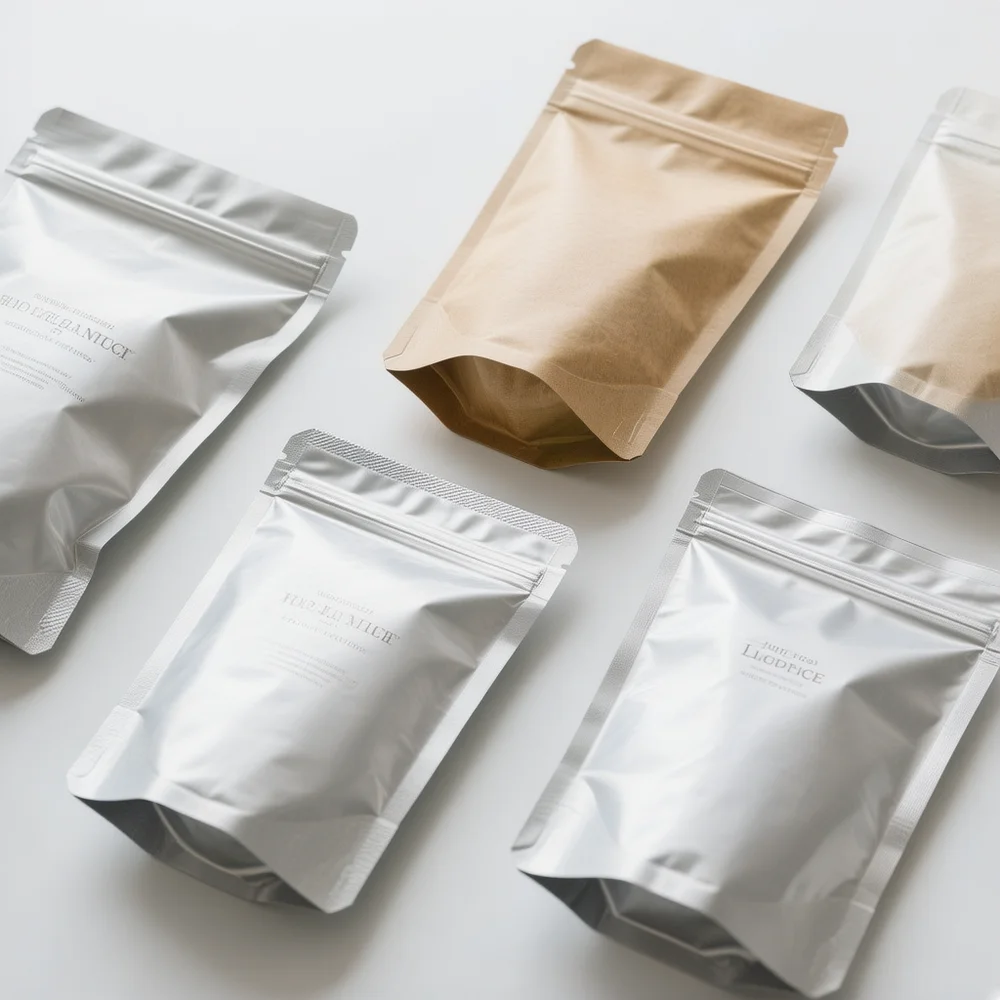
Flexible packaging customization is the process of matching pouch format, material, and printing to the product’s characteristics—not picking a pouch first and then sticking a design on it. Whether the contents fear moisture or oxidation, whether you use premade pouches or rollstock film, and how large the order is all change the material structure and printing method. This article walks through materials, printing, and product applications as three threads, clarifying what to decide first on each and which parameters interact, so buyers can state their needs accurately before requesting a quote.
Key Takeaways
- The order of flexible packaging customization is contents first, then pouch format, material, and printing in sequence.
- The material structure is determined by what the contents fear most; the barrier layer, seal layer, and stiffness each have their role.
- Choose gravure or digital printing based on volume and number of designs; leave the seal area blank in the layout.
- Confirm specifications, dimensions, and samples before full production to avoid reworking the entire batch.
The Three Main Threads of Flexible Packaging Customization
Broken down, flexible packaging customization really has only three threads: material determines whether the product is protected, printing determines how recognizable it is on the shelf and online, and product application determines the trade-offs in pouch format and functional features. The three threads are not decided independently; they constrain each other. Thickening the material changes the seal temperature; adding a window occupies layout space and breaks the barrier layer’s continuity; a pouch format with a zipper affects the filling method and cost.
Where buyers most often go wrong is fixing the artwork and price first, then retrofitting material and pouch format. The correct order is to first state the product characteristics and sales method, then have the supplier propose material and pouch format, and only last discuss layout and unit price. Reversing the order usually means remaking plates or resampling later.
How to Determine the Material Structure by Contents?
First ask what the product fears most. For basic moisture protection with controlled cost, a two-layer laminate such as PET/PE or BOPP/CPP is enough; if it fears moisture but not long-term light exposure, adding a metallized layer often suffices; only when it fears both oxidation and light—such as oily nuts, coffee, or meal-replacement powder—is a high-barrier structure with aluminum foil needed.
Thicker is not always better. Moisture and oxygen transmission depend on the type of middle barrier layer, not the total thickness. The outer layer determines print quality and stiffness; the inner sealant determines the usable seal temperature range; the middle layer is the main barrier. Whether a structure is sufficient must ultimately be confirmed by storage observation with the actual contents.
What Do the Barrier Layer, Seal Layer, and Stiffness Each Manage?
The barrier layer manages shelf life, blocking moisture and oxygen; common options are a metallized layer, aluminum foil layer, or high-barrier coating. The seal layer manages the seal; the melting point of the inner PE or CPP determines seal temperature and strength, and most weak seals come from the match between this layer and equipment parameters. Stiffness manages form; flat-bottom pouches and side-gusset pouches need enough rigidity in the outer layer to stand.
The three influence each other. Raising stiffness often means thickening the outer layer, which raises the required seal temperature; enhancing barrier means more layers, raising both cost and lamination difficulty. When judging, first meet the barrier baseline, then adjust seal and stiffness—don’t max out all three layers at once just for feel.
How to Set the Printing Method and Layout?
Printing is divided by volume and number of designs. For large volume with fixed artwork, use gravure printing—saturated color and low per-unit cost, but plates must be made first; for small volume, many designs, and market testing, use digital printing—no plates needed and flexible minimums. The trade-off between the two routes can be compared in the custom flexible packaging service.
Besides artwork, the layout must reserve space for barcodes, ingredients, and nutrition facts; the seal area must be left blank. Ink covering the seal area weakens the seal—this is the most easily overlooked issue at the sampling stage, and if found only on the machine, the plate must be redone, with plate-making cost and time recalculated.
How to Choose the Packaging Format for Different Product Applications?
Divide by the product’s use scenario and access method. For powders, granules, and small single-use quantities, a three-side seal or back-seal premade pouch is enough; for snacks, dried fruit, and pet treats that need repeated opening and closing, a stand-up pouch with zipper is more suitable; for large-capacity rice, flour, and grains that need stable standing, a side-gusset pouch or flat-bottom pouch is more stable.
Channel also changes the choice. For shelf display, a stand-up pouch format is more eye-catching; for mainly online sales, you can relax form requirements and put budget into printing and seal reliability. Liquid products with spouts need separate evaluation of spout diameter and cap type, which is a different logic from standard powder pouches. For reference on finished formats, see the specification approach of carry-handle rice pouches, a type of quad-seal packaging.
Checklist to Confirm from Quoting to Delivery
Writing the following items clearly before quoting avoids repeated communication and plate changes later:
- Form and characteristics of contents: powder, granules, blocks, oily, moist—whether they fear moisture or oxidation.
- Pouch format and target net content, plus reference dimensions of the finished pouch: width, height, and bottom gusset.
- Material structure and whether a barrier layer is needed; whether the use environment is frozen or high-temperature.
- Printing method, number of colors, and layout files; whether a clear window or matte finish is needed.
- Functional features: whether a zipper, spout, tear notch, hang hole, one-way degassing valve, etc. are necessary.
- Filling method and equipment; whether it must fit an automated production line.
What to Check at the Sampling Stage?
Sampling requires a physical sample, not just a digital proof. Check four things: whether color matches the physical appearance; whether the seal is strong and wrinkle-free at actual temperature and pressure; whether the formed pouch stands and the capacity is correct; whether the artwork orientation and clear window position are accurate. A digital proof confirms the layout but not the seal and forming performance.
From quoting to sampling to mass production there are sequential milestones. The specific division of work can follow the arrangement from communication to shipment in the full flexible packaging customization process, avoiding leaving sampling-confirmation items until the full production stage.
How to Decide Between Premade Pouches and Rollstock Film
Premade pouches are made into finished pouches by the factory, and only opening and filling happen on site—suitable for products with many specifications, small batches per spec, or frequent redesigns. Rollstock film is supplied by the roll, with forming, filling, and sealing completed continuously on the packaging machine—suitable for single-spec, continuous-volume products, saving the pouch-making and manual bagging steps.
The decision order is equipment first, then volume. If you already have an automatic packaging machine and a stable-spec line, rollstock film is usually more economical; if you have no equipment or are in the trial-sales stage, first verify pouch format and contents with premade pouches, then move to rollstock film. Both involve process parameters; related details can be found in the packaging process instructions.
Conclusion
The decision order for flexible packaging customization is contents first, pouch format second, layout last. First determine the material structure and barrier needs by what the product fears most, then choose pouch format and functional features by access method and channel, and only last set the printing method and layout. A parameter table only describes the material itself and cannot represent the finished pouch’s performance; seal strength, forming effect, and dimensions still require physical sampling confirmation. The compliance baseline for food-contact materials can refer to the GB 4806 food-contact material standard; write the applicable clauses and acceptance criteria into the contract before ordering.
Frequently Asked Questions
What is the minimum order for one flexible packaging customization?
This question depends first on material structure and printing method, then on the supplier’s scheduling capacity; there is no single answer. Gravure printing usually needs a certain volume to spread the plate cost, while digital printing suits the small-batch, multi-design trial stage. Estimate usage by actual consumption speed and sales rhythm, then confirm the matching minimum batch and lead time with the supplier, and write the conclusion into the order.
How to judge whether the material structure is sufficient?
First list clearly what the contents fear most—moisture, oxidation, or light—then look at the middle barrier layer type accordingly. A flexible packaging structure cannot be judged by total thickness alone; a two-layer laminate and an aluminum-foil high-barrier structure differ greatly in actual shelf-life performance. Ultimately, do storage observation with the actual contents and confirm against shelf-life requirements before finalizing; do not go straight to full production from experience.
Will print colors differ a lot from the full production run?
Yes, especially across different materials, the same ink shows differently. The way to reduce risk is to require on-machine sampling rather than only a digital proof; after receiving the physical sample, confirm color, material feel, and seal-edge effect, and only sign off on full production when fully satisfied. Give brand color values in CMYK explicitly in the layout to reduce deviation from interpretation, so sampling and full production are compared against the same standard.
Is it better to add more functional features?
No. Each added zipper, spout, tear notch, or hang hole increases material cost and process complexity and also affects seal position and filling method. The principle of flexible packaging customization is to choose necessary features by access scenario—add a zipper only if repeated opening is needed, add a spout only if liquid pouring is needed. Unnecessary features only pass cost onto the product.





