





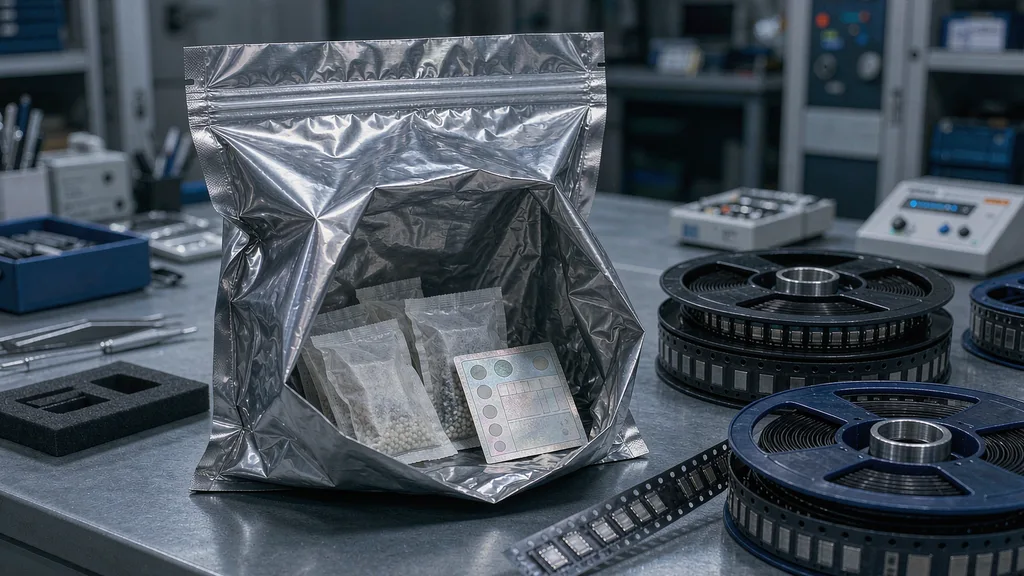
Packaging a moisture-sensitive device (MSD) is not just drop it in a foil bag with a desiccant. It requires an MSL level set by J-STD-020, a moisture-barrier bag that meets the WVTR requirement, a desiccant calculated from bag surface area, a readable humidity indicator card (HIC), and complete heat sealing and labeling. Miss any one, and the component floor life cannot be guaranteed so-called popcorn delamination and internal cracking may appear during reflow.
What Are Moisture-Sensitive Devices and the MSL Level?
A moisture-sensitive device (MSD) is a plastic-encapsulated semiconductor, BGA, QFN, etc. that cracks under reflow heat after absorbing moisture. J-STD-020 classifies devices by moisture resistance into Moisture Sensitivity Levels (MSL) and defines the allowed exposure time in the workshop environment (≤30℃, 60% RH) the floor life.
| MSL Level | Floor Life (≤30℃ / 60% RH) |
|---|---|
| MSL 1 | Unlimited |
| MSL 2 | 12 months (some standard versions: 1 year) |
| MSL 2a to 3 | 168 hours |
| MSL 4 | 72 hours |
| MSL 5 | 48 hours |
| MSL 5a | 24 hours |
| MSL 6 | Must be baked before use |
This table is the starting point of the whole packaging plan: the higher the level, the stricter the requirements on barrier performance, desiccant quantity, and seal integrity. Before selecting packaging, obtain the component MSL level and peak reflow temperature from the component supplier do not pick a bag by experience.
The Core Metric of the Moisture-Barrier Bag (MBB) Is WVTR
The barrier bag role is to form a low-humidity micro-environment. J-STD-033 focuses on two points for barrier bags: WVTR and structural integrity. WVTR is typically measured by ASTM F1249, with a common requirement of no more than 0.002 g/(100 in²·24 h); domestically, GB/T 1037 cup method or GB/T 21529 electrolytic method reports are also common watch for differing test conditions when converting.
Practical trade-offs in structure:
- Aluminum-foil laminate bag (e.g., PET/AL/PE): the most reliable barrier; the foil layer is nearly impermeable, with risk mainly from pinholes at creases
- Metallized laminate bag: barrier depends on metallized-layer thickness and uniformity; check test reports batch by batch do not rely on the word metallized alone
- Transparent barrier bag: allows visual inspection of internal components, but its WVTR is generally higher than foil structures and suits only low-level or short-cycle scenarios
A often-overlooked requirement for the bag is ESD protection. When the component itself is ESD-sensitive, the barrier bag must also meet surface-resistance requirements, commonly in the 10⁹ to 10¹² Ω/□ range. For combined ESD and moisture protection selection, see How to Choose Antistatic Packaging Bags.
How to Calculate Desiccant Quantity
Desiccant quantity is not one bag, one pack. J-STD-033 algorithm is based on three variables: total bag surface area, the barrier bag WVTR, and the required storage period. The standard measures desiccant in units, defined as the amount that adsorbs at least 2.85 g of water at 25℃, 40% RH; in practice convert by this unit rather than estimating directly in grams.
Consider these together when calculating:
- Initial in-bag humidity: the higher the relative humidity of the sealing environment, the faster the desiccant is consumed
- Moisture carried by components and carriers: trays, carrier tapes, and foam all introduce water
- Target storage period: usage differs markedly between long export-shipping cycles and short inventory
- Desiccant type: silica gel and molecular sieve have different adsorption curves; molecular sieve performs better in low-humidity ranges
A workable approach is to give the supplier bag surface area times target months and have it return the unit count from the J-STD-033 lookup table, then run accelerated verification at first-article sealing rather than reusing the last experience value.
How to Read the Humidity Indicator Card (HIC)
The humidity indicator card is the hygrometer inside the barrier bag, commonly a three-spot type at 5%, 10%, and 60%. The reading rule is straightforward:
- 60% spot unchanged: in-bag humidity is controlled; the components can be used directly
- 60% spot changed color: the components may have absorbed moisture and need baking per level before use
- New indicator cards should remain in their dry, uncolored state; any unused card after opening must be stored sealed
When purchasing, prefer cobalt-free indicator cards, as cobalt types face regulatory restrictions in some export markets. Place the card where it is easy to observe inside the bag, not fully hidden by components or carrier tape.
Sealing and Labeling: Put the Information Outside
The seal is the last line of the moisture-defense system. Heat-seal width is generally no less than 5 mm, and seal strength is verified per QB/T 2358 or an equivalent method. During packaging, evacuate or expel excess air before sealing to reduce residual in-bag moisture. A simple squeeze and visual check after sealing catches most weak seals.
External labeling must include at least six items: MSL level, packaging date and time, desiccant quantity, HIC reading instructions, component peak reflow temperature, and expiration date or validity period. A barrier bag missing the packaging date is the hardest to manage in production the floor cannot judge remaining life and can only bake the whole batch.
For how to verify these requirements at incoming inspection, follow the acceptance checklist in How to Perform Flexible Packaging Incoming Inspection.
Baking and Re-Packaging: Handling After Opening
Once a component exceeds its floor life, the standard practice is to bake and re-package. J-STD-033 commonly specifies 125℃ for 24 hours; for heat-sensitive devices, a low-temperature long-duration option of 40℃ for 192 hours is used follow the device datasheet.
Two cautions:
- Before baking, confirm the temperature rating of trays, tubes, and carrier tapes; plastic carriers deform at high temperature
- Complete packaging within the specified time after baking, or the components reabsorb moisture and the baking effort is wasted
When re-packaging, replace the desiccant and the humidity indicator card, and re-label the packaging date; do not directly reuse the old barrier bag.
Acceptance Checklist for MSD Packaging
- Is the barrier-bag WVTR test report within validity, and do its test conditions match the requirement?
- Does the bag surface resistance meet ESD requirements?
- Is the desiccant package intact, with no failure or discoloration indicator triggered?
- Is the HIC cobalt-free, and is its initial state normal?
- Seal width and integrity: sample-test by water-fill squeeze or vacuum-decay testing
- Are all six external labels present and legible?
- Transport and storage environment: protected from direct sunlight and high-humidity stacking?
For a basic judgment of moisture protection, you can also cross-check material selection against the comparison in Moisture-Proof Packaging Materials Explained.
FAQ: Common Questions on MSD Packaging
Where do I find the MSL level?
Rely on the specifications or package label provided by the component supplier; classification is based on J-STD-020. The same package type may have different levels from different manufacturers, so do not infer it from the package style.
Can the moisture-barrier bag be reused?
In principle, no. Once opened, the seal area of the bag is compromised, and there is no guarantee the internal desiccant and indicator card are still effective. If reuse is unavoidable, re-verify seal integrity and replace the desiccant and humidity indicator card.
Can a metallized bag replace an aluminum-foil bag?
It depends on measured WVTR data. Some metallized structures meet the requirement, but you must request test reports batch by batch and verify the test conditions do not judge by the word metallized alone.
Is more desiccant always better?
No. Excess desiccant raises cost and in-bag dust risk, with no linear benefit for long-term storage. The correct approach is to calculate the number of units from bag surface area, WVTR, and target storage period.
Does a pink humidity indicator card mean the components are scrapped?
A color change at the 60% point means in-bag humidity has exceeded the limit and the components need baking before use it does not mean scrap. But if the packaging date has also expired, assess per device level whether extended baking is needed.
What to do when floor life expires?
Two options: reflow soldering immediately, or bake per J-STD-033 conditions and re-package. Continued exposure significantly raises the risk of delamination and cracking during soldering, so do not shorten baking time by experience.
Do exports need extra protection?
Yes. The day-night temperature swing inside a shipping container creates condensation risk, so consider cushioning and moisture isolation outside the barrier bag, and check the indicator card status before stocking on arrival.





