





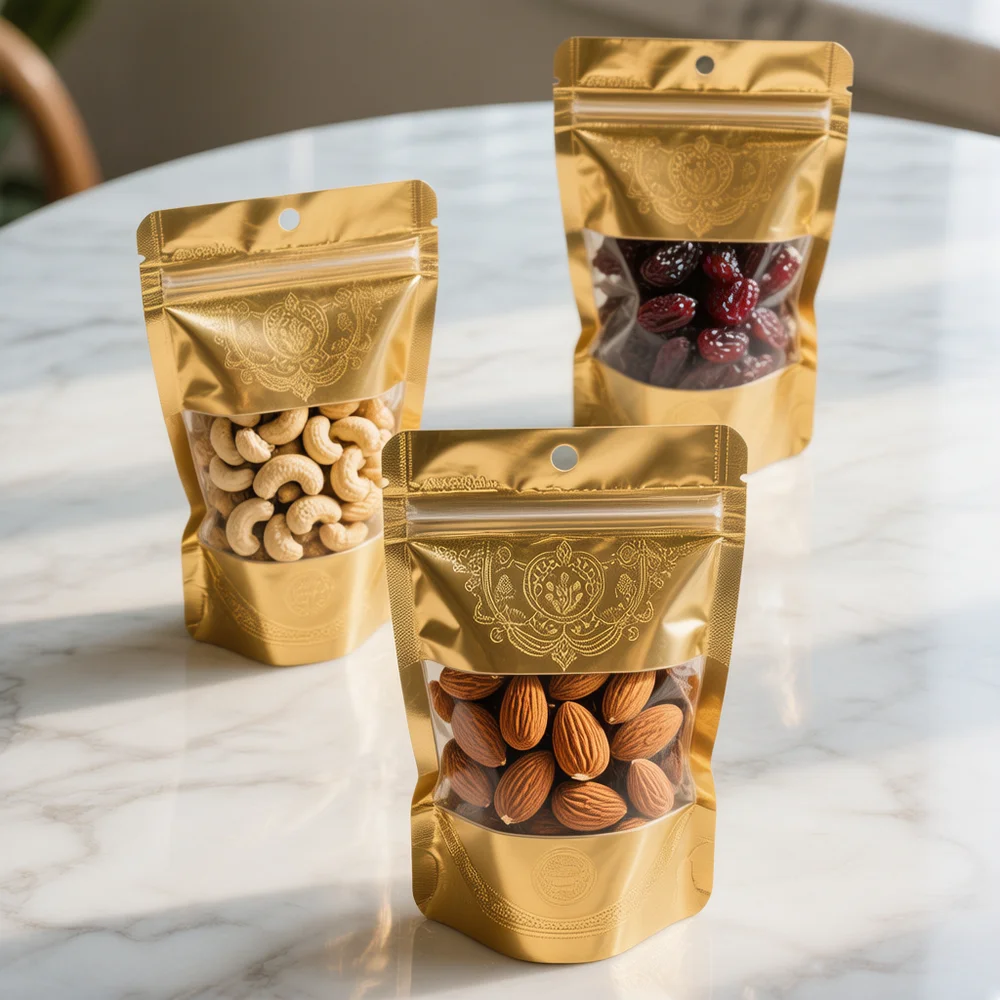
The approach to nut packaging pouch customization can be summed up in one main line: first set the laminate structure by the contents and distribution conditions, then set the pouch format by the sales form, and finally decide between nitrogen flushing, oxygen absorbers, or ordinary sealing by the preservation method. Once these three steps are done, requirements such as moisture barrier, light protection, stacking, and shelf display are all settled. Following this main line, this article introduces the decision order for pouch format, material, and packaging selection.
Where to Start with Nut Packaging Pouch Customization
Start with the contents and distribution cycle, not the pouch format. Nuts with high oil content fear oxidation; in-shell and kernel nuts fear moisture and softening; light-colored kernels fear light-induced discoloration. Channels with long distribution cycles and high shelf temperatures demand markedly higher laminate-structure requirements than short-cycle channels. First state the per-pouch weight, the form of the contents, and the target distribution time clearly; only then do the pouch format and material have a basis for judgment.
Which Pouch Format Suits Your Nut Products
The pouch format follows the sales form: portioned small pouches, retail family packs, and bulk packs each take a different route. The table below is a qualitative summary of common industry practice, not a hard boundary; the final decision should be based on filling equipment and channel needs.
| Pouch Format | Typical Use | Key Points |
|---|---|---|
| three-side seal small pouch | daily-nut portioning, small standalone packs | fits high-speed small-pouch filling lines, simple cost structure |
| stand-up pouch (with resealable zipper) | family pack, e-commerce retail pack | good upright shelf display, zipper supports repeated access |
| flat-bottom pouch | premium retail pack, mixed-nut gift box | flat body, large print area, can hold larger capacity |
For multi-small-pouch products such as mixed daily nuts, the inner pouch uses a three-side seal to hold a single serving of kernels and the outer pouch uses a stand-up zipper pouch to hold the whole box portion; the two formats each manage one stage. To see specific product forms, the dried-fruit and nut stand-up pouch product page lists common specification combinations, while the general flat-bottom pouch product page shows large-capacity approaches.
How to Combine Materials: Balancing Oxygen Barrier, Moisture Barrier, and Light Protection
The focus of nut packaging material is the combination of three capabilities: the oxygen-barrier layer slows oil oxidation, the moisture-barrier layer prevents kernels from absorbing moisture and softening, and the light-protection layer reduces light-induced discoloration and off-odor. In the laminate structure, nylon provides mechanical strength and puncture resistance, aluminum foil or a high-barrier metallized coating provides light protection and high barrier, and the inner heat-seal film handles sealing and food-safe contact. Moisture-barrier capability has a corresponding test method: water vapor transmission rate is measured by the ASTM F1249 method, and during selection you can ask the supplier for measured film data per this method. Light-protection needs and display needs are naturally in conflict: full aluminum foil gives the best barrier but no display surface, while clear windows and transparent areas let consumers see the contents at the cost of reduced barrier in that region—this trade-off must be clear before finalization.
Customization Order Steps and Checklist
- Confirm the contents: category, per-pouch weight, oil content, and whether in-shell or sliced.
- Confirm filling equipment and preservation method: filler model, whether nitrogen flushing is used, and whether oxygen absorbers are placed.
- Determine the pouch format and specifications; verify seal-edge position, tear notch, and display-surface orientation.
- Determine the laminate structure and require the test method and measured values for barrier data.
- Sample and trial-fill: use real contents and real equipment for trial filling; check seal strength and drop performance.
Nitrogen Flushing, Oxygen Absorbers, or Ordinary Sealing—Which Preservation Method?
The three methods solve the same problem to different degrees. Ordinary sealing combined with high-barrier material suits fast-turnover, medium-oil varieties; nitrogen flushing displaces the oxygen inside the pouch and is safer for high-oil nuts and long distribution cycles, but the format must withstand slight post-flushing bulging; oxygen absorbers suit transparent display packs or products with stricter residual-oxygen requirements, but they take up inner space and carry a risk of accidental ingestion. When selecting, put the target distribution time and shelf temperature into the comparison and the solution naturally converges.
Applicable Scenarios and Boundaries
This approach applies to conventional flexible packaging customization for roasted seeds and nuts, nut kernels, mixed kernels, and nuts-plus-snacks. The boundaries must also be stated: nut products requiring high-temperature retort processing follow the retort-pouch process route and are not directly covered by this plan; bulk weighed channels mainly use large rollstock film, where pouch-format choice yields to the full line match of pouch-making–packaging–weighing; export orders with long ocean shipping must list stacking and drop conditions separately for verification. Beyond these scopes, first confirm process feasibility with the factory before finalization.
Key Takeaways
- First fix the contents and distribution cycle, then the pouch format and material; the order cannot be reversed.
- Three-side seal handles small pouches, stand-up handles retail, flat-bottom handles large capacity—each has its role.
- Oxygen barrier, moisture barrier, and light protection are three independent capabilities; require suppliers to provide measured data per the test method.
- Choose nitrogen flushing or oxygen absorbers by oil content and distribution cycle, not by highest price.
For overall category-level planning, refer to the candy and snack packaging solutions page; the pouch-format differences among nut-adjacent categories are systematically compared in the snack packaging pouch design guide, and the two can be cross-referenced.
Conclusion
The success rate of nut packaging pouch customization depends on the first two decisions: whether the laminate structure is right, and whether the pouch format matches the equipment. State the contents, filling equipment, preservation method, and distribution conditions completely at once, and let sampling happen on a real production line, and the solution lands correctly the first time. For any data you are unsure about, require the supplier to measure per standard methods—replace guesswork with data. After the solution is finalized, archive the signed sample and measured data so that later repeat orders and revisions have a basis to rely on.
Frequently Asked Questions
Is nitrogen flushing mandatory for nut packaging pouch customization?
Not all nuts require nitrogen flushing. Varieties with short distribution cycles and medium oil content usually suffice with high-barrier material plus ordinary sealing; the value of nitrogen flushing becomes clear only for high-oil nuts, long-cycle ocean shipping, or summer high-temperature channels. The basis for judgment is the target distribution time and shelf temperature, not category inertia. When unsure, prepare a set of comparison retain samples and decide after observing under actual storage conditions; batches switched to nitrogen flushing should also be retained and re-tested once.
Will a clear window on the pouch affect the shelf life of nuts?
Yes. The window area lacks a barrier layer, so its oxygen and moisture transmission capability is higher than that of the laminate body; the larger the window and the longer the time, the more obvious the effect. A compromise is to control the window area, place it on a non-load-bearing face, and include comparison of windowed-batch and full-barrier-batch retain samples in verification. Brands with strong display needs can also choose a high-barrier transparent film instead of a window.
What information should be confirmed before nut packaging pouch customization?
The information to confirm falls into five categories: product category and per-pouch weight, filler model and packaging form, preservation method (nitrogen flushing, oxygen absorber, or ordinary sealing), target distribution cycle and channel temperature, and pouch-format specification and display-surface requirements. Only when the information is complete is the laminate structure and sampling plan for nut packaging pouch customization comparable; customers with export plans should add one more item—a description of the destination’s climate and transport method.
How do bulk packs and family packs divide labor in pouch format?
The division starts with the access method. Bulk packs prioritize load-bearing and stacking, where flat-bottom pouches and heavy-spec stand-up pouches are more stable; family packs prioritize the access experience, where stand-up zipper pouches are the mainstream choice. The two can share the same laminate structure, but the different seal-edge and stress positions from format differences mean drop and stacking performance must be verified separately during trial filling—do not apply the same criterion to both formats.





