





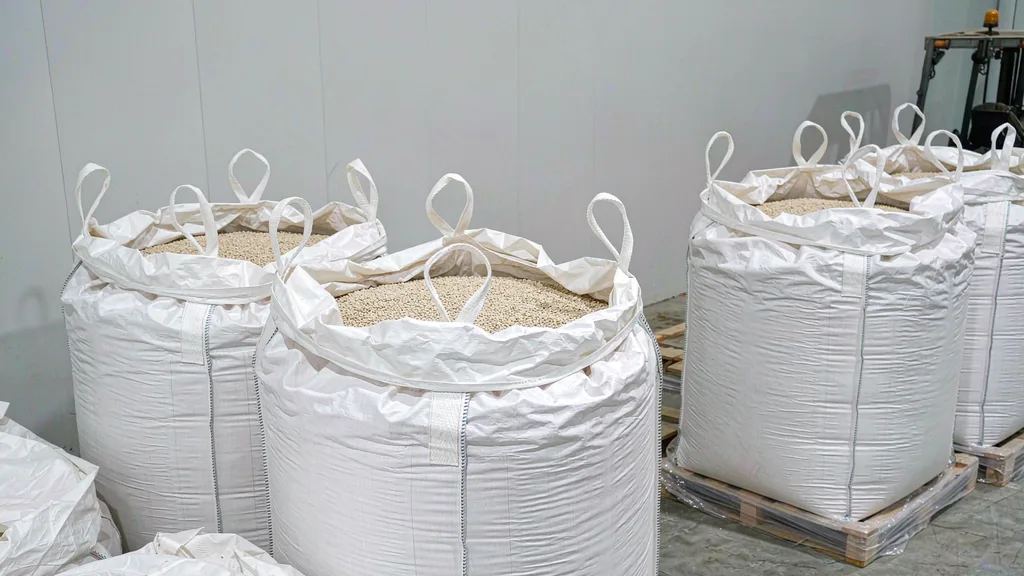
Selecting an FIBC (bulk bag, also called a jumbo bag) comes down to three decisions first: safety factor, bag design, and export shipping method. The safety factor determines how much it may hold and whether it can be reused; the bag design determines the lifting method, stacking stability, and discharge efficiency; the shipping method determines UV resistance, moisture protection, and container-securing requirements. Once these three are set, the base-fabric weight, loop strength, and fill/discharge spout forms can all be filled in against the standards item by item.
Decide Three Things First: What, How Much, and How to Lift
The FIBC is the workhorse packaging for industrial bulk materials, typically loading 500–2000 kg. Its failure consequences are far more severe than small packaging: one burst means the loss of an entire batch of material, and can also injure people or contaminate the site. So the selection order is the reverse of ordinary packaging bags—define the duty first, then the material.
What you load determines the electrostatic class and liner requirements. Powders, plastic pellets, chemical raw materials, and food additives carry completely different static risks and hygiene requirements. How much you load determines the safety factor and base-fabric weight. How you lift determines the loop structure and top form: forklift lift, overhead crane lift, or single lifting point.
Safety Factor: Where 5:1 and 6:1 Really Differ
The safety factor (SF) is the ratio of the FIBC’s breaking load to its safe working load (SWL). Industry practice generally has two tiers:
- 5:1: single-use. Lift once after filling, discharge, and the bag is not reused. This is the most common standard FIBC.
- 6:1: repeated use, or loading dangerous goods. A reused bag accumulates damage across multiple lifts and must carry a higher margin; dangerous goods must also pass the UN type test.
The basis for judgment is the type test, not the supplier’s verbal promise. The base standard for domestic FIBCs is GB/T 10454, and the international general standard for non-dangerous goods is ISO 21898; when exporting dangerous goods, a design type test per Chapter 6.5 of the UN Recommendations on the Transport of Dangerous Goods is also required, corresponding to codes such as 13H1–13H4.
A type test usually includes five items: top-lift test, drop test, toppling test, righting test, and tear test. What procurement needs is not the phrase “we have tested,” but the test report number, the testing body, and the corresponding standard number.
Bag Design: Four-Loop, Single/Double Lifting Point, Circular, and Baffle Bags
The choice of bag design depends on the lifting equipment and stacking method.
- Four-loop bag (four slings): the most versatile; four loops extend up from the bag bottom for the most even load distribution, suitable for both forklift and overhead-crane scenarios.
- Single-/double-lifting-point bag: has only one or two lifting tabs, suited to single-hook lifting, fast loading and unloading, but with higher demands on the lifting gear and operation, and prone to eccentric loading.
- Circular (round) bag: circular cross-section that bulges into a barrel when filled; poor stacking stability, but thorough discharge with little residue.
- Square (baffle) bag: baffle fabric at the four inner corners keeps the bag square after filling, with clearly better stacking stability and container-space utilization—the first choice for long-haul export shipping.
If a shipment goes by ocean container, square baffle bags are almost always more cost-effective: the same box packs more neatly, stacks more stably, and sees less shifting and friction in transit.
Electrostatic Class: How to Choose Type A / B / C / D
When loading powders, granules, or chemical raw materials, static electricity is one of the biggest hidden hazards. FIBCs are divided into four types by electrostatic protection capability (refer to IEC 61340-4-4):
- Type A: no electrostatic protection; base fabric is ordinary polypropylene. Only suitable for non-flammable environments with no surrounding combustible gas or dust.
- Type B: low base-fabric breakdown voltage (typically required not to exceed 6 kV), can suppress brush discharge but cannot conduct charge away. Still not usable in combustible-dust environments.
- Type C: conductive type; conductive threads are woven into the base fabric, and the resistance from any point on the bag to ground is typically required to be below 10⁸ Ω; it must be reliably grounded in use. Suitable for combustible-dust and flammable-solvent environments, but loss of grounding means loss of protection.
- Type D: dissipative type; the base fabric itself dissipates charge into the environment, typically requiring surface resistance below 10¹¹ Ω; no grounding needed. Suited to sites without grounding, but you must confirm there is no combustible gas on site.
The selection principle is simple: first check whether there is combustible dust or solvent on site, then check whether grounding can be guaranteed. If neither can be satisfied, the process must change rather than the bag type.
Base Fabric and Loops: Weight, Strength, and UV Resistance
The base fabric is the load-bearing body of the FIBC; common weights fall in the 140–220 g/m² range, and the key is matching it to loop strength: strong fabric with weak loops breaks the loops, strong loops with thin fabric bursts the body.
Three things must be stated clearly at procurement:
- Base-fabric tensile strength (given separately for warp and weft, tested by the strip method);
- Loop breaking strength, with the loop-to-body connection method (sewing type, stitch density) also specified;
- UV-resistance requirement. FIBCs stored in the open or on long ocean voyages must include a UV-stabilizer additive; the industry typically specifies a retained-strength rate of no less than 50% after 200 hours of artificial accelerated aging. If this is omitted, a few months in a summer open yard will leave the base fabric chalking.
Fill/Discharge Spouts and Closure Structure
The fill and discharge spouts determine filling and discharge efficiency, and also determine sealing:
- Fill spout: skirt type with tie-off, or tubular. For powders, a tubular spout with a sealing cord is recommended to reduce dust escape.
- Discharge spout: flat bottom (cut to open) or with discharge sleeve plus tie cord. For repeated discharge or dust control, choose the discharge sleeve.
- Liner: food-grade, moisture-sensitive, or high-value materials need a PE liner bag, with clear definition of whether the liner is “loose-filled” or “form-fitted to the bag.”
Export Shipping: Stacking, Pallets, and Container Securing
The part of FIBC export most prone to problems is not the bag itself, but shifting and stacking in transit.
- Work out the weight limit first: a 20-foot container is typically controlled at about 28 tonnes total load; a 1-tonne FIBC holds only about 20-odd bags, so you cannot just pack by volume.
- Stacking layers: square bags can stack two layers stably; circular bags are best at single layer or with separators. Stacking beyond the bag’s designed layer count leaves bottom bags under long-term compression and deformation.
- Pallet and stretch-wrap fixing: whole-pallet FIBCs must be secured to the pallet with stretch film or strapping to prevent in-transit slipping. For stretch-film selection, see How to Choose Stretch Film: Machine vs. Hand Use, Pre-Stretch Ratio, and Puncture Performance.
- Sea-freight environment: ocean containers see large day-night temperature swings and easy condensation; moisture-sensitive FIBCs need desiccants or a moisture-proof liner. For the failure mechanisms under sea-freight conditions, see Why Flexible Packaging Fails in Export Container Shipping: Condensation, Stacking, and Temperature-Humidity Cycle Protection.
If the load is at the 25 kg level rather than tonnage, the selection logic is completely different—see How to Choose a 25 kg Heavy-Duty Bag: Trade-offs Among FFS Heavy Film, Valve Bags, and Seal Strength. The methodology for incoming inspection can follow How to Do Flexible-Packaging Incoming Inspection: 8 Acceptance Standards for Both Buyers and Factories.
FIBC Acceptance Checklist
| Acceptance Item | Key Judgment Points | Common Non-Conformities |
|---|---|---|
| Safety factor & report | 5:1 or 6:1, with type-test report and standard number | Verbal promise only, no report number |
| Rated load (SWL) | Consistent with contract, clearly marked | Marking missing or inconsistent with actual |
| Electrostatic type | A/B/C/D clearly stated; Type C with grounding note | Mixed types shipped, no test data |
| Base-fabric weight & strength | Warp/weft tensile strength meets spec | Insufficient weight, brittle feel |
| Loop strength | Breaking strength and connection method conform | Insufficient loop stitch density, unraveling |
| UV resistance | Retained strength after aging meets spec | Base fabric chalks after months outdoors |
| Sewing quality | Even stitch pitch, no skipped or broken stitches | Frayed seams, cracking under load |
| Dimensions & bag type | Square/round, fill/discharge spout form conform | Mismatch with filling equipment |
| Marking & traceability | Batch number, production date, type marking complete | No batch, untraceable when problems occur |
FIBC FAQ
Can a single-use FIBC be reused?
Not by design. A 5:1 bag is designed for a single lift; repeated lifting accumulates fatigue damage in the loops and seams, and the damage often starts internally and is invisible from outside. If reuse is truly required, a dedicated 6:1 bag must be procured and inspection and retirement criteria established.
What certification is needed to ship dangerous goods in FIBCs for export?
A design type test per Chapter 6.5 of the UN Recommendations on the Transport of Dangerous Goods is required, obtaining the corresponding UN code (e.g., 13H1–13H4), with a report issued by a qualified body. Different codes correspond to different bag structures and sealing requirements; ordinary FIBCs cannot be substituted.
How to choose between conductive Type C and Type D FIBCs?
First check whether the site can be reliably grounded. If grounding is available and the environment has combustible dust or solvent, choose Type C—lower cost but must be grounded every time; if the site lacks grounding, choose Type D, but it is not suitable where flammable gas is present. Whichever is chosen, the inspection method must be clearly written into the operating procedure.
Should UV-resistance requirements be written into the FIBC purchase order?
They must be. Open yards, port delays, and long ocean voyages age the polypropylene base fabric under UV, showing as embrittlement and strength loss. The industry typically specifies a retained-strength rate of no less than 50% after 200 hours of artificial accelerated aging; the purchase order must state the aging standard and the retention threshold.
Why are square (baffle) FIBCs more suitable for export?
Because they stack stably, use space efficiently, and shift less in transit. Round bags bulge into a barrel shape when filled, roll off easily when stacked two layers high, and leave larger voids in the box. The difference in damage rate over long-haul shipping often matters more than the per-bag price difference.
What to watch for when packing food-grade materials in FIBCs?
Three points: the base fabric and loops must meet food-contact material requirements and provide test reports; add a food-grade PE liner and define how it is secured; and the sewing workshop’s cleanliness and foreign-object control must be written into the supplier audit form.





