





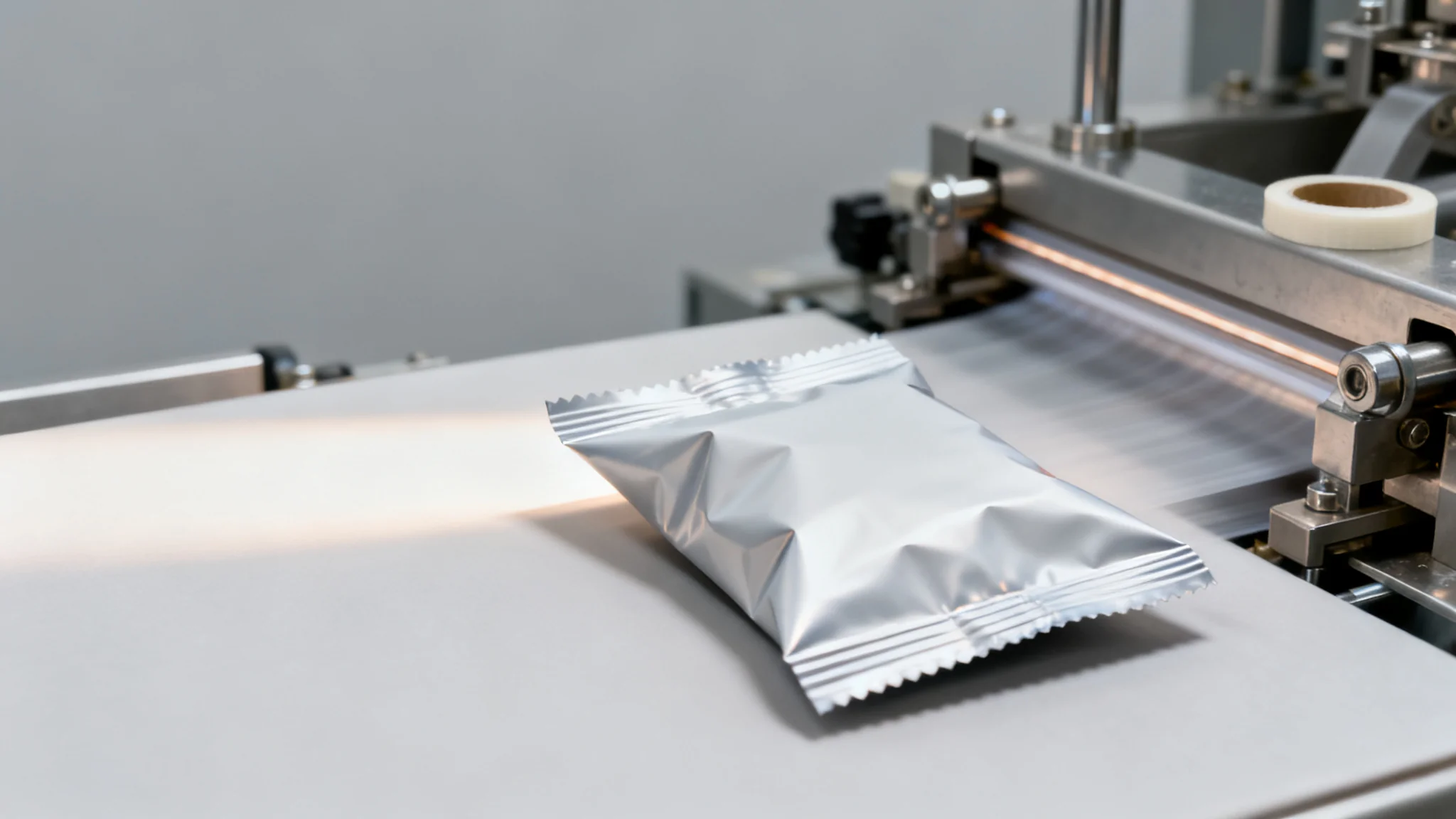
When preserved fruit pouches stick on the filling line, don’t rush to change the film. Follow the three steps “product adhesion – film adhesion – syrup into seal” to separate the causes, and most problems are located within two rounds. Soft, sugar-coated preserved fruit behaves very differently from crispy snacks on the former and seal bar: it responds directly to temperature, syrup viscosity, and downtime; the same roll can behave differently on the morning and afternoon shifts. Below, in on-site troubleshooting order, are the actions to take and what to check at sampling and first-article confirmation.
Key Points
- First tell product adhesion from film adhesion—the fixes are opposite.
- The restart segment after downtime sticks most easily; observe and isolate the first few pouches separately.
- Peeling the seal open for inspection must become a fixed action, not done only at start-up.
Why Do Preserved Fruit Pouches Easily Stick to the Former?
This article applies to preserved fruit on both vertical form-fill-seal and premade-pouch lines. Adhesion on the former comes from two directions. One: syrup oozing from the fruit surface meets the hotter former surface, viscosity drops, and a thin adhesion layer forms. Two: the film’s inner layer is friction-heated by the former and its surface energy changes, making it easier for syrup to wet. Together they show as higher film-travel resistance, skewed pouch shape, and in severe cases wrinkling or even breaking.
The effect of downtime is often ignored. After a short stop the former is still hot; fruit resting in the same spot keeps sitting, and restart is when sticking is easiest. So record downtime count and duration together, not just the normal-running segment.
First Separate “Product Adhesion” from “Film Adhesion”
These two have opposite fixes and must be separated before acting. Product adhesion shows as fruit carried out of the mouth leaving residue, sugar marks on the inner wall, and stringing when opening; film adhesion shows as empty pouches’ inner walls sticking to each other, hard to open, hard to inflate after converting. The former starts from product temperature, syrup state, and inner film surface; the latter is mostly about roll winding tension, storage temperature, and opening design.
| Phenomenon | Likely cause | Check first |
|---|---|---|
| Sugar marks on inner wall, stringing when opening | Product adhesion | Fruit temperature and surface syrup state at filling |
| Empty-pouch inner walls stick, hard to inflate | Film adhesion | Roll winding tension, storage temperature, opening structure |
| Hard spot at seal, sugar crystals on peeling | Syrup into seal zone | Feed position, distance from seal line to product surface |
| Normal at start, gradually worse after one hour | Former temperature buildup | Cooling airflow, downtime count and duration |
Opening and Tear-Notch Position Handling
“Won’t tear” and “tears off-center” are mostly not film problems but opening design or position problems. Common sources: the notch position is too close to the seal edge, so the tear runs onto the seal; the tear direction is not aligned with film orientation, so the tear line skews; notch depth is too shallow or too deep—too shallow won’t tear, too deep tears straight into the body. Preserved fruit pouches add one more case: the inner wall slightly wetted by syrup makes the two films stick, so the consumer needs more force, feeling like “won’t tear.”
The on-site verification is direct: take pouches from continuous production, tear open twenty as consumers would, and record whether it is smooth, whether it strays from the tear line, and whether there is syrup stringing. This action is closer to real feedback than looking at film samples.
In What Order Should Anti-Stick Treatment Be Done?
Order matters more than any single measure. First control product state, then equipment and environment, and only last consider changing the film. Product side: confirm fruit temperature and surface state at filling; fruit just out of the dryer with a large temperature difference tends to stick more. Equipment side: confirm former temperature, cooling airflow, and film-travel tension, especially the restart segment after downtime. Environment side: confirm the workshop temperature/humidity range it fluctuates in. After these steps are stable, if it still sticks, discuss changing the inner layer or adjusting opening and seal structure.
Note that material “anti-stick” is more a relative performance than a complete fix. Different inner layers do differ in release behavior, but how a specific preserved fruit performs must be confirmed by actual filling and sampling—not judged from film samples alone.
What to Do When Syrup Gets Into the Seal Zone?
Once syrup or sugar crystals are trapped in the seal, seal strength drops clearly and often invisibly, usually only showing after transit pressure. Two layers of on-site response: one, reduce the chance of syrup entering the seal zone—adjust feed position, lengthen the distance from seal line to product surface, add a blow-off after feeding; two, make seal inspection fixed—periodically peel and sample, not just once at start-up.
For detection, beyond routine seal-peel checks, do a gross-leak check per package-integrity methods. The conditions and pass/fail of gross-leak testing can reference ASTM F2096; the actual pressure and soak time used must match your product spec before execution.
What to Check at Sampling and First-Article Confirmation?
For preserved fruit, sample with the real product on the real machine, not by feeling film samples. First-article confirmation covers at least: actual adhesion at filling, including the first few dozen after downtime restart; whether the tear opens smoothly and stays on line; peel inspection of the seal zone; whether pouch shape and print position are stable; and how the packed case changes after resting. Sample quantity must be enough for transit simulation and rest observation, or you only see the day’s performance.
If the same machine also switches to crispy snacks or dry goods, dry and oily foods differ in material direction by nature, so confirm the material direction before switching to avoid sharing one roll that mismatches product traits. Bags like dried blueberry stand-up pouches already have a mature format as a starting point, but the final must still be sampled and confirmed on your product and actual filling conditions.
Conclusion
The stick, tear, and leak problems of preserved fruit filling can be handled on-site with one order: first assign the symptom, then stabilize product and equipment state, and only last touch material. Including the restart segment after downtime in observation and making seal-peel inspection a fixed action are usually more effective than frequently changing film structures. When the pouch format and structure need reworking, follow the thinking in agricultural product packaging solutions, then return to the specific product for sampling confirmation.
Common Questions
Preserved fruit sticks to the former—will changing the inner film solve it?
Not necessarily; it depends which side the adhesion in the preserved fruit pouch comes from. If syrup has wetted the inner wall and the film surface has been repeatedly heated, changing the release of the contact layer does help; but if adhesion mainly comes from high former temperature and long downtime, changing film only postpones the problem. Recommend first running a comparison with the same roll—lower former temperature, add cooling, shorten downtime—then decide if material really needs changing.
Stickiness is worse after downtime and restart—what to adjust first?
First handle temperature and time, not film. Before restart let the former return to normal running temperature, restore cooling airflow, and isolate the first few pouches after start for separate observation; don’t merge this period’s product into finished goods. Also record each downtime duration; beyond a threshold, do a fixed clean-and-test routine—standardizing the action beats repeated parameter tweaks.
Where is the best tear notch position for preserved fruit pouches?
Mainly the usable area between the seal edge and the contents. Keep enough distance between the tear notch and seal edge to avoid the tear running onto the seal; also avoid the inner wall wetted by syrup, since two slightly stuck films clearly raise opening force. After fixing position, tear continuously produced pouches as consumers would to check tear-line stability, then finalize.
Syrup found at the seal—should the whole batch be scrapped?
First judge the contamination scope, not the whole batch. Cut open and inspect seals of pouches taken at different times; if foreign matter appears only in isolated periods, it is usually an intermittent feeding or blowing issue—isolate that period’s pouches then do integrity check; if sugar crystals appear at multiple time points, the feed position or seal-line distance needs adjustment, and you should stop and correct before resuming.





