





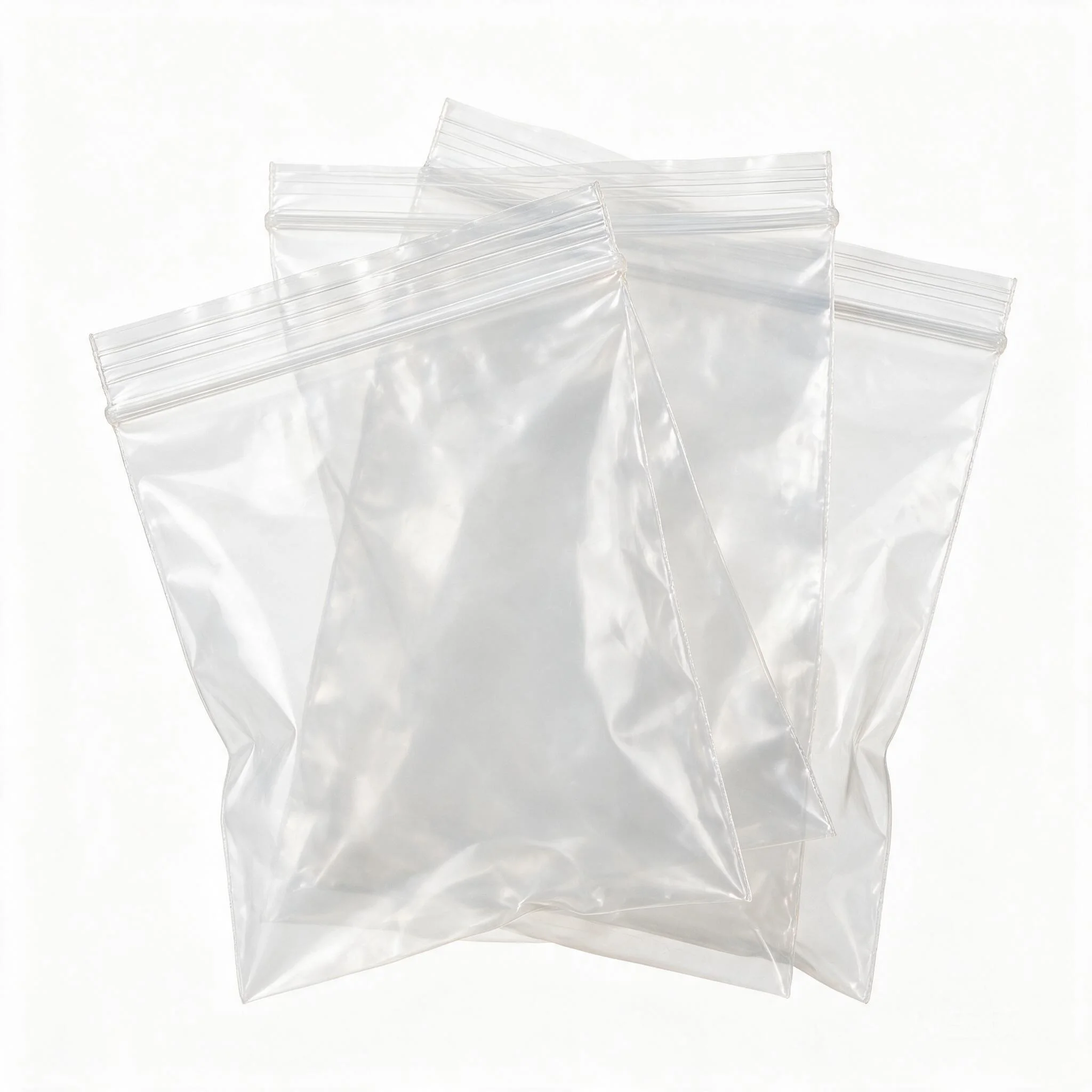
Buying snacks, storing dried goods, organizing small items—self-sealing bags and resealable bags are part of our daily lives. But many people are unclear: Are self-sealing bags and zipper bags the same thing? Can resealable bags really be reused? Is a self-sealing bag’s seal actually reliable? This article clears up the differences and respective use cases of self-sealing, resealable, and zipper bags in one read.
What Is a Self-Sealing Bag?
A self-sealing bag (also called a press-seal bag or grip-seal bag) is a plastic packaging bag with interlocking ridges at the opening. The user presses the opening from one end to the other with their fingers, pressing the ridges together to complete the seal. To open, simply pull the two sides of the opening outward and the seal strip separates.
The sealing principle of a self-sealing bag is physical interlocking—no heat-sealing equipment, glue, or zipper slider is needed. Its core component is the “grip seal” at the opening: a matching structure of one ridge and one groove. This structure determines the seal strength and service life of the self-sealing bag.
The most common materials for self-sealing bags are LDPE (low-density polyethylene) or LLDPE (linear low-density polyethylene). Both are soft, highly transparent, and tough, making them suitable for thin self-sealing bags. For details on common packaging materials, refer to our plastic packaging material selection guide. Food-grade self-sealing bags typically use food-grade LDPE resin and comply with the GB 4806.7 food-safety standard.
What Is a Zipper Bag?
A zipper bag is a packaging bag with a sliding zipper head installed at the opening. The back-and-forth sliding of the zipper head opens and closes the opening, similar to the zipper on our clothes. The sealing structure of a zipper bag is more complex than a self-sealing bag: inside the zipper head are two rows of interlocking teeth, and as the head slides it forces the teeth to close or separate.
The body of a zipper bag usually uses a composite material (such as PET/PE or PA/PE laminate) rather than a single-layer PE film. This composite structure gives the zipper bag higher strength, better barrier properties, and a stiffer appearance. The zipper head itself is typically made of HDPE or PP and feels sturdier.
Zipper bags are common in premium food packaging, frozen food, large-size snacks, clothing storage, and electronics packaging. Because of the zipper head, zipper bags cost noticeably more than self-sealing bags.
5 Key Differences Between Self-Sealing and Zipper Bags
1. Different Sealing Principles
A self-sealing bag seals by pressing the ridges on both sides of the opening—a “line seal”; a zipper bag seals via a zipper-head-driven tooth-engagement mechanism—a “point + line seal”: as the head slides, each tooth engages one by one, giving higher sealing precision.
2. Seal Strength Difference
After repeated opening and closing, the elasticity of the PE material in a self-sealing strip gradually declines, the ridge engagement weakens, and problems like “air leakage” or “auto-pop-open” easily occur. A zipper bag’s head presses more tightly, the tooth-engagement force is stronger, and it does not easily fail even in frozen conditions (-18°C). Generally, a zipper bag’s seal strength is about 2–3 times that of a self-sealing bag.
3. Cost Difference
The manufacturing cost of a self-sealing bag is very low. A standard-size self-sealing bag (20×30 cm) costs only a few cents. Because of the added zipper head and composite material, a zipper bag costs about 3–5 times a self-sealing bag. Of course, unit price drops with bulk customization, but the zipper bag’s structure makes it hard to reach the low cost of a self-sealing bag.
4. Different Application Scenarios
Self-sealing bags suit: dried-goods storage, small-item repacking, document organization, e-commerce small parcels, and one-time packaging where sealing demands are not extreme. Zipper bags suit: frozen-food packaging, liquid or semi-fluid foods (such as jam and soup), valuables needing moisture protection, and daily use requiring repeated opening and closing.
5. Different User Experience
Self-sealing bags are easy to open, but closing requires even finger pressure along the opening; if the opening is too long or the material is stiff, incomplete closure often happens. Zipper bags close by sliding the head—easier and less effortful for users, with a more consistent open/close experience. But if a zipper bag’s head is damaged (e.g., misaligned teeth, detached head), the whole bag becomes unusable.
Are Self-Sealing and Resealable Bags the Same Thing?
Strictly speaking, “resealable bag” is a general term—any bag that can seal its opening can be called a resealable bag. But most “resealable bags” on the market are in fact self-sealing bags. Some brands label their product “resealable bag” while the actual product is a self-sealing bag; this is not a violation, because a self-sealing bag does provide basic sealing function.
Note, however: a self-sealing bag ≠ a vacuum seal bag. A self-sealing bag only prevents granular leakage and provides light moisture resistance, but cannot block air for long periods. If you need true vacuum fresh-keeping (such as long-term storage of coffee beans or nuts), you should choose dedicated packaging with a degassing valve or vacuum pouches.
How to Choose? A Table Tells You
| Use case | Recommended format | Reason |
|---|---|---|
| Dried goods / short-term snack storage | Self-sealing bag | Low cost, sufficient |
| Frozen meat / seafood | Zipper bag | Good seal, low-temperature resistant |
| E-commerce small-item packaging | Self-sealing bag | Low cost, convenient |
| Electronics moisture protection | Zipper bag | Reliable seal |
| Long-term food storage | Zipper bag + vacuum | Best barrier |
| Office document organization | Self-sealing bag | Transparent, cheap |
Conclusion
Self-sealing and zipper bags each have their strengths and use cases. The self-sealing bag’s advantage is cost and convenience, suiting daily and one-time packaging; the zipper bag’s advantage is seal strength and user experience, suiting long-term food storage and repeated opening. The goal is not the “best” but the “most suitable”—decide based on product characteristics, budget, and usage habits.
Have questions about customizing self-sealing or zipper bags? Welcome to contact HASUPACK; visit our Contact Us page.





