





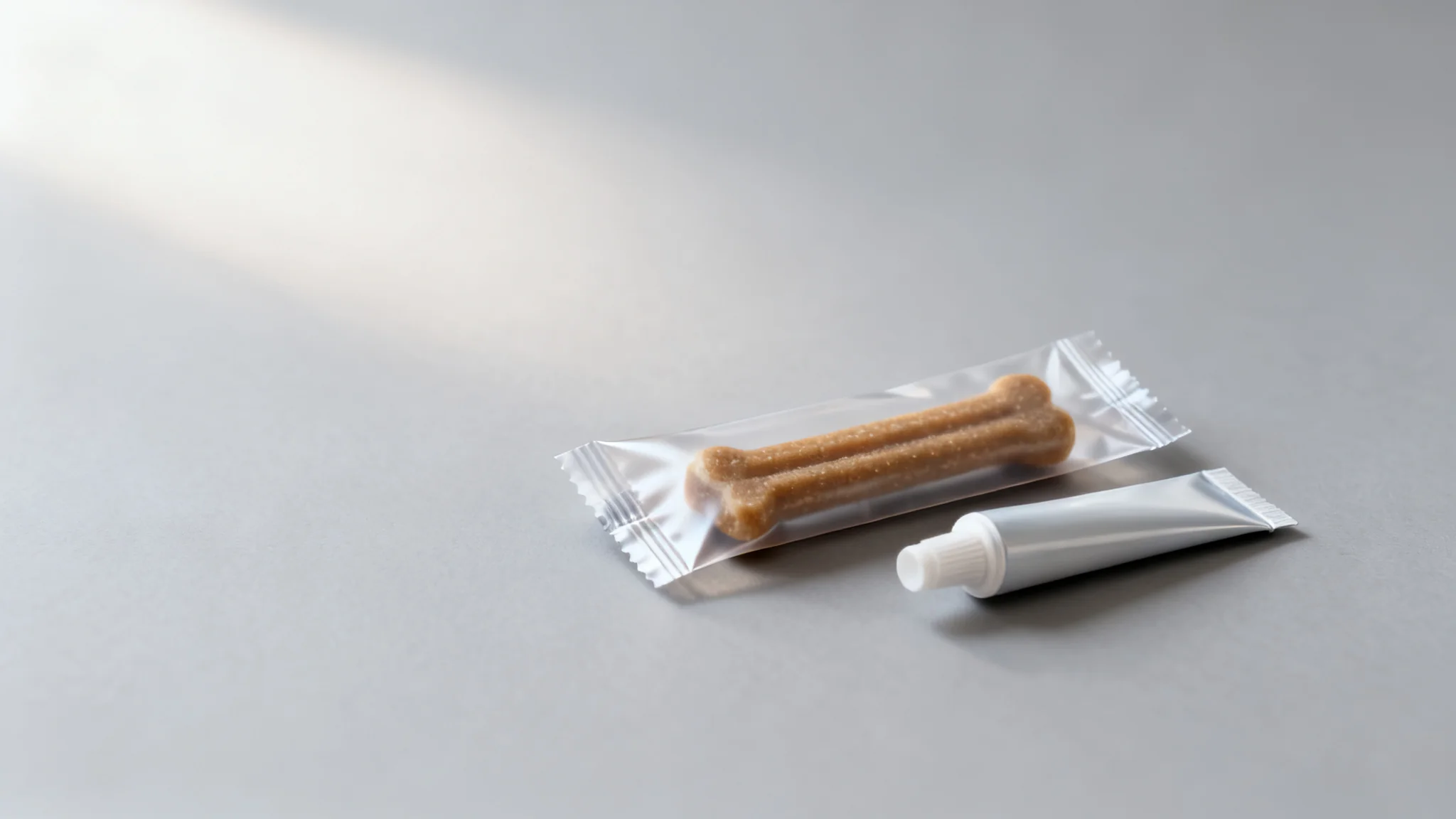
The difficulty in custom pet-treat packaging bags is not choosing the bag but the product forms being too varied. Strip meat paste, wet-food sticks, high-moisture meat chunks, squeezable sauce packs, dried snacks, and freeze-dried products each have different filling methods, sealing requirements, and barrier needs. Many packaging problems are invisible at the sampling stage and only emerge during mass production or after some distribution time: for high-moisture products, water keeps migrating inside the bag. This article sorts out the common formats and selection order for custom pet-treat packaging bags.
First, distinguish the product form for custom pet-treat packaging
The first step is to classify the product. For high-moisture, sticky soft snacks, the focus is whether they smear the seal zone during filling and whether moisture migrates inside the bag; for air-dried and baked snacks, oil content and brittleness stand out, shifting the focus to puncture resistance, oxidation prevention, and breakage prevention; freeze-dried and supplement powder/tablets have very low moisture, so the packaging mainly provides moisture protection and metered dispensing.
The second step is to confirm distribution conditions. Ambient, cold chain, or both directly affect whether a structure can be used; whether there is a freeze-then-thaw step and whether specific sterilization processes must be withstood must be clarified before selection. If the form or distribution conditions are set wrong, the chosen pouch format will likely need rework.
Should strip meat paste and wet-food sticks use a spout pouch or a stick pouch?
It depends on the feeding method. For squeeze-feeding, use a soft spout pouch; the spout diameter must match the product viscosity — too thick won’t squeeze smoothly, too thin dispenses too much at once. For tear-and-eat strip products, use a stick pouch with a tear notch; the key is the tear position and force path. Multi-pack links also need a reseal structure, and the reseal strip eats into capacity on small-spec pouches.
| Packaging format | Corresponding product | Key point |
|---|---|---|
| Spout pouch (soft) | Meat paste, squeezable sauce packs | Spout diameter matched to viscosity |
| Stick pouch / tear strip | Wet-food sticks, meat strips | Tear position and tear force |
| Eight-side seal / flat-bottom pouch | Bulk weigh, mixed dry goods | Standing and stacking stability |
| Four-side seal small pouch | Freeze-dried, powder tablets | High-speed filling and moisture protection |
Data nature: the format comparison is compiled from common industry practice to indicate direction and does not represent measured results. For formed pouches, see the site’s eight-side-seal stand pouch category; for strip products, see the cat-treat stick pouch.
What structure for high-moisture and high-oil products
The core risk for high-moisture products is moisture migrating inside the bag, not water entering from outside. Surface moisture evaporates into the headspace and condenses on the cooler film, forming local water stains and sticky zones; improper desiccant dosage can even pull the product’s own moisture away, hardening its texture. The focus is controlling headspace, choosing a matching barrier layer, and, when necessary, separating contents — not simply thickening the bag.
High-oil products need attention to oil’s effect on the seal layer and print surface. Oil seeping into the seal zone weakens heat-seal strength, and seeping onto the print surface can cause blotching. The heat-seal layer material, seal width, and heat-seal parameters must be arranged together and verified on equipment close to mass production. The division of labor among structure layers can be considered alongside the specifications and stacking section in Pet Food Packaging Bag Selection.
Why separate contents in dry-wet mixed snacks?
When wet and dry materials are packed in one bag, moisture migrates from the wet side to the dry side, degrading both. Separation cuts this migration path; common approaches include independent small pouches, a composite-compartment structure, or separately packing the dry side. Whether separation is necessary depends on the water-activity difference between the two sides and the product’s acceptable change range.
Separation occupies pouch space, adds a forming step, and changes the filling method — it is a structural decision. Before choosing, measure the water activity on both sides and the target shelf life, then judge the level of separation needed.
When to finalize printing and shelf display?
Purchase decisions for pet treats are mostly made by the owner, so the layout information density is high: product form, suitable dog/cat, feeding advice, and ingredient selling points are all crowded onto the front. Once the layout is set, the pouch format, specifications, and reseal position cannot be changed much, so print layout must advance in sync with structure.
The printing method affects file requirements. Large dark areas and fine reversed-out text are prone to plate filling at high speed, so font weight and line width must stay within the process tolerance. Hang holes, standing shape, and stacking also affect the layout safe margin; for actual color, we recommend confirming with a sample on the same substrate as mass production.
Which items are most easily missed during sampling?
The first is the machine. Soft snacks are sticky and easily smear into the seal zone during filling, so mass-production seals develop micro-channels that hand samples completely hide. Sampling must run on equipment close to mass-production speed, checking the mass-production seal rather than hand samples. The second is records: heat-seal parameters such as temperature, time, and pressure must be archived, otherwise they cannot be reproduced after a material batch change.
The third is the acceptance criteria. The seal-strength range, leak-check method, post-distribution appearance and texture checkpoints, and the storage-test milestones derived from shelf-life validation should all be agreed before sampling. The internationally common heat-seal strength test method, ASTM F88/F88M, can be cited as a communication baseline.
When is a high-barrier structure unnecessary?
For freeze-dried, powder tablets, and low-moisture supplement products, if the shelf-life requirement is not long and sales are mainly ambient short-chain, dropping one barrier tier is usually more cost-effective. Conversely, for high-oil, high-moisture, or products needing a longer shelf life and cold-chain fluctuation, it is not appropriate to cut barrier to save cost.
Whether a degassing or oxygen-absorbing configuration is needed, and whether freeze tolerance is required, both depend on the product and distribution conditions rather than applying a template. First write down the target shelf life and distribution temperature range, then structure discussion has a premise.
Key takeaways
- The order for custom pet-treat packaging bags is product form, distribution conditions, pouch format and filling, structure, and printing.
- Choose a spout pouch or stick pouch for strip products by feeding method; multi-packs must reserve reseal space.
- The risk for high-moisture products is in-bag moisture migration; the focus is headspace, barrier layer, and content separation.
- Sampling must be done on equipment close to mass-production speed, with heat-seal parameters and acceptance criteria archived.
Authoritative references and acceptance guidance
For export products, refer to FEDIAF’s industry self-regulation framework: FEDIAF Pet Food Nutrition Self-Regulation Guidelines; packaging claims must match the product’s actual situation. The current version of standards for domestic products can be queried in the National Standards Full-Text Public System; when procuring, include the sales destination in the quotation conditions.
For acceptance, we recommend fixing four items at the sampling stage: seal strength, leak-check method, post-distribution appearance checkpoints, and the storage-test milestones from shelf-life validation. Agree on the method and criteria first so the test results are binding. For more flexible-packaging solutions, see the site’s Pet Food Packaging Solutions.
Conclusion
Whether custom pet-treat packaging is done well depends on the order: first confirm product form and distribution conditions, then choose pouch format and filling method, then set structure and printing. For high-moisture products the focus is in-bag moisture migration, and sampling must be completed on equipment close to mass-production speed with parameters archived. The next step is to organize water activity, oil content, distribution temperature, and shelf-life target into a requirements table, then run trial filling and seal validation against the conditions.
Frequently asked questions
Does custom pet-treat packaging always require aluminum foil?
Not necessarily. Whether custom pet-treat packaging needs aluminum foil depends on the product’s oil content, water activity, and target shelf life. For high-oil, high-moisture products, or those needing a longer shelf life and cold-chain fluctuation, an aluminum-foil laminate structure is safer; for low-moisture products like freeze-dried and powder tablets sold via ambient short chains, a metallized or EVOH-containing structure is usually sufficient. The basis is matching oxygen-transmission and moisture-transmission data measured by standard methods with the target shelf life.
At which stage should the tear position of strip snacks be set?
It should be set when the pouch format and bottom dimensions are finalized. The tear position depends on the force path when tearing; landing near the seal or where contents pile up easily tears crooked or leaves strings. Sampling should run on equipment close to mass production, actually tearing open a few bags to confirm the opening shape and break, rather than only looking at hand samples. Changing the position after finalization means reworking the layout and dimensions.
For high-water-activity products, should desiccant be added?
In most cases we do not recommend adding it directly; calculate first, then add. Too large a dose may pull the product’s own moisture away and harden its texture, while too small a dose is ineffective. The more effective order is to first confirm the moisture-migration path, then respond with headspace control, barrier-layer selection, and necessary content separation; whether to pair with desiccant is decided by shelf-life validation.
If sampling passes but mass production shows seal channels, what is usually the cause?
The most common causes are trapped material and machine differences. Soft products are sticky and smear the seal zone during filling, and the effect is amplified at mass-production speed. Next is heat-seal parameters not being archived, so they cannot be reproduced after a material batch change. The response is to do sampling on equipment close to mass-production speed, record temperature, time, and pressure, and write the seal-strength range into the sampling agreement.





