





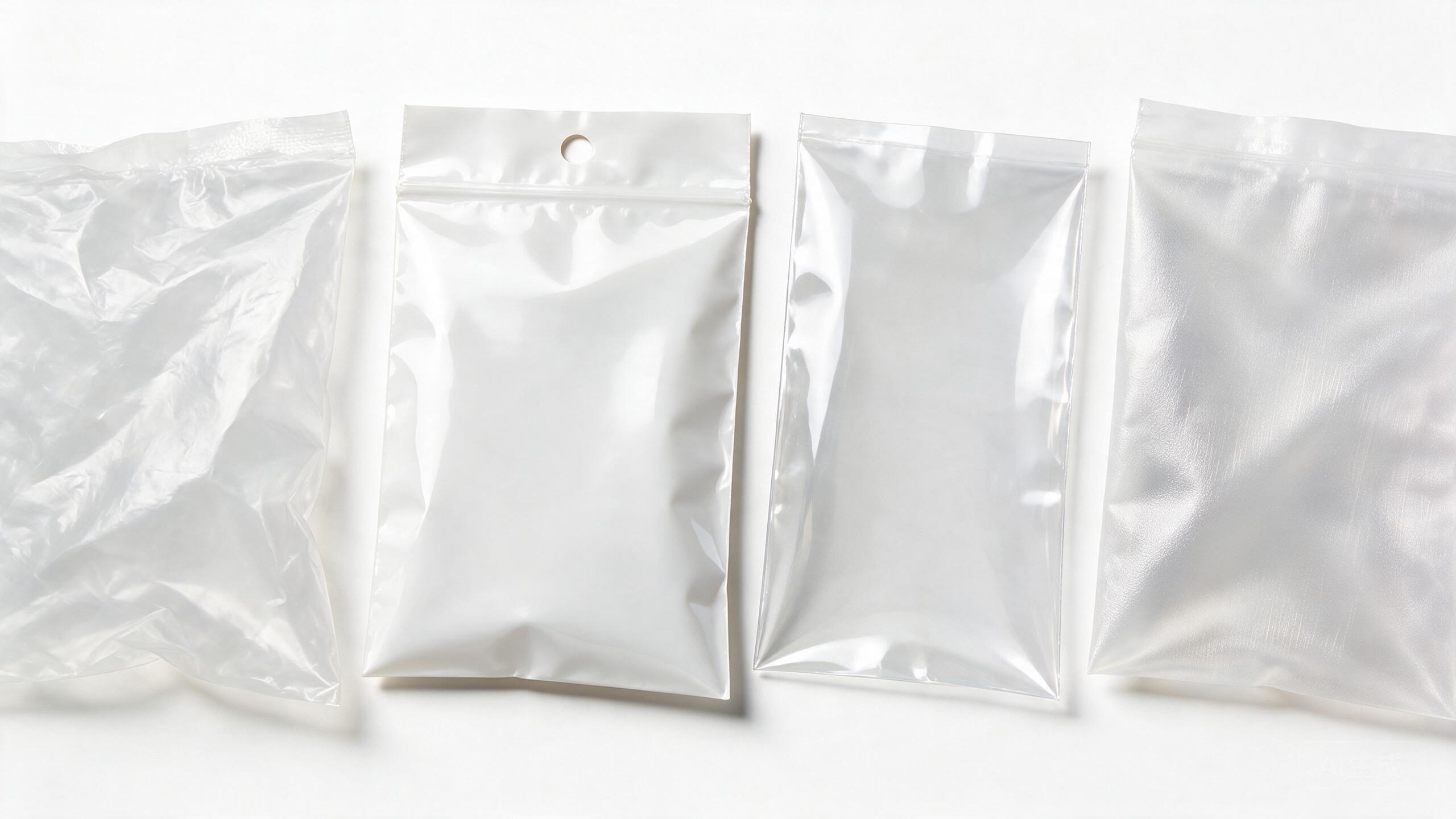
Why Choosing the Right Packaging Material Matters
In the packaging procurement process, the first and most confusing question is: what material should a plastic packaging bag actually use? PE, PP, PET, PA (nylon)… these terms sound similar but differ greatly in performance. Choose wrong, and the packaging may easily break, lack sufficient barrier properties causing product spoilage, or even add unnecessary cost. For more material-selection details, refer to our food packaging bag material comparison. This article clarifies the properties and applications of several mainstream plastic packaging materials at once.
PE (Polyethylene) — The Most Common General-Purpose Packaging Material
Polyethylene is the highest-volume plastic grade; the common types are LDPE (low-density polyethylene) and HDPE (high-density polyethylene).
LDPE: Soft and Transparent, Suited to Light Packaging
LDPE feels soft, has high transparency, and good heat-sealing performance. It is commonly used for garment bags, food storage bags, and daily-goods outer packaging. Its drawbacks are low tensile strength and heat resistance, making it unsuitable for heavy items or high-temperature environments.
HDPE: High Rigidity, Suited to Load-Bearing Packaging
HDPE is harder and more abrasion-resistant than LDPE; it is common in shopping bags, garbage bags, and shampoo bottles. With a semi-transparent, relatively brittle feel and good tear strength, it is the first choice for low-cost load-bearing packaging.
PP (Polypropylene) — High Heat Resistance and Transparency
The standout advantage of polypropylene is good heat resistance; its melting point can exceed 160°C, allowing high-temperature retort sterilization. It also has high transparency and gloss, and is widely used in food packaging.
BOPP (biaxially oriented polypropylene) is a PP film that has undergone orientation; it offers excellent transparency and is often used as the outer layer of snack bags, candy packaging, and printed laminates. Note that PP has poor impact resistance at low temperatures and becomes brittle easily.
PET (Polyester) — The Star Material for High Barrier and High Strength
PET offers excellent mechanical strength and barrier properties; its resistance to oxygen and water vapor far exceeds that of PE and PP. PET film has high transparency and chemical corrosion resistance, and is widely used in beverage bottles, food packaging laminates, and electronics packaging.
In laminated packaging, PET usually serves as the outer layer, providing mechanical support and printability, paired with an inner PE or CPP layer for heat sealing. Metallized PET (VMPET) also delivers excellent light-blocking and moisture-proof performance.
PA (Nylon) — The Champion of Puncture Resistance and Oil Resistance
The most prominent feature of nylon film is its extremely strong puncture resistance, making it suitable for products with sharp edges (such as bones and frozen seafood). It also resists oil well, and is a common material for oily foods (such as nuts, cured meats, and fried foods).
Common nylon grades are PA6 and PA66, but nylon material is more costly and should be weighed against product characteristics. In laminate structures, PA usually serves as the middle layer providing puncture resistance.
Quick Reference: Common Laminate Structures
In real packaging, single materials are rarely used; composite structures are preferred to combine their advantages:
- PET/PE: General-purpose food packaging, balancing barrier and heat sealing
- BOPP/CPP: Snack bags, high transparency and low cost
- PA/PE: Frozen food, oily food, puncture- and oil-resistant
- PET/AL/PE: Vacuum packaging, retort pouches; the aluminum foil layer provides ultimate barrier
- PE/EVOH/PE: High-barrier fresh-keeping packaging; EVOH has extremely strong oxygen barrier
How to Choose Packaging Material Quickly
When selecting material, ask yourself four questions:
- Does the product have sharp edges? → If yes, consider a PA-containing laminate structure
- Does it require high-temperature sterilization? → If yes, choose PP or a heat-resistant PET-containing structure
- Is it sensitive to oxygen/water vapor? → If sensitive, choose PET/AL/EVOH laminate
- Limited budget? → PE or BOPP/CPP is the cost-effective choice
If you are still unsure, we recommend contacting a professional packaging supplier directly. An experienced packaging manufacturer will recommend the most suitable material solution based on your product characteristics, storage conditions, and shipping method.
Conclusion
Understanding the properties of different plastic packaging materials is the first step in good packaging planning. PE is cost-effective, PP resists heat well, PET barriers strongly, and PA resists puncture—each has its strengths. In practice, laminate structures achieve combined performance that a single material cannot.
Still have questions about material selection? Welcome to contact HASUPACK or visit the OMOPACK website; we provide one-stop service from material selection to finished production, and offer professional packaging planning advice for free.





