





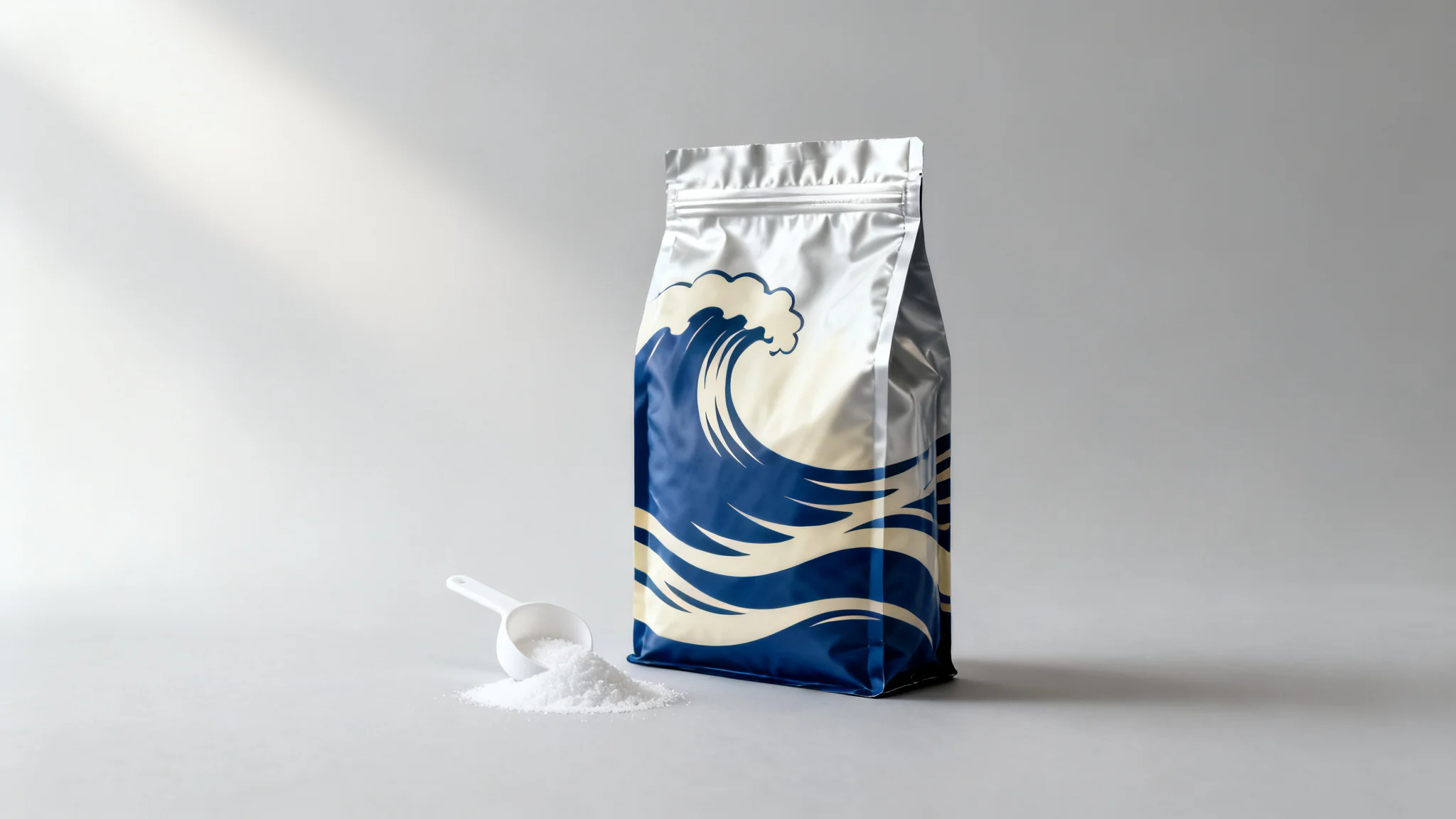
A detergent powder pouch has three jobs at once: keep moisture away from a hygroscopic product, keep fine dust out of the seal, and carry up to five kilograms without splitting. Most failures in this category trace back to one of those three rather than to the printing, so the decisions below are about structure, seal control and format choice.
What Makes Detergent Powder Harder to Pack Than Other Powders?
Detergent powder is a blend, not a single material. Formulations typically combine sodium sulfate, sodium carbonate, zeolites, surfactants and a fragrance system, and the builder salts are hygroscopic: once they take up moisture they form bridges between particles, and powder that poured freely at the nozzle sets into a block inside the bag.
Two other properties matter. The dust fraction coats inner film, filling tube and seal jaws, settling wherever the pack pauses. Bulk density also varies between formulations and between batches, so a die line built around one density over-fills or under-fills another; give the converter a density range rather than a fill weight alone.
Fragrance is volatile and migrates through polyethylene, so a scent claim belongs in the film specification.
Moisture Barrier: Matching Film Structure to the Market
Moisture protection is described by water vapor transmission rate, measured on film per ASTM F1249. A lower rate means less moisture crosses the film; choose against the humidity and storage time the pack will meet. PE-based laminates suit dry markets with fast turnover, metallized polyester improves the barrier at moderate cost, and foil laminates give the highest barrier, though both crack at folds and open pinholes where the pouch flexes.
The barrier layer is only half of the decision: sealant thickness controls seal strength and dust tolerance, and a thin sealant that saves material fails earlier on a dusty line. Ask for transmission data on the finished laminate, not a single film, since adhesives and coating weights change the number. Home care borrows from personal care lines, and the personal care and home care packaging formats page shows the same structures applied to both.
Why Powder Dust Breaks Seals and How to Control It?
A heat seal forms when two sealant surfaces melt and polymer chains diffuse across the interface. A powder particle sitting in that interface holds the surfaces apart, leaving a channel that passes air and moisture while the seal still looks continuous. It is the most common leak path on powder lines and invisible to inspection.
On a vertical form fill seal machine the dust comes from the product drop. Lower the fill level so the powder settles below the seal zone, add a short pause or light vibration before the jaws close, extract dust at the filling tube, and specify a sealant grade that tolerates light contamination with a wider jaw or longer dwell so it flows around particles.
Verify with a bubble emission test per ASTM D3078 on filled packs and seal strength per ASTM F88, because a seal that looks smooth can still leak. Jaw temperature, pressure and dwell are covered in the packaging process instructions reference.
Gusset, Bottom Seal and Standing Stability
Three formats dominate: the stand-up pouch, the side gusset bag and the flat bottom or box pouch. The stand-up pouch folds a base gusset so the pack stands on shelf; the side gusset adds volume through two inward folds and prints on four surfaces. In both, the bottom seal carries the full product weight, and gusset corners concentrate stress where fold meets seal, which is where a split starts.
Flat bottom spreads the load over a rectangular base, stands without support and gives the most print area, but it needs a filler that opens and holds the base and costs more per unit. When to use it depends on the filling equipment and the shelf slot rather than on price. Gusset depth is the dimension most often carried over unchanged when a formulation changes; recalculate it from fill volume.
Which Pouch Format Fits a 500 g to 5 kg Fill Weight?
500 g to 1 kg retail packs
A stand-up pouch without a handle is enough. The base has to stand on shelf after opening, and a press-to-close zipper helps where part of the pack is stored. Sealant thickness still has to allow for top-seal dust, proportionally heavier in a small pack.
2 kg to 3 kg family packs
Side gusset or flat bottom with a welded handle. Weld width and handle film thickness decide whether it tears at the anchor, and the body usually needs a thicker sealant so the bottom corners carry the load without stretching.
4 kg to 5 kg bulk packs
Flat bottom or box pouch with a die-cut or welded handle and a wider bottom seal. Drop and stack tests belong in sample approval at this weight, where the failure mode shifts from leaking to splitting. Formats in this band are shown in the washing powder packaging bag range.
Print, Handle and Store Conditions in Humid Markets
Surface printing on polyethylene scuffs: in a humid warehouse cartons rub on the pallet and ink wears at the edges. Reverse printing keeps ink behind the outer film, and a matte or slip-modified varnish reduces blocking when pouches stack warm. A rub test after storage tells you more than a fresh sample does.
How to Qualify a Detergent Powder Pouch Before Mass Production?
Run the trial with the real powder at the real fill weight on the real line. Samples filled with rice or water pass tests the product fails, because neither reproduces the dust, the density or the hygroscopic behaviour. Cover the failure modes in order: seal strength on the filled pack, leak test, drop from carton height, stack at pallet compression, storage in destination conditions, and print rub last.
Give the converter the figures that decide the structure: fill weight and bulk density, filling method and jaw width, climate and storage time, carton configuration, and whether fragrance retention is a claim. Without them a quote rests on a generic structure.
Conclusion
The structure follows from the market climate, the seal from dust control at the line, and the format from the fill weight. Bulk density and destination humidity decide most of it.
Frequently Asked Questions
Does a detergent powder pouch need an aluminium foil layer?
No, a detergent powder pouch does not always need an aluminium layer. Foil gives the highest moisture barrier available in a flexible laminate, so it is the safe choice for humid climates, long storage or a fragrance that must survive a year on a shelf. In dry markets with fast turnover, a metallized polyester or a PE-based laminate can be sufficient. The decision should rest on water vapor transmission rate data for the finished laminate, measured per ASTM F1249, compared against the humidity and shelf time you actually expect.
Why does the powder cake inside a pouch that never leaked?
Because caking can start from moisture already inside the pack, not from moisture entering it alone. Residual moisture in the powder, humid air trapped in the headspace and a warm fill all raise the humidity inside a sealed pouch. The first check is the moisture content of the powder going in and the headspace volume; the second is the transmission rate of the laminate. Drying the powder or reducing fill temperature often resolves what looks like a barrier failure.
How do I keep powder out of the seal area on a form fill seal line?
Start by lowering the fill level so the powder settles below the seal jaws, then give the pack a short pause before the seal closes. A dust extraction shoe at the filling tube removes the airborne fraction, and a sealant grade that tolerates light contamination covers what remains. Widening the jaw or extending dwell time helps the sealant flow around particles. Confirm with a bubble emission test, because a contaminated seal can look perfect and still leak.
What should a buyer check on a detergent powder pouch sample?
Check the seal, the load path and the print, in that order. Measure seal strength on the filled pack, run a leak test, then drop the filled pouch from carton height and stack it for a week at the weight it will carry. Only after that assess print rub and gloss. A dimensional check matters as well: a pouch measured flat will not match the same pouch filled with powder at five kilograms.





