





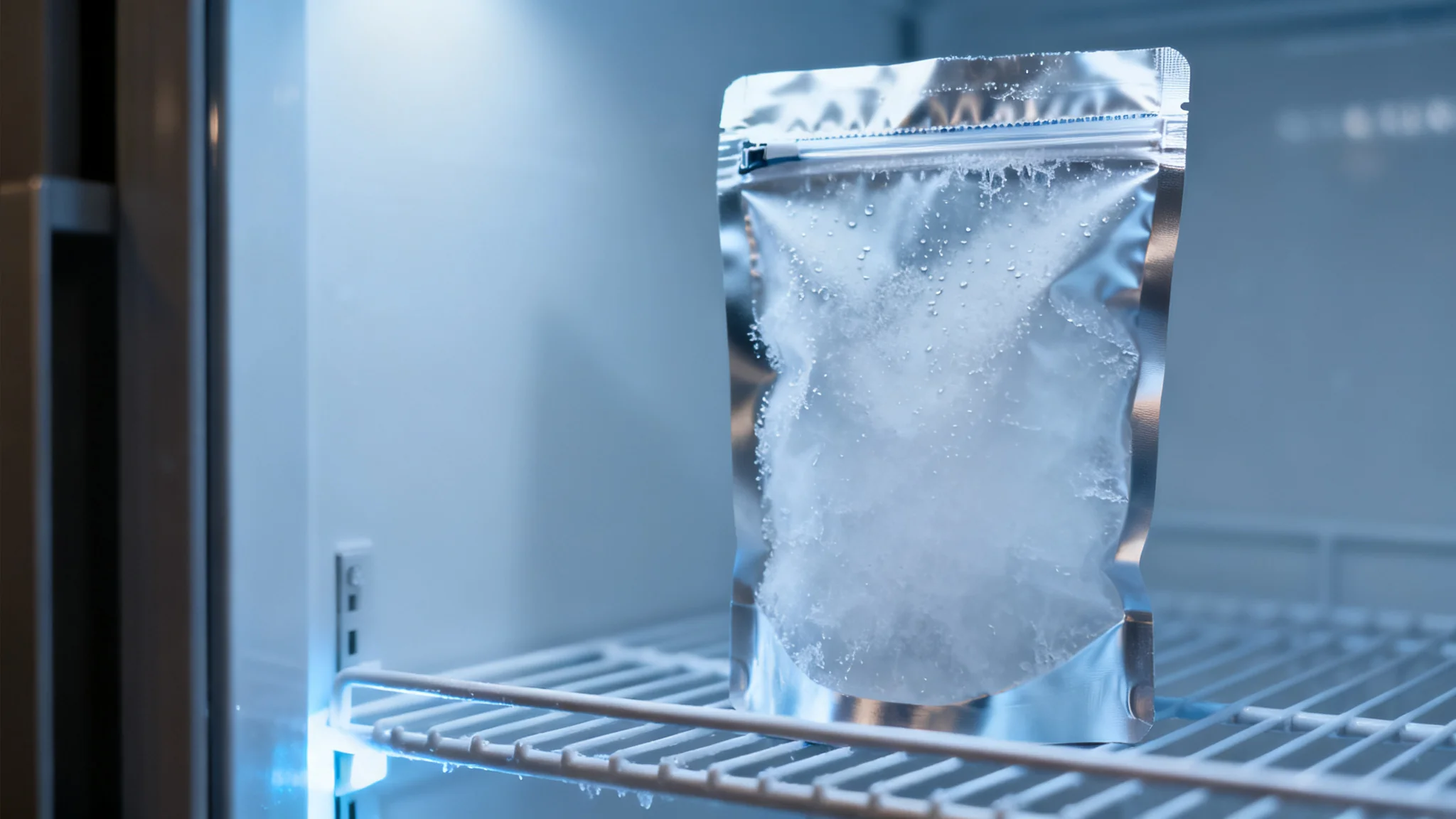
A frozen food zipper pouch fails at the zipper more often than at the film. The film can hold its barrier at -18°C while the profile turns hard, the seal zone stiffens, and the bag cracks on the fold line or tears when pulled open. These failures are decided at the specification stage, before the first pallet reaches a cold store. What follows covers how zipper resin behaves at freezer temperature, which film and profile pairs stay workable, and where a zipper should not be used.
Why Does a Frozen Food Zipper Fail in the Cold?
Three mechanisms account for most cold-store zipper failures, and they are routinely confused in complaint handling. Profile embrittlement comes first: the zipper is a separate extrusion, often from a different resin than the film, so it does not inherit the film’s low-temperature toughness. Seal-zone stiffening comes second, where heat used to weld the flange destroys the orientation of the film around it. Ice in the interlock is third, and it stops the hooks from seating once the bag has been opened.
The profile is a separate material decision
A pouch built from a tough low-temperature sealant film can still ship with a brittle profile if the zipper was bought on price. And a cracked zipper rarely shows as a leak in a room-temperature pressure decay test; it shows as a bag that will not stay closed, or a split along the fold above it.
Zipper Profile Resin and Cold Brittleness
Polyethylene-based profiles, particularly those built on linear low-density or metallocene LLDPE, keep more ductility as temperature drops than polypropylene-based profiles, which harden earlier and crack at the hinge of the hook. Ethylene vinyl acetate copolymers widen the working window in some formulations, at the cost of a softer feel.
Datasheets rarely state a brittleness temperature for the profile, so it has to be measured. ASTM D746 covers brittleness temperature of plastics and elastomers by impact; for the film itself, ASTM D1790 covers brittleness temperature of plastic sheeting. Run both: a pouch is only as cold-tolerant as its weakest component.
Seal Zone Stiffening and the Failures It Causes
Welding a zipper into a pouch needs more heat and pressure than a film-only seal, because the flange is thicker and heat has to travel through the profile base. The film around that weld loses part of its orientation and becomes stiff, so the boundary between sealed and unsealed film turns into a hinge line where pinholes and splits begin.
Over-sealing is louder: the profile softens and deforms, so the hooks no longer engage or the bag is welded shut. Under-sealing is quieter and costlier, because the flange ends seal only partially and leave a channel that passes a room-temperature test but opens once the bag is handled cold.
How Does Reopening Force Change After Freeze-Thaw Cycles?
Opening force rises at low temperature. Resin modulus increases as the profile cools, so the zipper that opens under light pressure at room temperature needs a firm pull at -18°C. That shift stays manageable if the profile was specified for it; it becomes a complaint when the bag tears at the top seal before the zipper opens.
Freeze-thaw cycles add a second effect. Moisture condenses into the open groove when the bag leaves the freezer and refreezes on return, and ice bridging the interlock blocks the hooks. Repeated opening while cold also wears the hooks, so holding force drops. Three cycles at -18°C is a practical test minimum for a retail pack.
Film Structures That Keep a Zipper Usable at -18°C
Most frozen zipper pouches combine a PET or BOPP outer layer for print and stiffness, a barrier core where needed, and a low-temperature sealant on the product side. The zipper flange must be compatible with that sealant, otherwise the strongest film still gives a weak closure seal. PE-flange zippers seal within film seal temperatures; PP-flange zippers need a higher window.
Typical starting points:
- PET//PE with a metallocene LLDPE sealant, for short freezer cycles where print and toughness outweigh oxygen barrier.
- PET//VMPET//PE, where light and oxygen protection are needed and metallised barrier suits.
- PET//AL//PE, for products sensitive to oxygen and moisture across long frozen storage.
None of these fixes a brittle profile; zipper and sealant are a pair and get tested together. Formats sit under frozen food packaging solutions, including the frozen shrimp zipper stand-up pouch.
When Is a Zipper the Wrong Choice?
A zipper pays back only where the pack is reopened. It is wrong in five cases. Vacuum packs: the profile traps air and collapses, so the bag cannot pull tight. Glazed or individually quick-frozen products carry surface ice that fills the track on the first closure. High-speed vertical form-fill-seal lines without a zipper applicator run slower or stop. Packs below roughly 100 g carry a closure that costs more than it returns. Bone-in or shell-on products puncture the film at the zipper shoulder.
Where a zipper is kept, the rule for when to use it is narrow: specify it where the pack is reopened at home.
What to Test Before Approving a Frozen Zipper Pouch
Approval should rest on tests run at freezer temperature, on finished bags, not on material certificates. The sequence follows the order in which failures appear and maps onto the line controls in the packaging process instructions and custom frozen seafood packaging.
- Brittleness temperature of profile resin and film to ASTM D746 and ASTM D1790, against the lowest cold-chain temperature.
- Seal strength at the zipper flange and back seal to ASTM F88, conditioned at freezer temperature rather than 23°C.
- Opening and closing force at -18°C, on a new bag and after three freeze-thaw cycles.
- Leak test on the filled, closed bag; bubble emission to ASTM D3078 exposes flange channels a pressure test misses.
- Drop and compression tests from the frozen state, where most shoulder splits happen.
- A trial on the actual filling line, because applicators, fill temperature and dwell interact with the profile.
Conclusion
A frozen food zipper pouch is a system of three parts: the profile, the seal zone and the film. Cold performance is limited by the weakest of them, and the profile is usually the one nobody specified. Ask for the brittleness temperature of the zipper resin, measure seal strength and opening force at -18°C, and run freeze-thaw cycles before approving it. Where the application is vacuum or glazed, the honest answer is no zipper.
Frequently Asked Questions
Does a frozen food zipper pouch always need an aluminium foil layer?
No, not always. A frozen food zipper pouch needs foil only when the product is sensitive to oxygen and light across long frozen storage, or when aroma must be held inside. Fat-rich products and cooked ready meals usually justify it; frozen vegetables on a short retail cycle do not. Foil also stiffens the pouch, which keeps the zipper flat but concentrates stress at the seal edge.
Why does the zipper crack at the seal edge after freezing?
The crack is a hinge failure rather than a zipper failure. Heat used to weld the flange removes part of the film’s orientation in a narrow band, and that band turns rigid at freezer temperature. Every flex works the boundary between sealed and unsealed film until it splits. Lower seal temperature with longer dwell, a wider seal bar or a tougher sealant each help; check the window against the actual zipper lot.
Can we use a slider zipper on frozen food packs?
Yes, but a slider adds parts that cold makes less forgiving. It relies on a clip or spring to press the profiles together, and at -18°C the plastic hardens and closing force rises, so the slider can jam or leave the track partly open. Sliders also collect ice in the channel. If accessibility demands one, specify a PE-based body and test closing force cold.
What information does a supplier need to quote a frozen zipper pouch?
The quote rests on five inputs, and every one is production data. They are the product’s fat, moisture and salt content; the lowest cold-chain temperature and how long the pack stays frozen; fill weight and pack format; line type and speed, including whether a zipper applicator is fitted; and barrier and print requirements. Photos of the current pack and complaint samples beat a specification sheet.





