





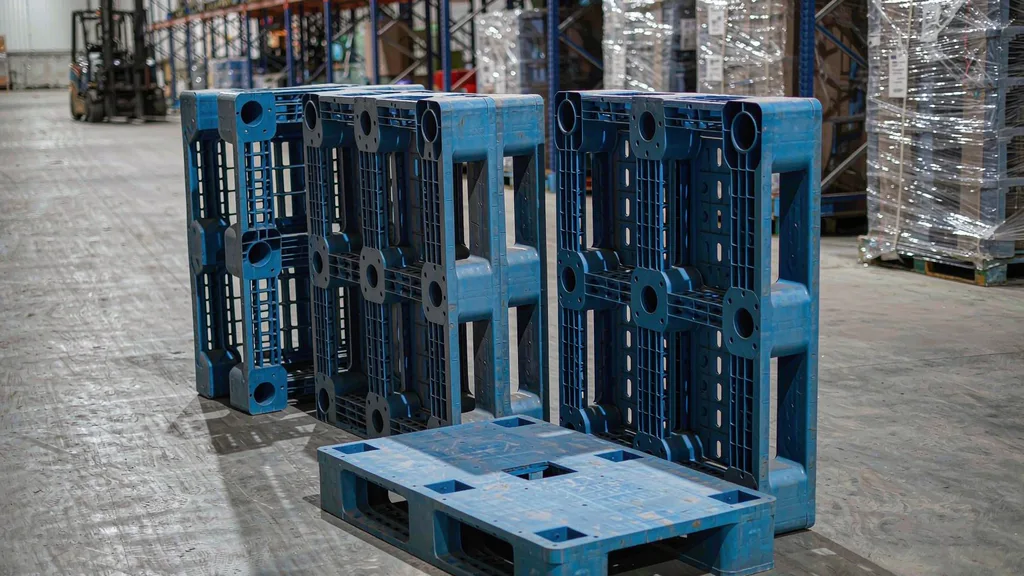
Plastic pallets are rated three separate ways: static load, dynamic load and racking load. The racking figure is usually the lowest — often 40–60% of the dynamic rating — and it is the number that decides whether a pallet survives a year in a warehouse. Buyers who compare only the headline “1,500 kg” figure are comparing the wrong number.
What Do the Three Load Ratings Actually Mean?
A pallet has to do three different jobs, and each one loads the structure differently.
- Static load is the weight of pallets stacked on top of each other, on the floor, with nothing moving. Typical plastic pallet ratings run 4,000–6,000 kg because the load passes straight down through the blocks.
- Dynamic load is the weight the pallet carries while being moved by a forklift or pallet truck, including the shock of lifting, braking and cornering. Typical ratings run 1,000–1,500 kg.
- Racking load is the weight carried when the pallet spans two beams with nothing underneath. This is the bending case, and it is where plastic pallets differ most from timber.
The racking figure matters because almost every warehouse stores on racking, and a pallet that is fine on the floor will creep and deflect when suspended across beams for months.
| Load case | What it measures | Typical plastic pallet | Design driver |
|---|---|---|---|
| Static | Stacked in a block on the floor | 4,000–6,000 kg | Block and column strength |
| Dynamic | Moved by forklift or pallet truck | 1,000–1,500 kg | Impact, deck stiffness |
| Racking | Spanning two beams, unsupported | 400–1,000 kg | Bending stiffness of the deck |
Why Is Racking Load So Much Lower?
Racking turns the pallet into a beam. The load sits in the middle of the span, the deck bends, and the top surface goes into compression while the bottom goes into tension. Plastic is good at neither when it is warm.
Two effects make this worse over time:
- Creep. Thermoplastic deflects gradually under sustained load. A pallet that sags 8 mm on day one may sag 15 mm after six months. Once the deflection passes roughly 1/200 of the span, the load starts to shift and the pallet becomes unstable on the beam.
- Temperature. HDPE loses stiffness quickly above 40°C. A pallet rated 1,000 kg at 20°C may only carry 600 kg in a warehouse roof space at 45°C in summer.
Ask the supplier for the racking load at the actual service temperature, not at 23°C in a test lab. And ask whether the figure is a short-term test or a long-term creep value; they are not the same claim.
Which Polymer Should the Pallet Be Made From?
Almost all plastic pallets are HDPE or PP, often with recycled content.
- HDPE: tougher at low temperature, better impact resistance, the default for cold stores and general logistics. Softer and more prone to creep under sustained racking load.
- PP: stiffer and more heat-resistant, so it holds racking load better in a warm warehouse. More brittle in the cold, and it can crack if hit hard below freezing.
- Recycled HDPE regrind: common and usually fine for closed-loop logistics, but the regrind content affects impact strength. Ask for the percentage and the impact test result, not just “recycled”.
For food and pharmaceutical use, the pallet is part of the food-contact chain. In the EU it should be supported by a declaration under Regulation (EC) No 1935/2004 and, where plastic contact is direct, 10/2011; in China, GB 4806.7 applies to plastic materials in contact with food. A blue pallet with no documentation is a blue pallet, not a food-grade pallet.
Does the Deck Design Matter?
More than most buyers expect, especially in food plants.
- Closed deck: smooth top, nothing falls through, easy to clean and to sweep. The right choice for powders, liquids, bagged ingredients and any area with an allergen or pathogen control programme.
- Open deck: lighter, drains water, but product spills and debris collect in the voids and are hard to remove. Fine for closed cartons, poor for open bags.
- Hygienic design: rounded corners, no hollow feet, no exposed metal inserts. The purpose is to remove places where water sits and bacteria grow.
If the pallet goes into a wash-down area, check the maximum wash temperature. Steam cleaning at 80°C will distort an HDPE pallet rated for ambient use, and repeated washing accelerates stress cracking at the feet.
What Sizes and Standards Apply?
Two footprints cover most of the world:
- 1200 × 800 mm: the EUR footprint, standard across European retail and defined in EN 13698-1. Works with Euro stacking containers and standard racking.
- 1200 × 1000 mm: the ISO footprint, common in Asia, the UK and for ocean freight, defined in ISO 6780.
- 1100 × 1100 mm: widely used in Japan and parts of Asia for bulk bags and beverage.
Height matters as much as footprint. A 150 mm pallet plus a 1,200 mm load plus racking beam clearance determines how many levels fit in the building. Changing pallet height by 20 mm can cost or save an entire racking level across a warehouse.
What Should Goods-In Check?
A practical receiving check for plastic pallets:
- Deck deflection under a known load, measured at the centre of the span after 24 hours
- Cracks at the feet and at the junction between deck and blocks, which is where fatigue starts
- Missing or deformed anti-slip grommets, if fitted
- Metal inserts: present, correctly seated, not corroded
- Cleanliness: residue in the deck grooves, label adhesive, broken board fragments from previous loads
- Marking: safe working load, polymer type, production date, recycling code
Buy, Pool or Rent?
The decision is mostly financial, not technical.
- Buy when the pallet is used in a closed loop and returns reliably. Typical payback against pooled pallets is 18–30 months at high trip counts.
- Pool (rented, often blue) when the pallet leaves the site and comes back unpredictably, or when retail customers demand a specific pooled pallet.
- Rent for seasonal peaks, so capital is not tied up in assets that sit idle for eight months.
Whichever route, the load rating question stays the same. A pooled pallet is not automatically suitable for your racking; check the racking figure against your actual beam spacing and your actual warehouse temperature.
Frequently Asked Questions (FAQ)
What is the difference between static and dynamic load on a pallet?
Static load is the weight of pallets stacked on a stationary pallet on the floor. Dynamic load is the weight carried while the pallet is lifted, moved and braked by a forklift or pallet truck. Dynamic ratings are typically one quarter of the static rating because of impact and acceleration forces.
Why is the racking load rating so much lower?
On racking, the pallet spans two beams with no support underneath, so it behaves as a bending beam. Plastic creeps under sustained bending load, and stiffness falls as temperature rises. Most plastic pallets are rated at 400–1,000 kg on racking against 1,000–1,500 kg dynamic.
Can plastic pallets be used in food production?
Yes, and they are often preferred because they do not absorb water, do not splinter and can be washed. Closed-deck hygienic designs with no hollow cavities are the standard choice. The pallet must also have food-contact documentation under EU 1935/2004 and 10/2011, or GB 4806.7 in China.
How long do plastic pallets last?
In a closed loop with normal handling, eight to ten years is common. Life is shortened by high racking loads, steam cleaning, UV exposure in outdoor storage and rough forklift entry. Cracks at the feet are the usual end-of-life signal.
Is HDPE or PP better for plastic pallets?
HDPE is tougher in cold stores and better at absorbing impact; PP is stiffer and holds racking load better in hot warehouses. Choose by the conditions the pallet actually sees: cold-chain logistics point to HDPE, a hot roof-space warehouse points to PP or a reinforced HDPE design.
Do plastic pallets need to match the racking beam spacing?
Yes. The racking rating is only valid for the beam spacing it was tested at, usually the narrowest common configuration. Wider beam spacing increases the span and reduces the safe load, so the rating must be adjusted rather than assumed.
Pallets rarely fail alone. The load unit — pallet, stretch film and the cartons or bags on top — behaves as one structure, and a pallet rated correctly will still fail if the film does not hold the load square. For loads that also need thermal protection in transit, the cold-chain insulated packaging guide covers the layer above the pallet.





