





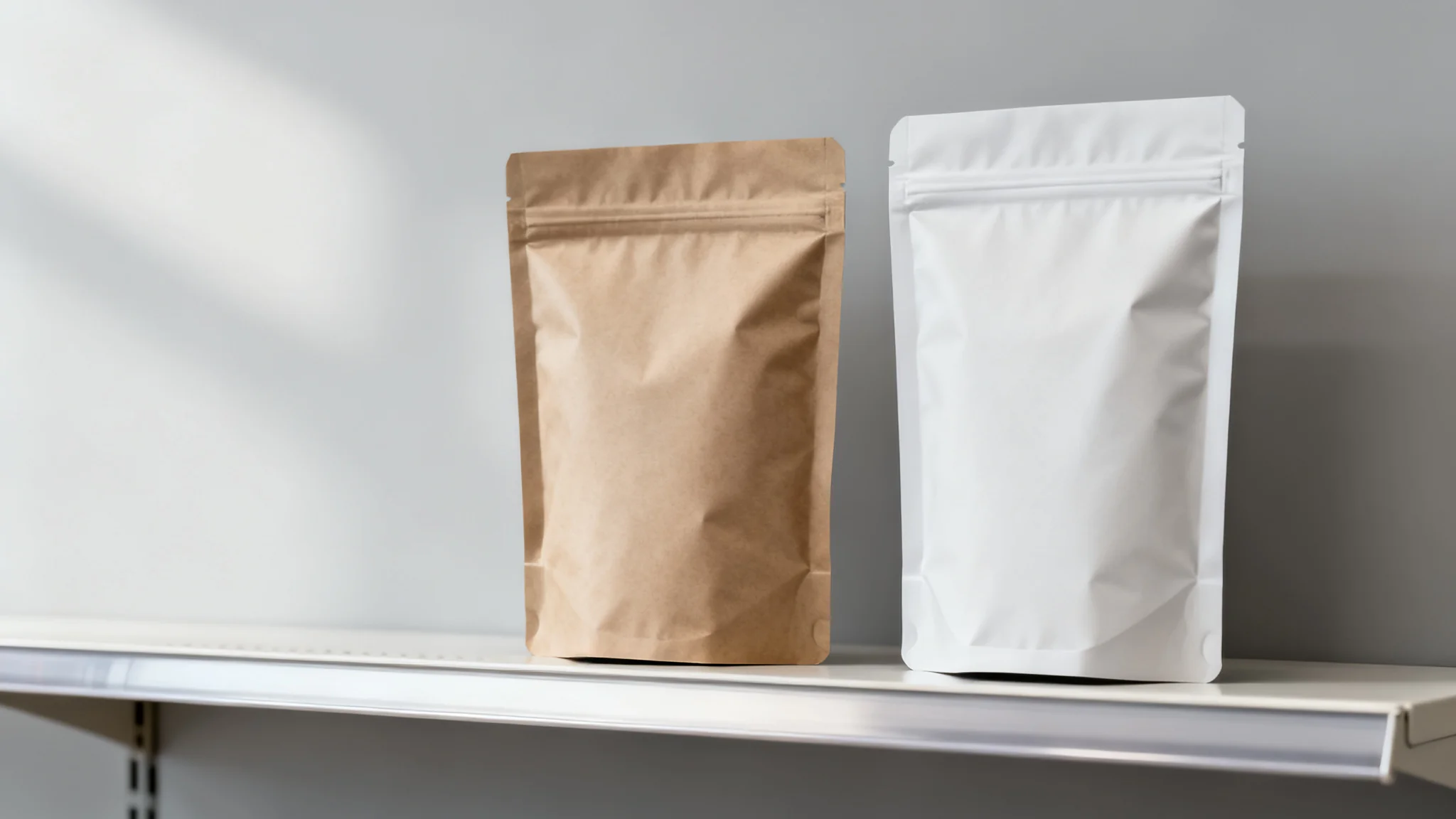
A quad seal pouch and a flat bottom pouch both stand upright on a shelf and both carry coffee, pet food or powder, yet they are built from different seal patterns and they fail in different places. The quad seal body is folded from a web with two side gussets, so each edge carries two vertical seal lines and the pouch stands on that fold. A flat bottom pouch uses a separately formed base that opens into a rectangle. That difference decides filling equipment, shelf behaviour and where a leak first appears.
Seal Geometry: Two Ways to Build a Square Pouch
In a quad seal pouch the front and back panels are joined by vertical fin seals running the full height of both edges, with the side gussets captured inside those seals. Because the gusset is folded in half, each edge carries two seal lines, which is where the four seals come from. A top and bottom seal close the body, leaving four flat surfaces and a base made by the bottom fold.
A flat bottom pouch is assembled differently. Its base is a formed rectangle held by four vertical corner seals, so the pouch sits on a defined footprint instead of a fold. That base is why it looks like a box on shelf, and why the format is almost always supplied pre-made. Compare how pouch formats are formed and filled before choosing.
Corner Seals and the Stress Points They Create
The weak point of a quad seal pouch is not the middle of a seal line but where the two vertical seals meet the bottom seal. There the film stack steps from two layers to four, and the jaw must deliver the same temperature and pressure through that step, which is where underfilled pouches and drop impacts concentrate load.
The second risk is the gusset crease: a crease running into the seal zone leaves a channel the sealant cannot fill, and the pouch passes a visual check while leaking slowly. Seal strength has to be measured rather than judged by eye: ASTM F88 covers the seal strength test method for flexible barrier materials.
Which Format Fills Faster on a Vertical Form Fill Line?
The quad seal pouch usually wins on throughput because it is formed from rollstock on a vertical form fill seal machine: film arrives on a roll and the pouch is made, filled and sealed in one pass. There is one web and no pouch magazine; size changeover is mostly a former and seal jaw change.
A flat bottom pouch normally arrives pre-made and runs on a magazine-fed fill and seal machine with an opening station and a bottom-shaping station, which adds handling steps and floor space. Neither format holds a fixed speed advantage for every product; dose weight, product flow and the number of fill stations decide the real rate.
Does Standing Stability Really Differ Between the Two?
Yes, and the gap appears after filling rather than on an empty sample. A flat bottom pouch stands on a rectangle held square by four corner seals, so the base resists bulging when product settles and the pouch keeps its footprint on a crowded shelf. A quad seal pouch stands on the gusset fold, and its base squares up only when fill level and product angle of repose cooperate; powder that settles to one side will lean.
For pallet stacking, ASTM D4169 describes a distribution cycle for shipping containers and systems, the sound way to compare how both formats survive the same journey.
Print Panels, Copy Space and Registration
A quad seal pouch gives two wide panels plus two narrow gusset strips. The strips suit ingredient text, batch coding and regulatory copy that must be present without competing with the brand block, but they fold inward, so keep fine type off the crease.
A flat bottom pouch offers four panels and a base, which suits a product that needs copy on every face. More panels mean more print stations and more artwork, and a design that reads well flat can break where the panel wraps the corner seal.
When to Use a Quad Seal Pouch
Choose the quad seal format when film can run from rollstock on an existing vertical form fill seal line, when the product is a free-flowing solid such as ground coffee, milk powder or diced pet food, and when pallet cube and film utilisation matter more than a rigid shelf presence. Short runs where a pre-made pouch inventory would be wasteful also fit; see roasted coffee quad seal packaging.
Do not choose it when the pouch must hold its shape through a long retail life, when the fill is heavy enough to distort the base, or when the brand depends on a box-like silhouette. Where the boundary is unclear, a filled sample left on a shelf for a week tells you more than a specification sheet.
How Should You Compare Samples Before Ordering?
Compare filled samples, not empty ones, under the same conditions. An empty pouch hides the base behaviour that decides shelf performance, and a hand-filled sample hides the seal contamination a filling line produces.
Work through one list for both so the comparison stays honest:
- Seal strength to ASTM F88 at the side seal, bottom seal and corner junction, with direction recorded.
- Seal width and appearance along the full length, including the gusset thickness step.
- Base flatness and lean after a day standing at the intended fill weight.
- Drop and compression results against a defined distribution cycle, not an improvised drop.
- Print registration on the gusset strip and on the panel that wraps the corner.
Film structure belongs on the same list: for food and pet food contact the sealant layer is normally an olefin polymer, and 21 CFR 177.1520 sets out which ones are acceptable. Send the film and print specification as one custom packaging brief so both samples are quoted alike.
Conclusion
Quad seal and flat bottom pouches solve one problem with two geometries. Quad seal wins where rollstock forming, film utilisation and line simplicity matter; its weak point is the junction where vertical seals meet the base. Flat bottom wins where shelf presence and a stable footprint matter, at the cost of pre-made logistics and more artwork to control. Decide on filled samples measured against a defined method, then confirm the film structure against the food-contact rules for your market.
Frequently Asked Questions
Can a quad seal pouch replace a flat bottom pouch on an existing filling line?
No, not as a drop-in change. A quad seal pouch is formed from rollstock on a vertical form fill seal machine, while a flat bottom pouch is normally pre-made and needs a magazine-fed fill and seal machine with a bottom-shaping station. Moving between the two means different formers, seal jaws and often a different machine. The two formats can share a factory, but they rarely share a line without a rebuild.
Why do quad seal pouches leak at the bottom corners?
The corner junction is where four film layers meet the bottom seal. Seal bar temperature and pressure have to carry through a step change in thickness, and the gusset crease adds a channel the sealant may not fill. Check in this order: seal bar parallelism, dwell and pressure at the corner, contamination in the seal zone, then film gauge consistency. A leaking corner that looks well sealed usually points to the crease, not the temperature.
Does a flat bottom pouch need a thicker film to stand up?
No, standing comes from geometry before it comes from thickness. The base of a flat bottom pouch is a formed rectangle supported by four corner seals, so it holds its footprint with a normal laminating structure. Thickness adds stiffness and puncture resistance and can help a tall pouch resist leaning, but adding gauge will not fix a base that is folded or sealed out of square.
What should be measured on a seal before approving a sample?
Measure seal strength, seal width and seal continuity, then repeat at the corner junction. ASTM F88 gives the strength method, and the pull direction matters, so record whether the sample was tested across the seal or along it. A passing number at the middle of a side seal does not clear the corners. Test corner, side seal and bottom seal as three separate locations.





