





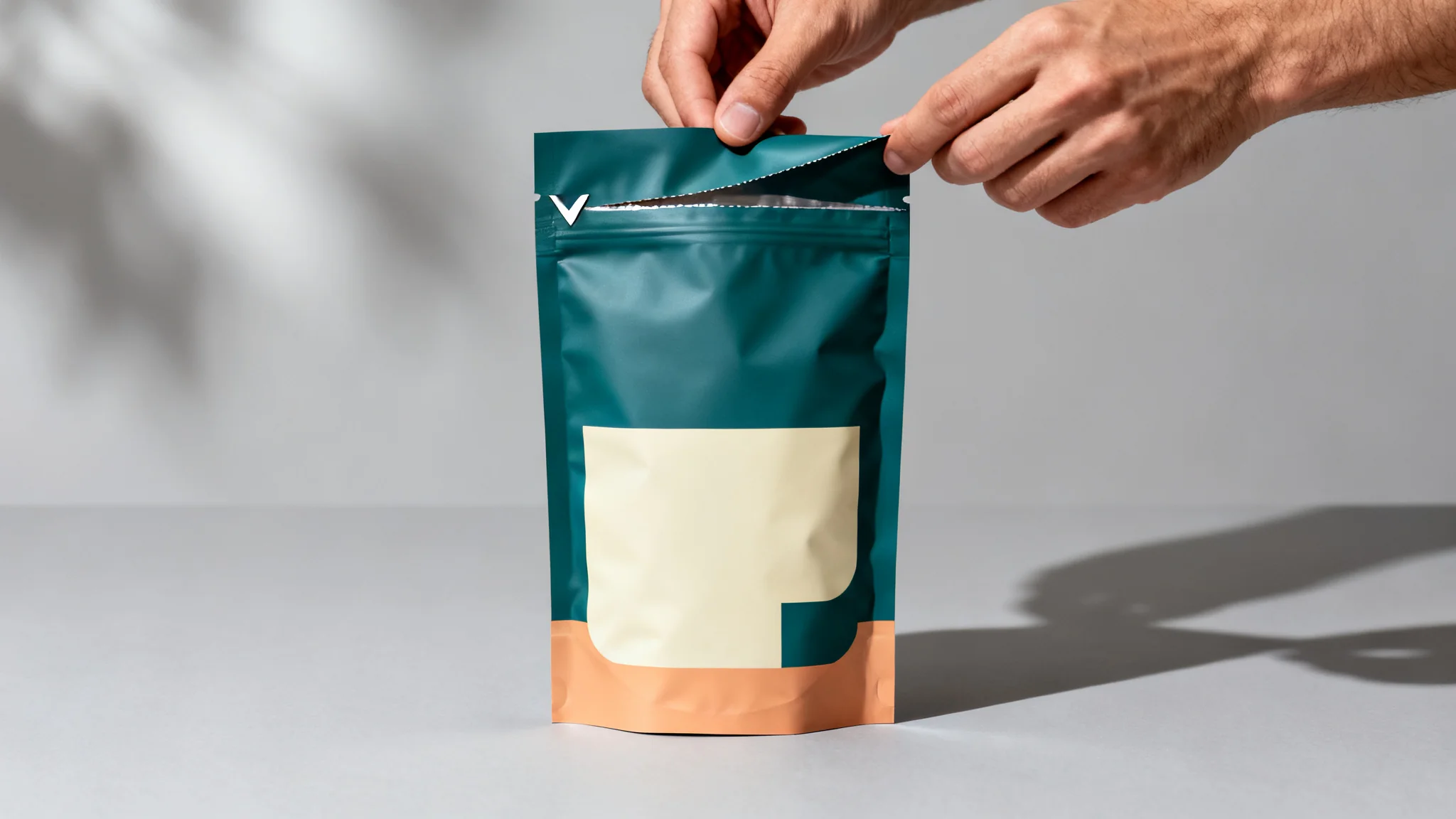
An easy peel pouch is a flexible pack whose seal is engineered to open by hand along a controlled peel line instead of tearing the film itself. The difference sits in the sealant layer and in the geometry around the tear notch, not in the outer print or the pouch format. Buyers usually arrive at this specification after a complaint: consumers cannot start the opening, or they start it and the seal splits where it was supposed to hold. This guide covers what belongs on the drawing, what to test before a die is cut, and where the transport trade-off bites.
How an Easy Peel Pouch Opens
Two failure modes happen inside a sealed area. In a peelable seal, the bond between the sealant and the neighbouring layer is deliberately weaker than the film, so force separates the interface cleanly and leaves a smooth or matte track. In a strong seal, polymer chains entangle across the joint and the film fails first, showing up as stringing, delamination outside the seal, or a torn corner. A working easy peel pouch depends on the first mode repeating at a similar force across the full seal width, which is why the sealant is selected before the laminate is fixed.
Peelable Sealant Layers: Where the Failure Happens
Peelable behaviour comes from the sealant layer: a blended resin that separates at a designed cohesion level, or a coextruded grade that delaminates at a defined interface. The choice changes how the seal reacts to contamination. A cohesive peel tolerates light dust better, while an interfacial peel gives a cleaner and quieter opening but is less forgiving of grease or powder trapped in the seal zone. The sealant must also fit the product’s regulatory position; olefin polymers used in food-contact sealants are listed under 21 CFR 177.1520, and the converter should confirm the exact grade.
Peel Strength Window: What to Specify on the Drawing
A drawing should carry a window, not a single figure. The lower limit protects the pack through filling, cartoning and transport; the upper limit protects the consumer. Put the test method beside the value, normally seal strength per ASTM F88, and state the specimen width, the peel speed and the peel direction relative to the seal. State conditioning, sample size, and whether the figure is an average, a floor, or the lowest reading. A peel number alone means little: the same value on a narrow strip and a wide strip describes two different packs.
Why Transport Integrity and Openability Pull in Opposite Directions
Almost everything that raises seal strength also raises opening force. Higher seal temperature, longer dwell and greater jaw pressure widen the bond, and they make the pack harder to start. That is why an easy peel pouch is a balancing act rather than simply a stronger pouch. Fix the opening force first, from a consumer test you trust, then push the seal settings as far as that ceiling allows, then confirm the result against a distribution cycle. When the pack fails drop or compression at the ceiling, the cause is usually film stiffness or format.
Tear Notch Position, Depth and Laser Score
The notch is a stress concentrator: it gives the tear a start point and a direction. Position matters more than size. Keep it in the seal flange, clear of the product zone and clear of the print register that carries legal text, and align it with the peel direction so the tear runs along the seal rather than across the body. A notch cut too deep starts a tear that jumps into the film; too shallow, and the consumer cannot begin. Laser scoring removes material along a line instead of cutting a V, giving a more predictable start on stiff laminates, but it adds a process step and needs a registration check. Both routes deserve a line on the custom pouch specification before the die is ordered.
Which Products Need an Easy Peel Pouch?
Use cases for peelable seals cluster where one portion is opened once and then discarded: condiment sachets, single-serve snack packs, medical and diagnostic pouches, and packs opened by people with limited hand strength. Narrow formats such as travel-size shampoo sachets or freeze-dried candy window pouches show it clearly, because there is little film to grip. The boundary sits on the other side for products that must stay sealed against moisture or oxygen for months, and for retort or hot-fill packs where the seal is part of the sterility barrier.
How Do Seal Jaws Change Peel Behaviour?
Peelable sealants tolerate contamination poorly, so keep powder, oil and residue out of the seal zone. Check jaw flatness and pressure across the width: a jaw tight at one end gives a seal that peels easily on one side and refuses to open on the other. Set dwell and temperature from a heat sealability curve made on the actual structure, following the laboratory practice in ASTM F2029, rather than copying settings from a similar job. Vertical form-fill-seal lines also need stable film tension, because a wandering web moves the notch away from the seal centre; the seal setup sequence is described in the packaging process instructions.
Conclusion
An easy peel pouch is defined by three things: a window of peel force, a sealant that fails predictably, and a notch that starts the tear in the intended place. These checks settle most projects before a die is cut:
- Agree the peel window and the test method on the drawing, including specimen width, speed and sample size.
- Run a heat sealability curve on the actual laminate, then confirm the notch on a filled sample opened by hand.
- Test a distribution cycle at the chosen ceiling, and treat any failure as a structure or format question before tightening the seal.
When those three hold, the pack opens in a customer’s hands the same way it opened on the bench. Tear behaviour across candidate films can be compared with ASTM D1938 when two laminates open acceptably but run in different directions.
Frequently Asked Questions
Does an easy peel pouch need a different film structure than a standard pouch?
Usually yes, because an easy peel pouch needs a sealant designed to peel rather than to hold. The print film and the barrier layer can often stay the same; what changes is the sealant, where a blended or coextruded peelable grade replaces the standard one and the seal parameters are re-set around it. Confirm the grade with the converter, and check that it still meets the food-contact requirement for the product before approving a proof. Ask for the resin data sheet rather than a verbal confirmation.
How do you test whether the peel force is right?
Test it with a seal strength method, not by hand. Cut strips across the seal at the width written on the drawing, pull them at the specified speed on a tensile tester, and record the average and the lowest reading. Hand opening tells you whether one sample feels acceptable; it does not tell you what the next thousand will do. Keep the strips from the same roll and sealing run, so the result describes the process rather than the operator.
Can a tear notch be added to an existing pouch without a new die?
Often yes, but the die change depends on where the notch sits. If it falls inside the existing seal flange and the print leaves a clear area for the cut, a converter can usually add it to the die at modest cost. If it has to move outside the flange, or the layout has no free space, the print and the die both change. Ask for a marked-up drawing before approving, because a notch placed over a printed panel is a visible defect rather than a small adjustment.
Why does an easy-open seal sometimes fail in transit?
The seal is usually too weak, or contaminated at the edge. A peelable sealant set for comfortable opening has little margin left, so a small amount of powder or oil in the seal zone, a jaw that runs cooler at one end, or a film tension change on the line is enough to open it. Read the seal track first: an even matte peel line points to the sealant, while a patchy or glossy line points to contamination or heat. Only after that should you widen the peel window.





